
The healthcare industry is in the middle of a technology revolution. From digital health records to advanced imaging, U.S. healthcare is deploying more tech than ever-and it needs skilled workers to run it. In fact, BLS projects about 1.9 million job openings per year in healthcare occupations from 2024-34, driven by growth and replacements. Many of those positions will be tech-savvy. And likewise the broader IT field is also blooming: BLS forecasts around 317,700 new computer and information technology jobs per year through 2034, with a median salary of approximately $105,990. The intersection of healthcare and technology means strong demand and pay. Maybe you’re running high-tech medical equipment (think of things like MRI machines or X‑ray machines), working with medical data, or even want to improve healthcare IT systems. There are distinct avenues into these careers. This guide will be a top healthcare tech careers, their salary range, employment prospects and majors that will lead you step by toward them.
- Top Healthcare Tech Job Salaries (2024–2025)
- Surgical Technology Salary & Career Outlook
- Radiology Tech Salary
- X-ray Tech Salary
- MRI Tech Salary
- Ultrasound Tech Salary
- High-Paying Locations and Experience
- Pharmacy Tech Salary
- Veterinary Technician (Vet Tech) Salary
- Health Information Technology Jobs
- Information Technology Jobs in Healthcare
- Leveraging Your Technology Background
- government health agencies.
- Next Steps: Finding Jobs and Staying Informed
-
Top 10 FAQs about Healthcare Tech Careers
- 1. What is the highest-paying tech job in healthcare?
- 2. Which tech job has the highest salary overall?
- 3. What is the best technology used in healthcare today?
- 4. Do tech jobs really pay $500,000 a year?
- 5. Which tech jobs can pay $400,000 a year?
- 6. What jobs make around $3,000 a month without a degree?
- 7. What jobs pay over $400,000 without a degree?
- 8. Which tech field is best for the future?
- 9. What are the four main types of healthcare systems?
- Conclusion
Top Healthcare Tech Job Salaries (2024–2025)
Job Title | Median Salary (2024–2025) | Entry-Level Salary | Top 10% Salary | Growth Rate (2024–2034) |
Surgical Technologist | $62,830 | $45,000 | $75,000+ | 5% |
Radiologic Technologist (X-ray) | $77,660 | $50,000 | $90,000+ | 5% |
MRI Technologist | $88,180 | $65,000 | $121,000+ | 5% |
Ultrasound Technologist | $89,340 | $60,000 | $123,000+ | 26% (2021–2031) |
Pharmacy Technician | $43,460 | $30,000 | $55,000+ | 6% |
Veterinary Technician | $45,980 | $30,000 | $59,000+ | 9% |
Health Information Technologist | $67,310 | $50,000 | $90,000+ | 15% |
IT Specialist (Healthcare) | $105,990 | $61,550 | $131,000+ | 10%+ |
Surgical Technology Salary & Career Outlook

There are many important jobs on a surgical team performed by surgical techs, also known as operation room technicians. They prepare operation rooms; they sterile instruments and take from patients for treatment under the precise direction of the surgeon. Surgical tech is according to the Bureau of Labor Statistics (BLS) occupation pays a median annual salary $62830 as of May 2024. (Related job; surgical assistants had a median income of $60290.) On the practical side of things, entry-level surgical techs can expect to start making anywhere from about mid-$40,000s up. While experienced techs—who might well be working as management from time to time or even reside in high-cost regions—could make more than $70,000 a year on their own (with some specialized roles or high-demand locations paying even more). BLS expects there to be 141,000 surgical tech jobs in 2024, with 5% growth through 2034.
Surgical techs typically need postsecondary training. The common path is:
1. Education: Complete (in general 1–2 years) a surgical technology program at a community college or technical school. Schools have courses in anatomy, sterilization, surgical procedure and safety, and topics like this.
2. Certification: However, many employers want certification; for example, having a Certified Surgical Technologist (CST) credential from the National Board of Surgical Technology. A few states have licensing as well. Certification shows that you are good at your job, and it often goes on to raise pay rates.
3. Experience: Acquire experience in the operating room of a clinic during the time you’re getting trained. Some techs even gain specialty certificates (e.g. in certain surgical fields).
Step-by-step to become a surgical tech:
– Research approved surgical tech programs (see CAAHEP for accreditation). Put in your name and complete both coursework, plus clinical rotations.
– Pass your national certification exam (CST) once you graduate. If the state requires licensing, apply for it.
– Make a résumé focusing on clinical experience. Hospitals and surgical centers are places to apply. It’s good to add skills such as the use of sterile techniques and familiarity with surgical instruments but remember that these are not required in every job market.
– Consider subscribing at Indeed or ZipRecruiter to be emailed whenever a role like “Surgical Technologist” or “Operating Room Technician” becomes available.
Prospective surgical technologists should also remember safety: they work on their feet and must follow strict sterile procedures to prevent infections. But the career rewards include strong job security (hospitals will always need them) and solid pay. In sum, with dedicated training and certification, a surgical technology career can begin in just a couple of years and lead to a mid-$60k median salary with upward potential.
Radiology Tech Salary

Radiologic technologists (often called radiography techs) and MRI technologists handle medical imaging equipment to help diagnose patients. Radiology techs perform X‑rays, CT scans, and other imaging, while MRI techs specialize in magnetic resonance imaging. These careers require both technical skill and patient care.
The median salary for radiologic technologists and technicians was $77,660 in May 2024, and for MRI technologists it was $88,180. (An overall “median pay” quick fact for radiology techs was $78,980.) In other words, the typical X‑ray tech earns around $77K, and MRI techs earn closer to $88K. The pay can be even higher in specialized settings: for example, in May 2024 the top 10% of MRI techs earned over $121,000. These roles often come with shift differentials (evening or night shifts) that can add to total pay.
Job outlook: BLS projects about 272,000 radiologic and MRI tech jobs in 2024, with 5% growth over the decade. Radiology is a high-demand field because imaging is needed in many areas of medicine. Those 5% growth jobs translate to roughly 15,000 openings per year on average.
X-ray Tech Salary

As a radiologic technologist (often called an X-ray tech or radiographer), you’ll operate X-ray machines and CT scanners, positioning patients and ensuring images are clear. The median pay for general radiologic techs (which includes X-ray and CT techs) is about $77,660. Entry-level radiography grads might start near the lower end (often in the $50–$60K range), while seasoned techs or specialists in high-paying industries (like federal government or outpatient centers) can exceed $90K. For example, median pay in the federal government was about $93,970 for these roles in 2025.
How to become an X-ray tech:
– Education: Earn an associate’s degree in radiologic technology (2-year program) from an accredited school. Coursework includes anatomy, patient positioning, radiation safety, and equipment operation.
– Licensing/Certification: Obtain state licensure if required (varies by state). Most employers expect certification from the American Registry of Radiologic Technologists (ARRT). You must pass the ARRT exam after graduation.
– Experience and Specialties: Some techs focus on specialties like mammography or CT, which may require additional credentialing.
(Tip: When setting job alerts on Indeed/ZipRecruiter, use terms like “Radiologic Technologist,” “XR Technologist,” or “CT Technologist.” Many hospital and clinic postings use these titles.)
MRI Tech Salary
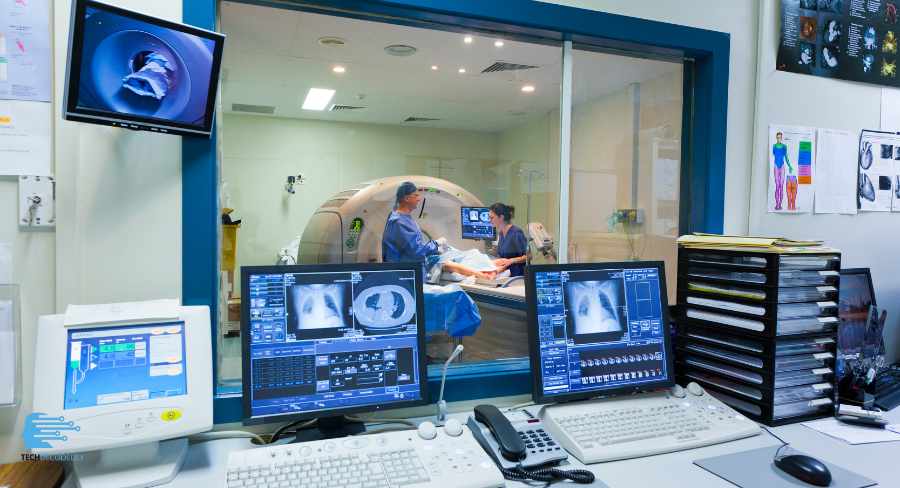
Magnetic resonance imaging (MRI) technologists operate MRI scanners. Since MRIs are advanced equipment, the pay is higher. In May 2024, the median MRI technologist salary was about $88,180, significantly above the radiologic tech median. The highest-paid MRI techs (top 10%) made over $121,000. Typical entry-level MRI techs might earn in the mid-$60K to $70K range, but those with 5+ years of experience or specialized skills can reach six figures, especially in outpatient imaging centers (where median was $128,290)
Becoming an MRI tech:
– Many MRI techs start as general radiologic techs first. Complete the same radiology degree (associates) and ARRT certification.
– Then pursue specialized MRI training: Some programs offer MRI specialization, or employers train radiologic techs on MRI equipment.
– Certification: Although only some states license MRI, professional certification (ARRT with an MRI specialty certification) is highly recommended.
– With certification and a few years of experience, you can move into high-paying MRI roles or supervisory positions in imaging departments.
Overall, radiology careers are a great fit if you enjoy technology and patient interaction. With on-the-job experience, radiology technologists can advance to lead tech, department manager, or even clinical instructor roles — all commanding higher salaries.
Ultrasound Tech Salary

Diagnostic medical sonographers (ultrasound technologists) use specialized ultrasound equipment to image internal organs, blood vessels, fetuses, and more. Sonography is another high-paying imaging field: BLS reports a median wage of $89,340 (May 2024) for ultrasound techs, making it one of the top-paying “health technologists” roles. Experienced sonographers often top $120,000 (10% earned over $123K).
Common specialties include abdominal ultrasound, obstetric and gynecologic (pregnancy), cardiac (echocardiography), and vascular sonography. Some specialties (like cardiac sonography) may have slightly different pay scales, but all are well above average.
Steps to become an ultrasound tech:
1. Education: Complete an accredited sonography program. This is typically an associate’s degree or a postsecondary certificate in diagnostic medical sonography, which includes both classroom instruction (anatomy, physics, patient care) and clinical internships. Some universities also offer 4-year degrees.
2. Clinical Training: Sonography programs include supervised clinical hours where you practice scanning patients at a hospital or clinic. This real-world experience is crucial.
3. Certification: Most employers require or prefer the Registered Diagnostic Medical Sonographer (RDMS) credential from the American Registry for Diagnostic Medical Sonography (ARDMS). To earn this, you must pass specialty exams (e.g. Abdomen, OB/GYN, or Cardiac). Certification demonstrates your competency and often increases pay.
4. Licensing: A few states (such as Oregon) require sonographers to be licensed. Check your state’s requirements.
With an ultrasound tech certificate and RDMS certification, you can qualify for many entry-level sonographer jobs. According to BLS data, jobs for diagnostic medical sonographers are projected to grow 13% from 2024–34, reflecting high demand. The OOH lists a median annual wage of $89,340 for these professionals. In practice, new sonographers often start in busy hospitals or outpatient imaging centers and can advance to lead tech or specialized roles.
High-Paying Locations and Experience
Experience and location significantly affect these salaries. For example, MRI and X-ray technologists tend to earn more in metropolitan areas and in certain states. California, Washington, and the District of Columbia report some of the highest mean wages for radiology and MRI roles (often in the mid-$80Ks to low-$90Ks). Similarly, ultrasound techs in outpatient imaging centers or large hospitals can earn well above the median. It pays to research state salary data (via BLS OES data tools or state labor sites) when planning your career.
Pharmacy Tech Salary

Pharmacy technicians assist pharmacists by preparing prescription orders, compounding medications, and managing records. This role is in retail (drugstore) and healthcare settings. The median salary for pharmacy techs was $43,460 per year in May 2025. BLS reports about 490,400 pharmacy tech jobs in 2024, with 6% growth through 2034 (faster than average). Entry-level pharmacy techs (often trainees) might start in the $30–$35K range, whereas experienced technicians in hospitals or specialty pharmacies can approach $50K or more (some advanced roles or those supervising others may exceed $55K).
How to become a pharmacy tech:
– Education: A high school diploma is the minimum. Many techs learn on the job, but formal training programs (certificate or associate’s degree in pharmacy technology) are available and increasingly preferred. Coursework covers pharmacology, pharmacy law, and math.
– Certification: Most states require pharmacy technicians to be registered or certified. The most common credential is the Pharmacy Technician Certification Board (PTCB) or the National Healthcareer Association (NHA ExCPT) exam. Requirements vary by state (some require certification as a condition of registration).
– Experience: Many new techs work under supervision in a retail pharmacy (e.g., Walgreens, CVS) or hospital pharmacy, performing tasks like filling prescriptions and managing inventory. On-the-job experience is highly valued by employers.
Step-by-step: Complete a pharmacy tech program or on-the-job training, then register with your state board of pharmacy. Pass the national certification exam (if required). Include certifications (PTCB or state license) on your resume. For job search, use terms like “Pharmacy Technician,” “CPhT” (certified pharmacy tech) on job boards. Federal pharmacy tech jobs (Veterans Affairs, military hospitals) are posted on USAJOBS.
Pharmacy techs can advance by moving into specialized areas (like nuclear pharmacy or specialty pharmacies) or by becoming lead techs or supervisors. In management roles, or in high-paying states (Washington, California, DC often lead pharmacy tech wages), annual incomes can approach $55–60K.
Veterinary Technician (Vet Tech) Salary

Veterinary technologists and technicians assist veterinarians by performing medical tests on animals, preparing lab samples, taking X-rays of pets, and nursing sick or injured animals. Although not strictly “human healthcare,” vet techs are high-tech medical support for veterinary care, so they fit this guide’s scope. BLS reports a median salary of $45,980 (May 2024) for veterinary technologists and technicians. About 134,200 jobs existed in 2024, and the field is projected to grow 9% by 2034 (much faster than average). The typical wage ranges roughly from $30K at entry (10th percentile ≈$30,180) to $59K at the high end (90th percentile ≈$59,310).
Becoming a vet tech:
1. Education: Enroll in a veterinary technology program. Technician programs (for vet techs) are usually 2-year associate’s degrees, accredited by the American Veterinary Medical Association (AVMA). Technologist programs (4-year bachelor’s) exist but aren’t always required. Coursework includes animal anatomy, pharmacology, lab procedures, and clinical experience.
2. Credentialing: Almost all U.S. states require passing the Veterinary Technician National Exam (VTNE) and registering or licensing. After earning your degree, you’ll need to pass the VTNE to be a Certified or Licensed Veterinary Technician (requirements vary by state).
3. Experience: Clinical rotations during school, plus internships at animal hospitals, give practical skills. Consider specialties like dental tech or emergency care, which may have separate certifications.
Vet techs often begin in small or large animal practices. Advancement can include roles like head technician, practice manager, or specialized nursing. Some work in research labs or zoos. Salaries tend to be higher in areas with high demand (California and New York veterans on BLS maps show mean wages in the mid-$50Ks).
In summary, vet techs start with an associate degree, licensing, and hands-on training. The career path is clear and can lead to management or specialized roles. If you love animals and have a science background, this is a rewarding tech role that combines both.
Health Information Technology Jobs

Beyond diagnostic equipment, healthcare relies on data and IT systems. Health information technologists and medical registrars (often called health IT specialists) manage electronic health records (EHRs), analyze clinical data, and help healthcare organizations use information systems. According to BLS, the median salary for these workers was about $67,310 in May 2025. Employment was 41,900 in 2024, with a 15% projected growth rate (much faster than average). This robust growth reflects healthcare’s shift to digital records, big data analytics, and new regulations requiring electronic documentation.
Health IT roles can include health information managers, data analysts, EHR implementation specialists, or medical coders (who code diagnoses for billing and records). Many jobs begin in hospitals, clinics, insurance companies, or state health departments. For example, medical records specialists (similar role, also in OOH) had a median of $50,250, indicating that with more tech-oriented duties, health IT specialists command higher pay.
How to enter health IT:
– Education: Often an associate’s degree in Health Information Technology (HIT) or Health Information Management (HIM) is required; some roles prefer a bachelor’s. Programs cover medical coding, healthcare databases, privacy laws (HIPAA), and health informatics. Schools may be accredited by the Commission on Accreditation for Health Informatics and Information Management Education (CAHIIM).
– Certification: After school, you can earn credentials like Registered Health Information Technician (RHIT) or Registered Health Information Administrator (RHIA) through AHIMA, or Certified Coding Specialist (CCS) if focusing on coding. Certification boosts credibility and salary potential.
– Skills: Develop strong computer skills (database management, even some programming or data analysis), plus understanding of medical terminology. Many employers also look for interpersonal skills to train staff on software and to explain data reports.
– Specializations: Some health IT professionals become data analysts or clinical informaticists, using data to improve patient outcomes or hospital efficiency. Others specialize in implementing new EHR software or ensuring cybersecurity compliance in healthcare settings.
Given the surge in health IT, these jobs often have clear credentialing paths. If you come from an IT or healthcare background, combining it with health data training can qualify you for roles like Health Informatics Specialist or Clinical Data Manager. BLS notes that demand will be strong: about 3,200 openings per year on average due to growth and turnover.
Overall, health information technology is ideal for tech-savvy people who want to stay on computers rather than in patient rooms. The pay is solid ($67K median) and the career path can lead to management (Health Information Manager, $117K median) or specialized analytics roles. Many schools and online programs now offer degrees in Health IT – making it an accessible way to enter healthcare technology.
Information Technology Jobs in Healthcare

Healthcare organizations also need General IT support: network administrators, cybersecurity analysts, software developers, and help-desk specialists. These information technology (IT) jobs in healthcare may not be medical roles per se, but they’re crucial to running hospitals and clinics. Good news: IT skills are in high demand everywhere. BLS projects that computer and IT occupations will see much faster than average growth through 2034, with 317,700 openings per year and a $105,990 median wage. In healthcare, roles like “healthcare IT specialist,” “EHR support,” or “clinical systems analyst” often pay similarly high salaries, especially in urban hospitals or health tech companies.
For example, information security analysts (protecting patient data and networks) had a median pay of $124,910. Software developers who build healthcare apps earn around $131,450 median, while systems analysts (who optimize a hospital’s IT systems) earn about $103,790. Even entry-level computer support specialists in healthcare earn roughly $61,550 median. (These figures are for IT occupations overall, but they reflect healthcare’s ability to pay for tech talent.)
Getting into healthcare IT:
– Build IT credentials: A bachelor’s in Computer Science, Information Technology, or Cybersecurity is common. Professional certs like CompTIA A+, Network+, Security+, or vendor-specific (Cisco CCNA, Microsoft Certified) demonstrate competence. For healthcare-specific paths, certifications like Certified Health CIO (CHCIO) or Health IT certifications can help.
– Learn healthcare systems: Familiarize yourself with EHR platforms (e.g. Epic, Cerner) or medical coding (ICD-10). Many IT pros in healthcare learn on the job, so internships at hospitals or clinics can give you an edge.
– Steps: Start with general IT support roles (help desk, junior network admin) but in a healthcare setting. Apply to hospital IT departments or health systems, highlighting any healthcare experience or understanding of regulations like HIPAA. Over time, specialize (e.g. become a database administrator for a hospital’s patient database).
In short, if you already have a technology background, the healthcare field offers many IT career options that are lucrative. The skills are transferable: hospitals use the same computers and networks as any business, plus some specialized medical devices. By adding domain knowledge (healthcare regulations, software), IT professionals can take on roles like EHR System Analyst, Health Data Architect, or Hospital IT Manager, all of which pay well above the national average for IT.
Leveraging Your Technology Background

If you already have a technology background (for example, a degree or experience in computer science, engineering, or related fields), you can transition into healthcare tech roles more easily. Your skills in networking, programming, or data analysis are valuable in any healthcare setting. Here’s how to leverage that background:
- Identify your fit: Do you prefer working with medical equipment, data, or systems? With a tech background, you might become a health informatics specialist, IT manager in a hospital, or even a developer of healthcare apps or telehealth solutions. Consider roles like clinical data analyst (using SQL or Python to analyze patient outcomes) or informatics nurse (if you have healthcare experience) bridging IT and clinical teams.
- Get relevant credentials: If your tech degree is general (CS or IT), consider adding a short healthcare certificate. For example, a graduate certificate in Health Informatics, or training on healthcare standards (HL7, DICOM). If you’re an engineer or technician (electronics, biotech), look into biomedical equipment technician training.
- Certifications: Many technical certs (Project Management Professional, Microsoft Certified, CompTIA, Cisco,) are respected in healthcare too. There are also health-specific ones like RHIT/RHIA (health info) or CHDA (health data analysis) you can earn part-time.
- Networking and job search: Join professional groups (e.g. HIMSS for health IT, AHIMA for health information). Attend conferences or webinars on health tech. When applying, emphasize any hospital or clinical projects you’ve done. Use keywords like “health,” “clinical,” or “medical” on your resume to pass the screening.
By marketing yourself as someone who can handle complex technology and learn medical context, you make yourself attractive to employers. For example, many companies hire32e IT specialists to work on electronic medical record (EMR) rollouts — they want someone with IT expertise who can learn how the data moves in hospitals. You can also consider roles at health tech startups, telemedicine companies, or
government health agencies.
In summary, your technical skills (network security, database management, software dev, etc.) are highly transferable. Supplement them with some healthcare know-how (even shadowing a clinical environment) and you can enter the field of health technology. The pay and demand are strong: with median IT wages above $100K and healthcare roles growing rapidly, this is an opportune time to pivot.
Next Steps: Finding Jobs and Staying Informed
Ready to take the next step? Here are some practical tips to launch your healthcare tech career:
- Set up job alerts: On job sites like Indeed, ZipRecruiter, or Monster, create email alerts for titles like “Surgical Technologist,” “Radiologic Technician,” “Ultrasound Technologist,” “Health Informatics Specialist,” etc. This way you’ll get notified of new postings in real time. Include your location or desired region to get local jobs.
- Use specialty sites: Besides general job boards, look at healthcare-specific recruiters and sites. For example, USAJOBS lists federal health tech roles (e.g. VA or military hospitals often hire radiology techs and pharmacists). Industry associations (like the Association of Surgical Technologists or HIMSS) sometimes have career pages.
- Network and certifications: Join professional groups on LinkedIn (e.g. Radiology Professionals or Health IT Jobs groups) and follow hospital recruiters. Earning certifications (ARRT, RDMS, PTCB, RHIT/RHIA, etc.) will not only make you eligible for more jobs but also appear in search filters on job sites.
- Research training programs: If you need more education, research local community colleges or technical schools offering programs in these fields. Many schools have career advisors who can connect you with internships or job placement.
- Update your resume: Tailor it to each role: include relevant skills (e.g. “BLS-certified” for techs, “Epic EMR experience” for health IT, “CompTIA A+” for IT). List any clinical rotations or volunteer healthcare experiences. Employers in healthcare tech value professionalism and customer service skills too, since these jobs involve patient contact.
Healthcare technology careers offer a blend of stable demand, rewarding work, and competitive pay. By getting the right training, certification, and staying active in your job search (with the help of alerts on Indeed or ZipRecruiter, and listings on USAJOBS, for example), you can navigate the path into one of these in-demand careers. The BLS outlook is positive across the board, and as healthcare continues to grow more high-tech, qualified professionals will be needed even more. So take action now: explore educational programs, network with professionals, and start applying. Your next step could be just a click away.
Top 10 FAQs about Healthcare Tech Careers
1. What is the highest-paying tech job in healthcare?
Chief Clinical Informatics Officers and senior health IT leaders often earn between $150K–$180K+, making them some of the highest-paid roles in healthcare technology.
2. Which tech job has the highest salary overall?
Fields like AI/ML engineering, cloud architecture, and senior product management regularly top the salary charts, often reaching $200K+ at major tech companies.
3. What is the best technology used in healthcare today?
Technologies such as telemedicine, AI diagnostics, EHR systems, wearable health devices, and data analytics are considered the most transformative in modern healthcare.
4. Do tech jobs really pay $500,000 a year?
Yes — senior software engineers at FAANG companies, hedge funds, or equity-heavy startups can earn $500K+ through salary, bonuses, and stock.
5. Which tech jobs can pay $400,000 a year?
High-level roles in cloud computing, sales engineering, enterprise architecture, and AI technologies can reach $300K–$400K+ in total compensation.
6. What jobs make around $3,000 a month without a degree?
Roles like dental assistants, medical assistants, delivery drivers, HVAC techs, and administrative staff often earn around $3,000 per month with no degree required.
7. What jobs pay over $400,000 without a degree?
High-income paths include real estate investors, successful entrepreneurs, luxury sales professionals, and full-time influencers, depending on skill and performance.
8. Which tech field is best for the future?
The fastest-growing tech fields are AI, cybersecurity, data science, cloud engineering, and full-stack development, all showing strong demand through 2035.
9. What are the four main types of healthcare systems?
Healthcare systems follow four models: Beveridge, Bismarck, National Health Insurance, and Out-of-Pocket — the U.S. uniquely uses a mix of all four.
Conclusion
The intersection of technology and healthcare is one of the fastest-growing, most rewarding career landscapes. Whether you’re drawn to imaging (like MRI or ultrasound), surgical support, pharmacy, veterinary medicine, or health informatics, there are roles with strong demand, competitive pay, and clear paths for advancement.
- High Demand & Growth: From 1.9 million expected healthcare job openings per year to rapid expansion in health IT, the need for skilled professionals is only increasing.
- Diverse Roles: You don’t need to be a clinician to make a big impact — technological roles in surgery, imaging, data, and systems are critical.
- Clear Pathways: With the right education, certification, and experience, it’s possible to enter and climb in these careers. Many roles require only 1–2 years of postsecondary education, and certifications can meaningfully boost salary.
- Strong Pay: Median salaries for roles like MRI and ultrasound techs, health information specialists, and pharmacy techs are competitive, and often increase with specialty, experience, and location.
- Flexibility & Transferability: If you already have a technology background, pivoting into healthcare tech is more accessible than ever — your current skills (e.g., data analysis, networking, programming) are highly transferable.
Next Steps:
- Consider the role that interests you most and research accredited programs.
- Set up job alerts for relevant titles (e.g. “MRI Technologist,” “Health Informatics Specialist”).
- Pursue certifications that align with your desired role.
- Network in both healthcare and tech communities to explore internships, mentorships, and job opportunities.
- Take advantage of online resources and courses to strengthen your healthcare knowledge and technical skills.
In short, now is an excellent time to explore a healthcare technology career — the demand, rewards, and potential for growth are all there. Whether you’re starting fresh or making a career shift, you can build a future where healthcare and technology meet your strengths.


TechDecodedly – AI Content Architect. 4+ years specializing in US tech trends. I translate complex AI into actionable insights for global readers. Exploring tomorrow’s technology today.