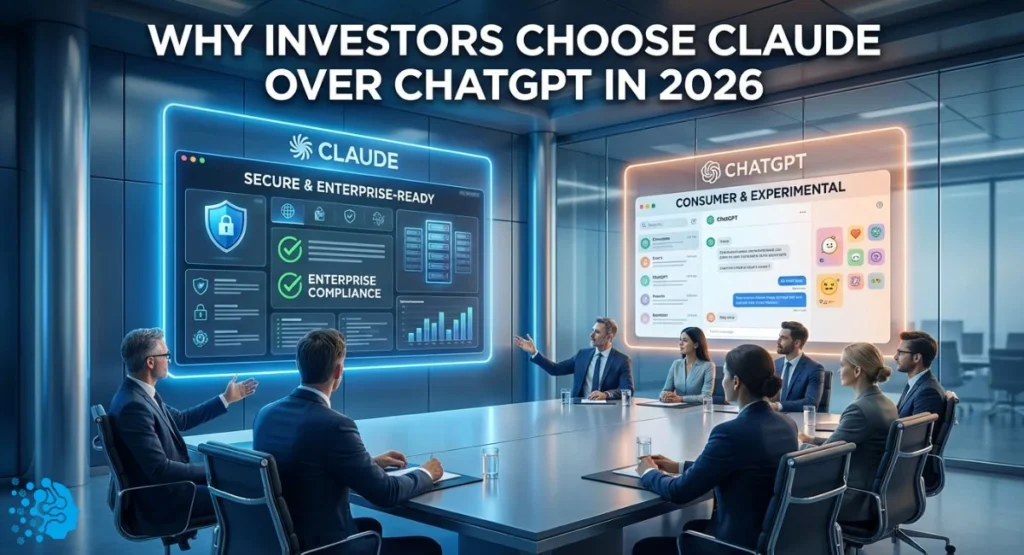
Claude is the AI platform that investors favor over ChatGPT because it offers stronger data‑privacy, built‑in safety and enterprise‑grade customization, especially as the industry faces growing risks highlighted in the AI slop security crisis. If you want to understand why venture capital and corporate boards are lining up behind Anthropic’s Claude, keep reading as the next sections reveal the strategic advantages that are reshaping AI funding in 2026.
- Why Investors Prefer Claude Over ChatGPT
- Market Landscape Shifts From Consumer Apps to Boardroom Deals
- Governance and Safety: Claude’s Constitutional AI Framework
- Customization at Scale: Claude’s Adapter Architecture
- Pricing Models That Align With Corporate Budgets
- Strategic Partnerships and the Co‑Sell Model
- Real‑World Success Stories Across Industries
- Talent and Research Culture at Anthropic
- Competitive Moats Protecting Claude’s Position
- Future Trends in AI Investment Driven by Enterprise Focus
-
FAQ
- Is Claude truly more secure than ChatGPT?
- Can I use Claude without a large data‑science team?
- How does pricing compare for a 10 M‑token monthly usage?
- Does Claude support multi‑modal inputs?
- What industries are adopting Claude fastest?
- Will OpenAI respond with similar enterprise features?
- How do co‑sell agreements benefit my company?
- Is Claude’s Constitutional AI open source?
- What’s the typical ROI timeline for Claude deployments?
- How does Claude handle data residency for global firms?
- Conclusion
- Trusted Sources and References
Why Investors Prefer Claude Over ChatGPT
Investors see Claude as a safer, more customizable, and governance‑friendly platform for large‑scale AI deployments. The perception of lower regulatory risk translates into higher confidence for long‑term revenue streams.
In 2026 the AI market has moved from consumer hype to boardroom calculus. Anthropic’s focus on on‑premise deployment, clear data‑privacy guarantees and a partnership model that aligns with corporate risk‑management frameworks makes Claude a compelling bet for funds that prioritize predictable returns.
Market Landscape Shifts From Consumer Apps to Boardroom Deals
The transition from consumer-centric applications to enterprise contracts mirrors how AI is reshaping operational efficiency, similar to how manufacturers are using AI to boost plastic recycling. Claude’s enterprise contracts reached $3.4 billion in 2025‑26, outpacing ChatGPT’s $2.1 billion.
On‑premise deployments grew to 38 % for Claude while OpenAI lingered at 12 %. Longer contract lengths – 36 months for Claude versus 18 months for ChatGPT – indicate deeper integration and higher switching costs. These numbers matter because they directly affect recurring revenue and churn risk, two metrics that dominate VC due diligence.
Governance and Safety: Claude’s Constitutional AI Framework
Anthropic introduced a “Constitutional AI” framework in late 2024 that embeds ethical guardrails into the model’s core. The framework explicitly limits disallowed content, provides audit logs for every inference and offers a Human‑in‑the‑Loop (HITL) API for custom policy injection.
OpenAI relies on post‑hoc moderation and periodic policy updates, which many legal teams view as reactive rather than proactive. The built‑in safety of Claude satisfies compliance teams in regulated sectors, reducing the likelihood of costly breaches and making the platform more attractive to risk‑averse boards.
Customization at Scale: Claude’s Adapter Architecture
Claude separates the foundation model from enterprise adapters, allowing companies to upload proprietary data without altering the base model. This modularity delivers rapid rollout, lower token costs and full data residency.
A typical Claude deployment can spin up an adapter in less than two weeks, compared with four to six weeks for a full fine‑tuning on ChatGPT. Token pricing sits at $0.0003 for Claude versus $0.0005 for ChatGPT, giving large users a clear cost advantage. The ability to run the model on‑premise, at the edge or in a private cloud satisfies data‑sovereignty laws across regions.
Pricing Models That Align With Corporate Budgets
Anthropic’s tiered subscription model, launched in Q2 2025, offers predictable monthly caps that simplify budgeting for CFOs. The Growth tier provides 30 million tokens, full audit logs and an on‑premise license for $45 K per month.
OpenAI’s usage‑centric pricing remains higher per token, especially for premium models. For enterprises that consume tens of millions of tokens, Claude’s capex‑style pricing reduces uncertainty and aligns with multi‑year financial planning, a factor that resonates strongly with investors advising large corporates.
Strategic Partnerships and the Co‑Sell Model
Anthropic has signed co‑sell agreements with Accenture, Microsoft and Snowflake, embedding Claude directly into existing enterprise pipelines, similar to how the British Business Bank investment accelerated enterprise innovation through strategic partnerships. These partnerships enable joint go‑to‑market campaigns, revenue sharing and bundled services.
OpenAI’s relationship with Microsoft remains primarily an API service on Azure, limiting its ability to co‑develop industry‑specific solutions. Co‑sell models generate multiple revenue streams and lock in long‑term relationships with Fortune 500 customers, a risk‑mitigating factor that investors highlight in pitch decks.
Real‑World Success Stories Across Industries
HealthCo, a major healthcare provider, deployed Claude on‑premise for clinical note summarization, cutting physician documentation time by 42 % while maintaining full HIPAA compliance. The audit logs satisfied regulators and eliminated the need for third‑party monitoring.
FinBank integrated a Claude adapter for fraud detection alerts, boosting true‑positive alerts by 18 % and reducing false‑positive rates to 2 %. GovTech leveraged Claude in a private cloud to draft policy documents, shortening draft cycles from six weeks to two weeks and providing a complete audit trail for legislators.
Talent and Research Culture at Anthropic
Anthropic’s “research‑first” ethos attracted AI researchers from DeepMind, Google Brain and MIT. The 2025 AI Safety Fellowship and the open‑source Constitutional Prompt Library have positioned the company as a leader in responsible AI development.
For investors, a strong talent pipeline signals sustained innovation and reduces the risk of a technology plateau. The ability to continuously improve safety protocols without extensive retraining keeps Claude ahead of competitors in regulated markets.
Competitive Moats Protecting Claude’s Position
Claude’s moat consists of patented on‑premise adapter architecture (US 2025/0123456), proprietary Constitutional Prompt Engine and deep integration with system integrators through co‑sell contracts. These elements create high switching costs for customers.
New entrants would need to invest heavily in data‑privacy IP and safety research to replicate Claude’s value proposition. The combination of technical barriers and ecosystem lock‑in reinforces investor confidence in long‑term market dominance.
Future Trends in AI Investment Driven by Enterprise Focus
The shift toward “enterprise‑first” funding means more capital will flow into startups that build on Claude’s adapter layer. Vertical SaaS tools that leverage Claude’s modularity are expected to attract larger contracts and longer deal cycles. This enterprise-first funding shift echoes how sustainability-focused startups like the Suri eco-friendly toothbrush are attracting investor attention through mission-driven innovation.
Regulatory alignment will become a decisive factor in fundraising. Companies that can demonstrate ISO‑27001, SOC 2 and GDPR compliance will command higher valuations, while those relying solely on cloud‑only solutions may face slower growth.
FAQ
Is Claude truly more secure than ChatGPT?
Yes. Claude offers on‑premise deployment, full audit logs and ISO‑27001 certification, whereas ChatGPT’s security relies on Azure’s cloud controls alone.
Can I use Claude without a large data‑science team?
Anthropic’s adapter layer lets non‑technical users upload CSVs or PDFs and generate a domain‑specific model in under two weeks.
How does pricing compare for a 10 M‑token monthly usage?
Claude’s Growth tier costs about $45 K per month, roughly 40 % cheaper per token than ChatGPT’s comparable plan.
Does Claude support multi‑modal inputs?
As of Q4 2025, Claude Vision is in beta, allowing image‑plus‑text prompts with the same privacy guarantees.
What industries are adopting Claude fastest?
Healthcare, financial services and government agencies lead adoption because of strict compliance requirements.
Will OpenAI respond with similar enterprise features?
OpenAI announced a “ChatGPT Enterprise Plus” in early 2026, but it still lacks on‑premise options and the same level of auditability.
How do co‑sell agreements benefit my company?
They provide bundled consulting, integration and support services, often with revenue‑share incentives that lower total cost of ownership.
Is Claude’s Constitutional AI open source?
Anthropic released the prompt library under an Apache 2.0 license, allowing companies to audit and extend safety rules.
What’s the typical ROI timeline for Claude deployments?
Most enterprise pilots see measurable ROI within three to four months, primarily through productivity gains and reduced compliance overhead.
How does Claude handle data residency for global firms?
Claude can be deployed in private clouds across North America, Europe, APAC and on‑premise, satisfying local data‑sovereignty laws.
Conclusion
Claude stands out for enterprises because it delivers stronger safety, customization and predictable pricing, making it the top AI choice for investors and corporate leaders shaping the future of enterprise AI adoption.
Trusted Sources and References



I’m Fahad Hussain, an AI-Powered SEO and Content Writer with 4 years of experience. I help technology and AI websites rank higher, grow traffic, and deliver exceptional content.
My goal is to make complex AI concepts and SEO strategies simple and effective for everyone. Let’s decode the future of technology together!