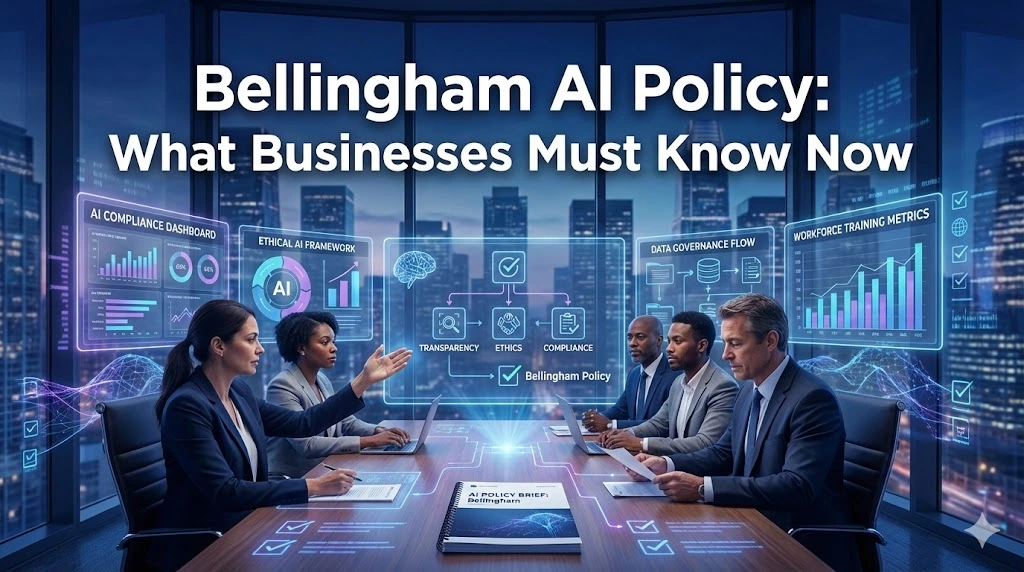
Bellingham’s AI policy requires city leaders, employees, and tech‑savvy professionals to adopt transparent, ethical AI practices now. If you want to stay ahead of the AI compliance curve, understanding Bellingham’s draft policy is the fastest way to future‑proof your organization.
- Why is Bellingham creating its first municipal AI policy?
- What are the four pillars of Bellingham’s draft AI policy?
- How does Bellingham’s approach differ from Seattle, Portland, and other U.S. cities?
- What technology powers the city‑level chatbots Bellingham uses today?
- What risks arise from unregulated chatbot use in municipal settings?
- How can businesses use Bellingham’s draft as a template for their own AI governance?
- What metrics should organizations track to measure AI policy success?
- What real‑world results did the Parks & Recreation department see after revamping its chatbot?
- What emerging trends will shape AI regulations after 2026?
- What quick‑start actions can leaders take today to prepare for AI regulations?
-
Frequently Asked Questions
- What is the difference between an AI policy and an AI strategy?
- Do I need a lawyer to draft an AI policy?
- How often should bias testing be performed?
- Can I use open‑source LLMs for city services?
- What happens if a chatbot inadvertently shares private data?
- Is employee AI‑training mandatory under the draft policy?
- How does Bellingham plan to enforce the policy?
- Will private contractors have to follow the same rules?
- What is an AI “sandbox”?
- Conclusion
- Trusted Sources and References
Why is Bellingham creating its first municipal AI policy?
Public pressure, data‑privacy concerns, and the risk of algorithmic bias are pushing cities to formalize AI rules. Media coverage of city staff using chatbots without oversight sparked a council response, while the 2024 Federal AI Transparency Act (FAITA) encourages localities to adopt “transparent, accountable, and fair” AI practices.
Economic incentives also play a role: clear policies attract AI‑focused startups while protecting citizens from misuse. By establishing standards now, Bellingham positions itself as a responsible AI hub, reducing legal exposure and building public trust.
What are the four pillars of Bellingham’s draft AI policy?
The draft centers on Transparency, Data Governance, Ethical Use, and Workforce Training. Each pillar translates into concrete actions that city departments must follow.
Transparency requires public disclosure of any AI system used in city services, allowing residents to request algorithmic explanations. Data Governance imposes strict consent and handling standards, cutting the risk of accidental data leaks. Ethical Use bans discriminatory outcomes and mandates regular bias testing, reinforcing trust. Finally, Workforce Training makes AI‑literacy mandatory for all employees, ensuring staff can use chatbots responsibly.
How does Bellingham’s approach differ from Seattle, Portland, and other U.S. cities?
Bellingham places a stronger emphasis on employee education than most peer municipalities. Seattle’s 2025 policy focused mainly on procurement rules and left staff training optional. Portland’s 2024 “sandbox” allowed experimental AI but lacked clear bias‑testing protocols.
Bellingham couples sandbox experimentation with a city‑wide AI‑literacy curriculum, setting a higher bar for internal compliance. This hybrid model not only encourages innovation but also ensures that every employee understands the ethical and technical implications of AI, reducing the chance of inadvertent misuse.
What technology powers the city‑level chatbots Bellingham uses today?
Most municipal chatbots run on large‑language models (LLMs) hosted in the cloud, accessed via APIs that integrate with legacy ticketing and case‑management systems.
An LLM is a neural network trained on billions of text snippets, capable of generating human‑like responses. Middleware translates citizen queries into structured data that back‑office workflows can process, while role‑based access control (RBAC) and end‑to‑end encryption protect sensitive information. This stack enables rapid response times but also introduces new data‑privacy and bias challenges that the policy seeks to mitigate.
What risks arise from unregulated chatbot use in municipal settings?
Without policy, chatbots can expose cities to privacy breaches, misinformation, and legal liability. Improper logging may store personal identifiers in unsecured logs, creating data‑leak vectors.
Bias propagation is another danger: if training data reflects historical inequities, the bot may give skewed advice on topics such as housing eligibility. Under FAITA, non‑transparent AI can attract fines up to $10,000 per violation, making compliance a financial imperative as well as an ethical one.
How can businesses use Bellingham’s draft as a template for their own AI governance?
Treat the four pillars as a roadmap to build a robust AI governance framework. Start by auditing every AI tool, mapping data flows, and implementing bias testing with open‑source libraries like Fairlearn or IBM AI Fairness 360.
Next, draft an internal policy that mirrors Transparency, Data Governance, Ethics, and Training. Launch quarterly AI‑literacy workshops with hands‑on labs, ensuring each department has at least one trained champion. By aligning internal practices with Bellingham’s model, businesses can reduce compliance risk and demonstrate responsible AI use to customers and regulators.
What metrics should organizations track to measure AI policy success?
Key performance indicators (KPIs) help gauge compliance, risk reduction, and stakeholder confidence. Recommended metrics include policy compliance rate, bias incident reports, employee AI‑literacy scores, and public trust indices.
A target of 95% documented AI tools, fewer than five bias incidents per year, an 80% pass rate on quarterly quizzes, and a ten‑point boost on citizen surveys provide concrete goals. Monitoring these figures quarterly allows leadership to adjust training, tighten data controls, or refine bias‑testing procedures before problems escalate.
What real‑world results did the Parks & Recreation department see after revamping its chatbot?
The department replaced its legacy bot with a compliant version in March 2026, achieving measurable efficiency gains.
Before the upgrade, 30% of citizen queries required manual follow‑up due to vague responses, similar to outages seen in Gamestop’s system that affected customer experience. After implementing bias checks and transparent logging, 85% of inquiries were resolved automatically, and a bias audit showed zero disparate impact across neighborhoods. The lesson is clear: embedding ethical safeguards directly into the chatbot workflow dramatically improves both operational speed and public perception.
What emerging trends will shape AI regulations after 2026?
Three trends are poised to become regulatory cornerstones: generative AI watermarking, model‑level licensing, and cross‑jurisdictional data trusts. Understanding AI hype versus reality is critical, as highlighted in Nvidia’s Davos outlook on the AI bubble.
Watermarking will require cryptographic signatures on AI‑generated content, making deep‑fakes easier to identify. Model‑level licensing may force cities to demand proof of third‑party model audits before deployment. Finally, data trusts shared among neighboring municipalities will enforce uniform privacy standards, reducing fragmented compliance efforts and encouraging collaborative oversight.
What quick‑start actions can leaders take today to prepare for AI regulations?
Use this 7‑point checklist to audit AI readiness immediately.
- Inventory every AI system, including SaaS tools.
- Document data sources, purpose, and decision logic.
- Run a bias audit on all predictive models.
- Publish a concise AI usage statement on your website.
- Train at least one staff member per department on AI ethics.
- Establish an internal AI oversight committee.
- Schedule quarterly reviews to adapt to new regulations.
Completing these steps positions your organization to meet Bellingham’s standards and any future state or federal mandates.
Frequently Asked Questions
What is the difference between an AI policy and an AI strategy?
An AI policy sets mandatory rules—what you must do—while an AI strategy outlines voluntary goals—what you aim to achieve. Both are needed for comprehensive governance.
Do I need a lawyer to draft an AI policy?
Legal counsel isn’t required, but an attorney can ensure alignment with FAITA and state privacy statutes, reducing the risk of costly penalties.
How often should bias testing be performed?
At minimum quarterly, or after any major model update, to catch drift and maintain fairness.
Can I use open‑source LLMs for city services?
Yes, provided you verify the training data, enforce security controls, and conduct bias audits before deployment.
What happens if a chatbot inadvertently shares private data?
You could face FAITA fines and state breach‑notification requirements; a robust mitigation plan is essential.
Is employee AI‑training mandatory under the draft policy?
The draft recommends mandatory training; final legislation may make it compulsory, so preparing now is prudent.
How does Bellingham plan to enforce the policy?
An AI oversight board will review deployments, audit compliance annually, and issue remediation orders when needed.
Will private contractors have to follow the same rules?
Yes—any vendor working with the city must meet the same transparency and data‑governance standards.
What is an AI “sandbox”?
A sandbox is a controlled environment where new AI models can be tested without affecting live city services, allowing safe experimentation.
Conclusion
Bellingham’s four‑pillar AI policy offers a practical, forward‑looking template that businesses can adopt today to stay compliant and competitive.
Trusted Sources and References



I’m Fahad Hussain, an AI-Powered SEO and Content Writer with 4 years of experience. I help technology and AI websites rank higher, grow traffic, and deliver exceptional content.
My goal is to make complex AI concepts and SEO strategies simple and effective for everyone. Let’s decode the future of technology together!