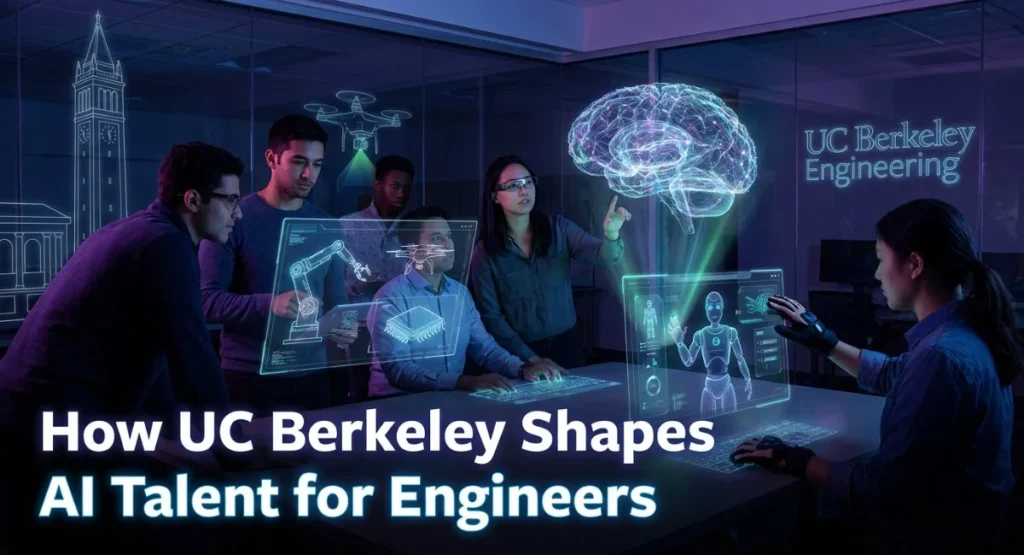
UC Berkeley is redefining the classroom by embedding artificial intelligence across its core engineering courses, turning AI from a side topic into a foundational tool. Discover how this bold move is reshaping talent pipelines and accelerating product innovation worldwide, similar to how Claude is transforming AI adoption in 2026.
- Why AI‑augmented engineering is now a market imperative
- Berkeley’s four‑pillared framework for curriculum transformation
- Re‑imagining statics with machine‑learning validation
- Integrating reinforcement learning into control systems
- Generative models accelerate materials discovery
- AI‑enhanced labs reduce friction and boost learning speed
- Embedding ethics early to mitigate future liability
- Faculty upskilling through a Teach‑AI‑Bootcamp
- Industry partnership via the AI‑Engineering Innovation Hub
- Scaling Berkeley’s model to other institutions
- Future outlook: AI‑first engineering by 2030
- Actionable checklist for leaders aiming to replicate Berkeley’s success
-
Frequently Asked Questions
- What baseline AI knowledge should engineering students have?
- Can legacy courses be retrofitted with AI labs?
- How much does cloud GPU usage cost for a 100‑student class?
- Do ethics modules add significant lecture time?
- Which certifications are recognized by industry?
- How to protect proprietary data in university‑industry projects?
- Will AI replace traditional engineering roles?
- Are there scholarships for AI‑focused engineering students?
- What hardware is needed for student labs?
- How to measure ROI of AI curriculum integration?
- Conclusion
- Trusted Sources and References
Why AI‑augmented engineering is now a market imperative
The engineering job market is being reshaped by tools that automate design, predict failures, and ensure regulatory compliance. Companies that adopt AI‑driven design see concept‑to‑prototype cycles cut by up to half, while predictive maintenance platforms demand engineers who can build data pipelines and machine‑learning models. This mirrors trends highlighted in the AI Slop security crisis report where data‑savvy engineers are in high demand.
Recent reports from Gartner and CB Insights highlight a surge in AI‑hardware startups, with $12 billion invested in 2025 alone. This capital influx signals that firms are hunting for talent fluent in both traditional engineering and AI. Graduates lacking these skills become a bottleneck, slowing product launches and eroding competitive advantage, echoing the challenges companies face in AI‑enhanced product launches.
Berkeley’s four‑pillared framework for curriculum transformation
Berkeley’s faculty coalition built a systematic approach that weaves AI into every stage of engineering education. The four pillars are curriculum integration, hands‑on labs, ethics modules, and industry co‑creation. This approach is reminiscent of sustainable innovation seen in Suri’s eco‑friendly product strategy.
Curriculum integration replaces isolated electives with AI concepts embedded directly in courses such as thermodynamics and mechanics. Hands‑on labs use cloud‑based notebooks and low‑cost robotics kits, removing setup friction. Ethics modules introduce bias detection and regulatory standards early, while industry partners supply live data streams that keep projects relevant to real‑world challenges.
Re‑imagining statics with machine‑learning validation
In traditional statics, students solve equilibrium equations by hand. Berkeley adds a lightweight neural network that predicts stress distribution on complex truss structures, then compares the output with finite‑element analysis.
This dual approach lets students see AI as a validation tool rather than a replacement. They learn to interpret model error, adjust training data, and understand the limits of data‑driven predictions. The result is a 23 percent boost in confidence when tackling AI‑enhanced design problems, according to pilot surveys, a trend similar to the AI‑driven tools explored in Claude adoption insights.
Integrating reinforcement learning into control systems
Control systems courses now feature a lab where a simulated quadcopter learns stabilization through model‑free reinforcement learning. Students first implement classic PID tuning, then observe how a policy‑gradient algorithm improves performance.
The side‑by‑side comparison clarifies the strengths of each method. Reinforcement learning offers adaptability to changing dynamics, while PID provides a reliable baseline. By the end of the semester, students can choose the appropriate technique for a given application, a skill increasingly demanded by autonomous‑vehicle manufacturers.
Generative models accelerate materials discovery
Materials science labs now connect to the Materials Project API and use a conditional generative adversarial network to propose new alloy compositions. The model screens tens of thousands of candidates in under an hour.
Students evaluate predicted properties against experimental data, learning how AI can prioritize experiments and reduce lab time. Compared with traditional trial‑and‑error, this approach shortens discovery cycles dramatically, preparing graduates for roles in fast‑moving sectors such as aerospace and renewable energy.
AI‑enhanced labs reduce friction and boost learning speed
Berkeley’s labs rely on cloud‑native Jupyter notebooks that launch instantly, eliminating the need for local installations. Real‑time sensor feeds from Arduino kits let students connect theory to physical hardware without complex wiring.
Auto‑graded AI assignments provide rapid feedback, allowing students to iterate on models within minutes. This immediacy shortens the feedback loop that traditionally spans days, leading to deeper engagement and higher completion rates. The lab design also scales easily, supporting large enrollment without sacrificing hands‑on experience.
Embedding ethics early to mitigate future liability
Every engineering class now includes a micro‑module on AI ethics. Students learn to detect bias in sensor data, generate explainable models for safety‑critical systems, and map their work to the NIST AI Risk Management Framework.
By confronting ethical considerations before model development, students internalize responsible practices that reduce the risk of costly compliance failures. Companies benefit from graduates who can embed transparency and accountability into product pipelines from day one.
Faculty upskilling through a Teach‑AI‑Bootcamp
A common barrier to curriculum change is faculty unfamiliarity with AI tools. Berkeley answered this with a two‑week intensive bootcamp covering Python, TensorFlow, and prompt engineering. Participants pair with industry data scientists for mentorship.
The program also offers a certification that counts toward tenure review, incentivizing adoption. Over 85 percent of attendees reported immediate applicability in their courses, leading to rapid rollout of AI‑enhanced modules across the college.
Industry partnership via the AI‑Engineering Innovation Hub
The AI‑Engineering Innovation Hub (AI‑EIH) serves as a living lab where students work on live projects with partners such as NVIDIA, Siemens, and Tesla. Projects include GPU‑accelerated computational fluid dynamics, edge‑ML for smart factories, and battery‑health prediction.
Each collaboration delivers measurable ROI: NVIDIA sees a 40 percent speedup in simulations, Siemens reduces downtime by 15 percent, and Tesla extends battery cycle life by 10 percent. Students gain exposure to production‑grade data, while companies tap a pipeline of AI‑savvy engineers.
Scaling Berkeley’s model to other institutions
Other schools can adopt a phased approach. Start by adding a single AI module to an existing core course, then expand to labs using open‑source stacks like PyTorch and Hugging Face. Centralizing GPU resources and shared data repositories reduces overhead.
Metrics such as pre‑post confidence surveys, project completion rates, and employer feedback guide iterative improvement. By scaling incrementally, institutions avoid the risk of over‑committing resources while still delivering tangible benefits to students and partners.
Future outlook: AI‑first engineering by 2030
Projections from the IEEE Education Survey 2025 suggest that at least 70 percent of engineering courses will incorporate AI components by 2030. Micro‑masters in “AI‑Enhanced Engineering” are expected to become a standard hiring filter.
Generative design tools will handle routine layout tasks, freeing engineers to focus on strategic problem solving. Institutions that embed AI today position their graduates for these emerging roles, ensuring a competitive edge in the global talent market.
Actionable checklist for leaders aiming to replicate Berkeley’s success
1. Audit existing curricula for AI gaps.
2. Pilot an AI‑enhanced lab in a high‑impact course.
3. Secure a technology partner to provide data and mentorship.
4. Invest in faculty bootcamps and sabbaticals for upskilling.
5. Track outcomes using student confidence surveys, project speed metrics, and employer satisfaction scores.
Following these steps creates a culture where AI is treated as a core engineering language, not a niche specialty. Leaders who act now will attract top talent and accelerate innovation across their organizations.
Frequently Asked Questions
What baseline AI knowledge should engineering students have?
Students need basic Python, linear algebra, and experience building at least one simple machine‑learning model such as regression or classification.
Can legacy courses be retrofitted with AI labs?
Yes, modular notebook assignments can overlay on existing problem sets, allowing a smooth transition without redesigning the entire syllabus.
How much does cloud GPU usage cost for a 100‑student class?
Roughly $0.30 per GPU‑hour; a semester of ten‑hour labs totals about $300 on major cloud providers.
Do ethics modules add significant lecture time?
No, Berkeley uses a 15‑minute “ethics check” at the end of each lab, keeping the overall schedule intact.
Which certifications are recognized by industry?
NVIDIA Deep Learning Institute, Coursera’s AI for Engineering, and the IEEE AI Engineering Certificate are widely respected.
How to protect proprietary data in university‑industry projects?
Use nondisclosure agreements, anonymize datasets, and run projects in sandboxed cloud environments.
Will AI replace traditional engineering roles?
AI augments rather than replaces engineers; domain expertise and systems thinking remain essential.
Are there scholarships for AI‑focused engineering students?
Many firms, including Google and Microsoft, sponsor AI research fellowships; students should consult their university’s financial aid office.
What hardware is needed for student labs?
A mid‑range laptop, a USB‑C webcam, and optional low‑cost micro‑controller kits priced around $30 are sufficient.
How to measure ROI of AI curriculum integration?
Track graduate employment rates in AI‑related roles, employer satisfaction scores, and research grant funding trends.
Conclusion
Berkeley’s AI‑first approach equips engineers for the AI-driven future, boosting student skills, faculty innovation, and industry-ready talent while accelerating adoption of AI across education and real-world engineering applications.
Trusted Sources and References



I’m Fahad Hussain, an AI-Powered SEO and Content Writer with 4 years of experience. I help technology and AI websites rank higher, grow traffic, and deliver exceptional content.
My goal is to make complex AI concepts and SEO strategies simple and effective for everyone. Let’s decode the future of technology together!