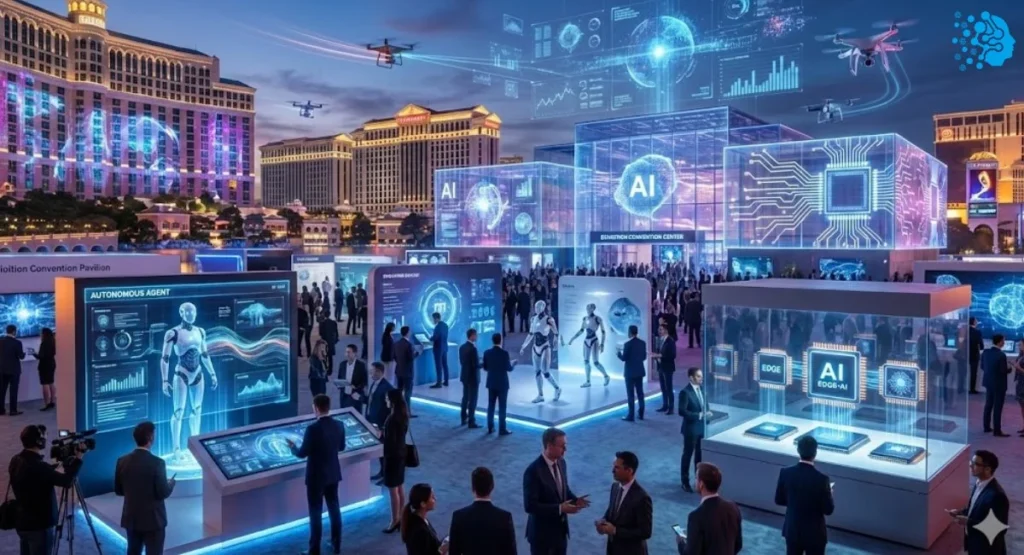
Tech Companies Show AI Transformation at CES 2026 means leading tech firms are showcasing how AI is moving from simple assistants to autonomous agents, more innovative hardware, robotics, and real-world enterprise systems that work faster, locally, and with less human input. In this article, we break down how tech companies are showing fundamental AI transformation at CES 2026, from agentic systems to AI-powered hardware and robotics.
Why This CES is Different: The Shift from Assistants to Agents
Previous years celebrated generative AI as a tool, such as ChatGPT, Gemini, and Claude, helping humans work better. Those are assistants. You ask; they respond.
CES 2026 pivots to agentic AI systems that perceive environments, make decisions autonomously, execute tasks, and improve from experience. The difference isn’t subtle.
Traditional AI (Assistant) | Agentic AI (Agent) |
Responds to user prompts | Monitors environments continuously |
Waits for the next instruction | Takes autonomous action |
Lacks contextual memory | Learns from outcomes, adapts behavior |
One task at a time | Coordinates multiple tasks simultaneously |
Requires human approval for major decisions | Makes complex decisions independently |
A manufacturing plant monitored by an AI agent detects bearing failure through vibration patterns. The agent schedules maintenance, orders parts, alerts technicians, and logs incidents, all without someone asking it to do the next step.
This capability shift fundamentally changes how enterprises operate.
- Why This CES is Different: The Shift from Assistants to Agents
- The Real Numbers: Enterprise Adoption is Accelerating, Not Speculative
- CES 2026: The Moment Hardware Catches Up to Software
- Physical AI Moves from Lab to Commercial Deployment
- Enterprise Data Platforms Redesign for Agentic AI
- Edge AI: Intelligence Without the Cloud Dependency
- Windows on Arm & AI PCs: The Processor Architecture Shift
- Automotive: From Software-Defined to AI-Defined Vehicles
- Semiconductors: The Architecture War Intensifies
- Strategic Implications: What This Means for Businesses
- The Convergence: Why 2026 is the Inflection Point
-
FAQs: Questions Readers Are Actually Asking
- Q1. What's the actual difference between agentic AI and regular AI assistants?
- Q2. Will AI agents actually replace human jobs, or is this overstated?
- Q3. Can smartphones really run advanced AI models locally?
- Q4. Why do companies choose edge AI over cloud AI if cloud processing is already available?
- Q5. Should enterprises adopt agentic AI now or wait for the technology to mature?
- Q6. What's the significance of the Snowflake-Palantir partnership for smaller companies?
- Q7. Why are companies abandoning Intel and AMD for Arm-based processors?
- Q8. Is it safe to run AI on edge devices, or are there security concerns?
- Q9. Which AI robotics companies should investors focus on?
- Q10. What happens to software developers if AI agents can automate coding?
- Conclusion
The Real Numbers: Enterprise Adoption is Accelerating, Not Speculative
Don’t mistake CES announcements for hype. The data shows this is already happening.
72% of enterprises are now using or testing AI agents. That’s 3 in 4 companies. Not planning to. Acpgetually deploying.
Enterprise adoption of autonomous agents will increase from 25% in 2025 to approximately 37% by 2026, crossing 50% by 2027. This trajectory is steeper than any prior enterprise software adoption curve.
By 2026, 40% of enterprise applications will embed task-specific AI agents, up from less than 5% in 2024. That’s an 800% increase in 24 months.
Where are they being deployed? Customer support leads with 49% adoption. Operations follow at 47%. Engineering at 35%. Even conservative departments like finance are moving at 24%.
The economic impact:
- Contact centers deploying AI agents reduce cost-per-contact by 20-40% through automated tier-1 resolution
- Unplanned downtime drops 40% when manufacturing agents predict failures
- Decision speed improves 30-50% across departments
84% of enterprise leaders plan to increase AI agent investments in 2026. Only 2% plan to decrease. This isn’t experimental anymore. It’s strategic.
CES 2026: The Moment Hardware Catches Up to Software
Hardware has been the bottleneck. Running AI models required either cloud processing (slow, privacy-compromising) or expensive local chips (power-hungry, expensive).
CES 2026 introduces NPUs, Neural Processing Units, chips explicitly designed for AI inference.
As AI hardware becomes more power-efficient, energy policy is also shifting. Here’s how U.S. solar policy changes are shaping the 2026 energy landscape.
Performance comparison:
Component | Speed | Power Consumption | Efficiency |
1 TFLOPS | 65W | Baseline | |
10 TFLOPS | 250W | Moderate | |
26 TFLOPS | 2.5W | 10x vs CPU |
That’s 10x more efficient than CPUs and 6x more efficient than mainstream GPUs for AI workloads.
What does this enable practically?
On smartphones: 120-billion-parameter language models running entirely locally. Your privacy is guaranteed because your data never leaves your device.
In manufacturing, Computer vision systems process thousands of parts hourly. Defect detection happens instantly without network latency.
On autonomous vehicles: Terabytes of sensor data are processed locally. Split-second decisions don’t wait for cloud responses.
In medical devices, Portable ultrasound equipment performs real-time image analysis. Continuous glucose monitors detect anomalies immediately.
Intel’s Core Ultra Series 3, AMD’s Ryzen updates, and Qualcomm’s Snapdragon X2 Elite all feature dedicated neural engines. This is no longer niche; it’s becoming standard across all categories of devices.
Physical AI Moves from Lab to Commercial Deployment
For 15 years, humanoid robots were research projects. CES 2026 marks the moment they became commercial products.
Boston Dynamics‘ Atlas will debut on the show floor, handling warehouse tasks previously requiring human workers. The robot perceives its environment, adjusts grip force based on object properties, and executes complex manipulation tasks. Boston Dynamics is positioning this as a commercial system, not a demo.
LG’s Clo ID represents a different approach to humanoids for household applications. It has two articulated arms with real-time grip feedback, enabling it to handle fragile objects safely.
Manufacturing companies have already deployed thousands of robots. Agility Robotics, AGIBOT, and Galbot are operating at scale in commercial environments. These aren’t prototypes; they’re shipping products.
Economic timeline:
Timeline | Price | Implication |
2026 | $100,000-$250,000 | Early adoption, specialty tasks |
2027-2028 | $30,000-$50,000 | Competitive with annual salary |
2029+ | $15,000-$25,000 | Broad industry adoption |
At $30,000-$50,000, a humanoid robot becomes economically rational compared to hiring workers earning $40,000 annually. Manufacturing, logistics, retail, and healthcare will face significant workforce transitions.
Enterprise Data Platforms Redesign for Agentic AI
The Palantir and Snowflake partnership signals something larger: enterprise data infrastructure must fundamentally change to support autonomous systems.
Meta’s $2B acquisition of Manus AI highlights how seriously companies are investing in autonomous systems, not just assistants.
Historically, moving data between systems created bottlenecks. Information lived in silos. Agents need immediate access to integrated, current data to make good decisions.
The Snowflake-Palantir integration removes this friction entirely. Data flows seamlessly between platforms using Apache Iceberg, enabling AI agents to access current information instantly.
Old Approach | New Approach |
Data copied between systems (hours/days delay) | Real-time, zero-copy data flow |
Agents work with stale information | Agents access live data instantly |
Custom integrations for each system | Standardized interoperability |
Palantir’s positioning:
Palantir recently shifted from “helping analysts make decisions” to “building systems that make decisions autonomously.” Their Foundry platform creates digital twins, digital replicas of business operations. Their AIP platform runs autonomous agents on that data.
Market cap grew to $424 billion. Revenue up 63% YoY in Q3 2025. This isn’t speculative growth; it reflects actual enterprise adoption.
Microsoft is integrating Palantir’s AIP directly into Azure. Salesforce is demonstrating Agentforce. The message is consistent: enterprises need integrated platforms explicitly designed for agentic deployment.
Edge AI: Intelligence Without the Cloud Dependency
The shift toward edge AI, moving intelligence from distant cloud servers to local devices, is accelerating rapidly.
Google Nest, Amazon Echo, and Samsung SmartThings are evolving from connectivity devices to full AI processors. Voice recognition, automation decisions, and all processing locally on-device.
Benefits of driving adoption:
- Privacy: Data stays local; nothing is sent to servers
- Speed: Millisecond response; no network latency
- Reliability: Works offline, independent of connectivity
- Cost: No cloud infrastructure expenses
- Efficiency: Lower power consumption than cloud processing
Medical wearables are getting sophisticated with local AI. Bright rings analyze sleep patterns, detect arrhythmias, and predict health risks entirely on-device.
As AI moves on-device, lawmakers are tightening rules around user protection, especially for children. California’s 2026 chatbot safety laws show where policy is heading.
Smart televisions from Samsung, LG, TCL, and Hisense now include embedded AI. They upscale lower-resolution content to 4K, apply intelligent noise reduction, and adjust color/contrast based on room lighting, all locally processed.
Market trajectory:
Edge AI will reach $66.47 billion by 2030, growing at 21% annually. That’s faster than cloud AI adoption rates. The inflection point is 2026.
Windows on Arm & AI PCs: The Processor Architecture Shift
For 20 years, Intel and AMD dominated laptop processors. That monopoly is ending.
Qualcomm’s Snapdragon X2 Elite delivers remarkable performance while consuming significantly less power. More importantly, it’s built specifically for running AI models locally.
100+ Windows on Arm models entering the market in 2026 across Lenovo, HP, Dell, and ASUS. These machines can:
- Run 120-billion-parameter language models entirely locally
- Generate images using creative AI workflows on-device
- Perform all operations offline without cloud dependency
For enterprise users, this matters substantially. Lawyers can run AI research tools locally without sending case files to third parties. Designers generate images without cloud processing delays. Developers fine-tune models for custom applications without external infrastructure.
The competitive response:
Intel and AMD are retrofitting designs with dedicated neural engines. Core Ultra Series 3 and Ryzen updates emphasize AI acceleration, not just raw processing speed. They’re forced to innovate or lose laptop market share.
Automotive: From Software-Defined to AI-Defined Vehicles
Traditional vehicles are mechanical systems with digital features bolted on. Modern vehicles are digital systems with mechanical bodies. Next-generation vehicles are AI-defined; their core capability is intelligent perception and autonomous decision-making.
Tesla’s AI5 chip: 40x faster performance than the prior generation. Speed matters because autonomous systems must process simultaneously:
- 8 cameras capturing the surroundings
- Radar and lidar detect distant obstacles
- Ultrasonic sensors detect nearby objects
- Motion sensors track acceleration
This data stream is continuous. The AI system must identify patterns, predict pedestrian behavior, optimize routing, and make steering/acceleration decisions in milliseconds.
Rivian’s custom autonomy chip, built on Arm architecture, integrates hardware specifically for autonomous stacks.
These platforms, Tesla’s, Rivian’s, Wayve’s, and Nuro’s, will enable robotaxi, autonomous delivery, and autonomous trucking. These aren’t future concepts. They’re operating in defined zones today.
Hyundai, LG Electronics, Sony, and Honda Mobility will showcase advanced automotive AI at CES 2026. The momentum is real.
Semiconductors: The Architecture War Intensifies
NVIDIA dominates AI training and inference at data center scale. But consumer devices need different architectures.
The shift: Arm-based processors becoming the default for AI-optimized devices.
Apple’s M-series chips, Qualcomm’s Snapdragon, Tesla’s custom chips, Rivian’s autonomy processor, and Microsoft’s Copilot+ PC chips all use Arm architecture.
The implication? The x86 era (Intel/AMD dominance) is fragmenting. Specialized hardware for specific tasks will dominate.
AWS is deploying Graviton chips (ARM-based) for cloud infrastructure. HERE Technologies uses Graviton-based AWS infrastructure for mapping and navigation services. Enterprise-scale adoption signals the shift is fundamental.
The pricing reality:
Custom chips cost millions to design, but distribute costs across millions of units. Qualcomm’s Snapdragon X2 will power hundreds of millions of devices. Intel’s and AMD’s higher-priced processors will lose market share unless they innovate aggressively.
Strategic Implications: What This Means for Businesses
For enterprises:
Agentic AI is now infrastructure, not a feature. Organizations failing to adopt will watch competitors optimize operations, reduce costs, and respond faster. Your data strategy must be unified. Your systems must be integrated. Fragmented databases won’t work with agents requiring immediate access to current information.
The Palantir-Snowflake partnership signals enterprises need platforms explicitly designed for agentic deployment. Legacy ERP systems and disconnected databases create friction that autonomous systems can’t overcome.
For job markets:
Humanoid robots entering deployment will displace some workers while creating others. Manufacturing, logistics, and warehouse roles will shift dramatically. New roles emerge: AI operations engineers, robot supervisors, autonomous system architects, AI governance specialists.
McKinsey and other research suggest unemployment stays below 4% in 2026 despite automation. The shift will be painful for some roles but creates opportunities elsewhere.
For technology purchasing:
Edge AI becomes the default. Cloud-only architectures face pricing pressures and privacy scrutiny. Organizations will ask: “Why send sensitive data to the cloud when we can process locally?” This drives investment in local inference infrastructure and device-level AI.
For product teams:
Agentic AI integration is mandatory, not optional. Users expect applications to improve continuously without retraining. They expect systems to predict needs rather than react to requests. They expect multi-agent coordination, your CRM coordinating with invoicing, and coordinating with inventory.
AI pioneer Geoffrey Hinton has warned that rapid autonomous AI deployment could outpace our ability to control it—especially without strong governance.
The Convergence: Why 2026 is the Inflection Point
Previous CES shows celebrated individual breakthroughs. CES 2025 highlighted impressive language models. CES 2024 showed AI chatbots everywhere. CES 2023 showed AI as emerging.
CES 2026 shows convergence.
Hardware (NPUs, custom processors) is ready. Software (language models, reasoning engines, agentic frameworks) is mature. Platforms (Palantir, Snowflake, Azure, Salesforce) enable deployment at scale. Use cases are proven. Adoption metrics are no longer speculative; they’re real.
Companies arriving in Las Vegas aren’t showcasing concepts. They’re demonstrating working systems.
Samsung’s AI integration isn’t a beta feature; it’s a core strategy. Lenovo’s “smarter AI for all” represents a complete pivot. Intel and AMD’s AI acceleration ships in Q1 2026. Qualcomm’s 100+ Windows on Arm models signal Intel’s PC monopoly is ending.
This convergence creates genuine transformation. Not hype. Actual change in business operations and technology possibilities.
FAQs: Questions Readers Are Actually Asking
Q1. What’s the actual difference between agentic AI and regular AI assistants?
Regular AI assistants respond to prompts you provide; agentic AI autonomously monitors environments, makes decisions, executes actions, and improves without your input. For example, a regular assistant writes marketing copy when asked, while an agent creates copy, publishes it, monitors engagement, and adjusts targeting independently.
Q2. Will AI agents actually replace human jobs, or is this overstated?
Some roles will be displaced (manufacturing, logistics, repetitive tasks), but new roles emerge: robot supervisors, AI operators, and system architects. History shows automation (ATMs, self-checkout) displaced jobs but created more overall—the transition is difficult for some, but opportunities exist elsewhere.
Q3. Can smartphones really run advanced AI models locally?
Yes. NPU processors enable 7-70 billion parameter models entirely on-device with slightly lower quality than cloud versions but dramatically better speed and privacy. Google’s Gemini Nano and Apple’s on-device health processing demonstrate this capability.
Q4. Why do companies choose edge AI over cloud AI if cloud processing is already available?
Edge AI offers three critical advantages: speed (milliseconds vs. seconds), privacy (data never leaves the device), and reliability (works offline). Autonomous vehicles, medical devices, and remote operations require these capabilities—cloud latency is impractical for safety-critical applications.
Q5. Should enterprises adopt agentic AI now or wait for the technology to mature?
72% of enterprises are already using or testing agents, which means falling behind. Start with data unification (agents need integrated, current data), pilot one small use case, measure outcomes, build governance frameworks, and invest in workforce training.
Q6. What’s the significance of the Snowflake-Palantir partnership for smaller companies?
This partnership makes enterprise AI more accessible and affordable by enabling seamless data flow and reducing integration costs. Smaller companies now have a straightforward path to autonomous systems that previously required expensive custom development.
Q7. Why are companies abandoning Intel and AMD for Arm-based processors?
Arm-based processors are more power-efficient, customizable for specific tasks, and include specialized neural processors that outperform traditional x86 for AI. Intel and AMD are adapting with AI acceleration features, but Arm’s efficiency advantage is decisive for AI computing.
Q8. Is it safe to run AI on edge devices, or are there security concerns?
On-device AI is more private than cloud alternatives because data never leaves your device—companies cannot access it technically. However, devices can still be hacked or collect metadata. Maximize privacy by combining on-device AI with encrypted storage and strong device security.
Q9. Which AI robotics companies should investors focus on?
Robotics is moving from experimental to commercial with significant early-stage risk. For lower-risk AI exposure, software platforms (Palantir, NVIDIA, Microsoft) and chip makers (Qualcomm) offer more mature markets than specialized robotics companies.
Q10. What happens to software developers if AI agents can automate coding?
Developers shift from boilerplate code to architecting complex systems, designing agent behaviors, and optimizing workflows. The role transforms, not disappears, similar to how high-level languages replaced assembly without eliminating programmers; demand for sophisticated technical talent increases.
Conclusion
CES 2026 marks the transition from assistant to agent. Humanoid robots are entering warehouses. Autonomous vehicles are handling real deliveries. Enterprise systems orchestrate workflows without human intervention. Hardware is ready. Software is mature. Adoption is real 72% of enterprises are already deploying. The question isn’t whether AI transforms industries. It’s whether your organization leads that transformation or lags.


TechDecodedly – AI Content Architect. 4+ years specializing in US tech trends. I translate complex AI into actionable insights for global readers. Exploring tomorrow’s technology today.