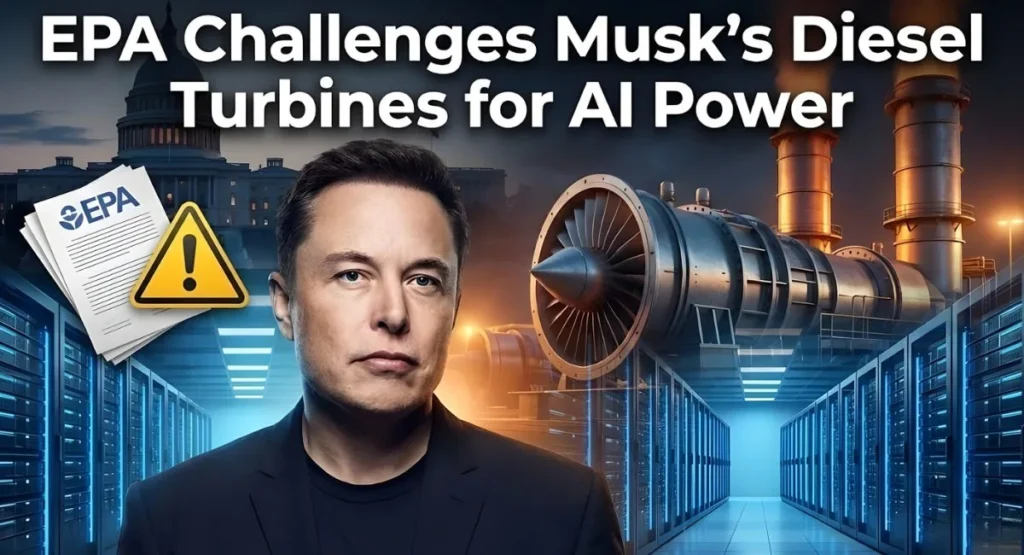
The EPA has halted Elon Musk’s unpermitted diesel turbines used to power AI compute, citing violations of the Clean Air Act. If you want to understand how outages ripple across enterprise systems, compare this with the recent Microsoft 365 outage that disrupted recruitment operations.
- What the EPA Notice to Musk Actually Says
- Why Diesel Turbines Became the Go‑To Choice for AI Data Centers
- How Much Energy Modern AI Really Needs
- Diesel Turbines Compared With Renewable Power Options
- The Legal Framework Behind the EPA’s Action
- Immediate Steps Companies Should Take to Achieve Compliance
- How Leading Tech Firms Are Mitigating the Diesel Risk
- Financial, Reputation, and Investor Implications
- What the EPA’s Action Means for the Future of AI Infrastructure
- Emerging Clean Power Technologies That Could Replace Diesel
- Frequently Asked Questions
- Conclusion
- Trusted Sources and References
What the EPA Notice to Musk Actually Says
The Environmental Protection Agency formally warned Tesla and SpaceX that two diesel‑fuel turbines installed at a new AI‑focused data center were operating without the mandatory New Source Review (NSR) permits. The notice states that the turbines exceed the 100 MW threshold that triggers major source classification, making the installations illegal under the Clean Air Act. This direct enforcement action signals that the agency will not overlook unpermitted fossil‑fuel generation, even when it powers cutting‑edge AI workloads.
Why it matters is threefold: regulatory risk escalates, potential fines can cripple budgets, and the precedent forces the entire tech sector to re‑evaluate on‑site power strategies. Companies that ignore the permit process risk shutdowns, costly retrofits, and damage to brand reputation, especially as investors demand stronger ESG compliance.
Why Diesel Turbines Became the Go‑To Choice for AI Data Centers
AI model training consumes massive, continuous electricity, and many operators prioritize reliability over cost. Diesel turbines can start instantly, deliver 24/7 power, and avoid dependence on grid fluctuations. For Musk’s projects, the promise of a self‑contained, high‑capacity source appeared to align with the aggressive timelines for large‑scale language‑model training.
In practice, the turbines were sized to support clusters of up to 1,000 GPUs, each drawing roughly 300 kW. When aggregated, the power demand reaches several hundred megawatts, a level where grid contracts become expensive and potentially unstable. Diesel turbines therefore seemed a pragmatic short‑term fix, despite their high carbon intensity and emerging regulatory scrutiny.
This urgency mirrors the broader AI energy demand crisis now reshaping data center infrastructure worldwide.
How Much Energy Modern AI Really Needs
Training a state‑of‑the‑art large language model can consume more electricity than the entire annual usage of a small country. A single high‑end GPU draws 300–350 kW, an 8‑GPU rack consumes about 2.5 MW, and a 1,000‑GPU cluster can require up to 350 MW. Over a year, that translates to 2.6–3.0 million MWh for the largest clusters.
These figures explain why operators chase on‑site generation: the cost of purchasing that amount of grid power, especially during peak demand periods, can dwarf the capital expense of a diesel plant. However, the sheer scale also amplifies emissions, making regulators more likely to intervene when the source is fossil‑fuel based.
The scale of consumption is driving innovation in AI-powered materials discovery to improve energy efficiency and hardware performance.
Diesel Turbines Compared With Renewable Power Options
A side‑by‑side comparison shows diesel turbines emit 800–1,000 kg CO₂ per MWh, while solar plus storage can stay below 50 kg CO₂ per MWh. Capital costs are higher for renewables ($2.5–3.5 M per MW) but operational expenses are lower, and maintenance is minimal. Diesel offers instant start‑up and 24/7 output, but fuel price volatility and emission penalties add hidden costs.
From a compliance perspective, renewables avoid the NSR permitting hurdle because they fall below the major‑source emission thresholds. Companies that blend on‑site diesel with solar and battery storage can reduce net emissions, lower long‑term operating costs, and position themselves favorably under emerging EPA guidelines.
The Legal Framework Behind the EPA’s Action
The Clean Air Act requires any new major source of air pollutants to obtain an NSR permit before construction. Diesel turbines that emit nitrogen oxides (NOₓ) and particulate matter become “major sources” once they exceed 100 MW of capacity. The EPA’s enforcement hinges on this provision, and state agencies can impose additional standards, such as California’s CARB limits.
Practically, this means a tech firm must submit detailed emissions forecasts, demonstrate the use of best‑available control technology, and possibly purchase emission offsets. Failure to secure a permit before operation is a direct violation, exposing the firm to daily penalties of up to $25,000 per violation and mandatory shutdown orders.
Immediate Steps Companies Should Take to Achieve Compliance
First, conduct a thorough energy audit to map every on‑site generator and its emissions profile. Next, engage an environmental consulting firm to prepare and submit an NSR application, including mitigation plans such as selective catalytic reduction (SCR) technology. Simultaneously, begin negotiations for renewable power purchase agreements (PPAs) to offset remaining emissions.
Finally, install continuous emissions monitoring systems (CEMS) to provide real‑time data to regulators. These steps not only reduce the risk of EPA enforcement but also demonstrate a proactive ESG stance that investors increasingly demand.
For regulated industries, this aligns closely with the rise of AI risk and compliance platforms designed to automate regulatory readiness.
How Leading Tech Firms Are Mitigating the Diesel Risk
Many companies adopt a hybrid power mix, pairing diesel turbines with on‑site solar arrays and lithium‑ion battery banks. This configuration smooths out peak loads, cuts net diesel runtime, and can qualify for emission offsets. Some firms also purchase Renewable Energy Certificates (RECs) to claim carbon‑neutral status for their AI workloads.
Edge‑compute relocation is another tactic: less‑critical AI tasks are moved to data centers in regions with greener grids, while only the most compute‑intensive jobs remain on‑site. A senior data‑center manager reported a 30 % reduction in carbon footprint after adding a 5 MW battery system, illustrating the tangible benefits of hybrid solutions.
Financial, Reputation, and Investor Implications
Direct costs from EPA action include fines ($25,000 per day per violation) and retrofit expenses ($300–$500 k per MW for SCR systems). Indirectly, the brand impact can be severe; a 2025 Gartner survey found 68 % of enterprise buyers consider a vendor’s carbon intensity when selecting AI services. Companies that ignore compliance risk losing market share to greener competitors.
Investor pressure is also mounting. ESG‑focused funds now control over $2 trillion in assets and often include carbon‑intensity clauses in their mandates. Non‑compliant firms may trigger divestment triggers, leading to stock price volatility and higher cost of capital. Proactive compliance, therefore, protects both the bottom line and the corporate reputation.
What the EPA’s Action Means for the Future of AI Infrastructure
The enforcement signals a broader regulatory shift toward stricter emissions caps for data centers, especially those relying on on‑site fossil generation. The EPA is expected to introduce more granular reporting requirements for AI‑related energy consumption, and Congress may pass legislation offering tax credits for AI facilities that adopt renewable power.
Tech leaders should view this as a catalyst to future‑proof their compute strategy. By aligning AI expansion with clean‑energy initiatives now, firms can avoid retroactive compliance costs and position themselves as industry standards‑setters in sustainable AI.
Emerging Clean Power Technologies That Could Replace Diesel
Hydrogen fuel cells are gaining attention for their zero‑emission profile and high energy density, though current capital costs remain prohibitive for megawatt‑scale AI clusters. Small Modular Reactors (SMRs) promise continuous, carbon‑free electricity, but regulatory pathways are still evolving. Advanced thermal energy storage systems can capture excess heat from renewable sources and convert it back to electricity during peak AI training windows.
Early adopters are piloting these technologies in partnership with energy innovators. While none are yet mainstream, the trajectory suggests that within the next decade, AI firms will have viable alternatives that satisfy both performance and environmental criteria, reducing reliance on diesel turbines entirely.
Frequently Asked Questions
What specific violation did the EPA cite?
The EPA alleged that Musk’s companies installed diesel turbines exceeding 100 MW without the required New Source Review permits, violating the Clean Air Act.
Can existing diesel turbines be retrofitted instead of removed?
Yes. Adding selective catalytic reduction (SCR) systems can lower NOₓ emissions below EPA limits, but a permit amendment is still required.
How much does a typical diesel turbine cost?
Capital costs range from $1.5 million to $2.0 million per megawatt, plus ongoing fuel and maintenance expenses.
Are there tax incentives for switching to renewable AI power?
The 2024 “AI Green Power” credit offers up to 30 % of capital costs for renewable installations that support AI workloads.
Will the EPA target other AI companies?
Likely. Any firm using on‑site fossil‑fuel generators above the NSR threshold could face similar scrutiny.
How does battery storage help with compliance?
Battery systems reduce reliance on diesel during peak loads, lowering total emissions and potentially qualifying for lower‑emission permits.
Can a Power Purchase Agreement replace on‑site turbines?
Yes. PPAs provide contracted renewable electricity, eliminating the need for on‑site fossil generation and associated permits.
Is carbon offsetting enough to satisfy the EPA?
Offsets can complement compliance but do not replace the legal requirement for a permit on the emitting source.
What should investors watch for?
Investors should monitor ESG disclosures, permit status, and any pending EPA enforcement actions disclosed in annual filings.
What timeline is typical for obtaining an NSR permit?
The process usually takes 6–12 months, depending on the completeness of the application and state agency workload.
Conclusion
The EPA’s crackdown forces AI leaders to replace diesel power with compliant, low‑carbon solutions, turning regulatory risk into a strategic sustainability advantage.
Trusted Sources and References
- U.S. Environmental Protection Agency
- Gartner 2025 Enterprise AI Survey
- International Energy Agency – World Energy Outlook 2024



I’m Fahad Hussain, an AI-Powered SEO and Content Writer with 4 years of experience. I help technology and AI websites rank higher, grow traffic, and deliver exceptional content.
My goal is to make complex AI concepts and SEO strategies simple and effective for everyone. Let’s decode the future of technology together!