What jobs are safe from AI? Roles requiring hands-on expertise, emotional intelligence, and strategic judgment, such as healthcare, skilled trades, and executive leadership, remain secure. As AI takes over repetitive work, human adaptability, problem-solving, and decision-making in complex environments remain essential.
Discover why 2026 will redefine job security, which careers AI cannot replace, and how mastering human-centric skills and AI management can future-proof your career in an era where technology handles routine work.
- The 2026 AI Reckoning: From Evangelism to Evaluation
- The Unautomated Frontier: Why Skilled Trades Defy Digitization
- The "Agent Boss" and the Frontier Firm: Microsoft’s 2025 Vision
- The Empathy Economy: Healthcare’s Irreplaceable Human Element
- The Creative Pivot: From Generation to Curation and Strategy
- Strategic Leadership: The Liability Shield and Ethical Governance
- The Entry-Level Crisis: The "Canary in the Coal Mine" Phenomenon
- Technical Deep Dive: Why Robotics Fail in "Unstructured" Reality
- Competitor Analysis and The Macro-Economic Moat
- Future-Proofing Skills: The Human Advantage Matrix
-
Frequently Asked Questions (FAQs)
- 1. Will AI replace electricians and plumbers by 2030?
- 2. Is coding still a safe career choice in 2026?
- 3. What is the "Agent Boss" mentioned in Microsoft’s reports?
- 4. Are creative jobs like graphic design dead?
- 5. Why are healthcare jobs considered AI-proof?
- 6. Can AI replace project managers?
- 7. What is the safest white-collar profession?
- 8. How will AI impact entry-level jobs?
- 9. What skills should I learn to future-proof my career?
- 10. Will AI cause mass unemployment by 2026?
- Conclusion
The 2026 AI Reckoning: From Evangelism to Evaluation
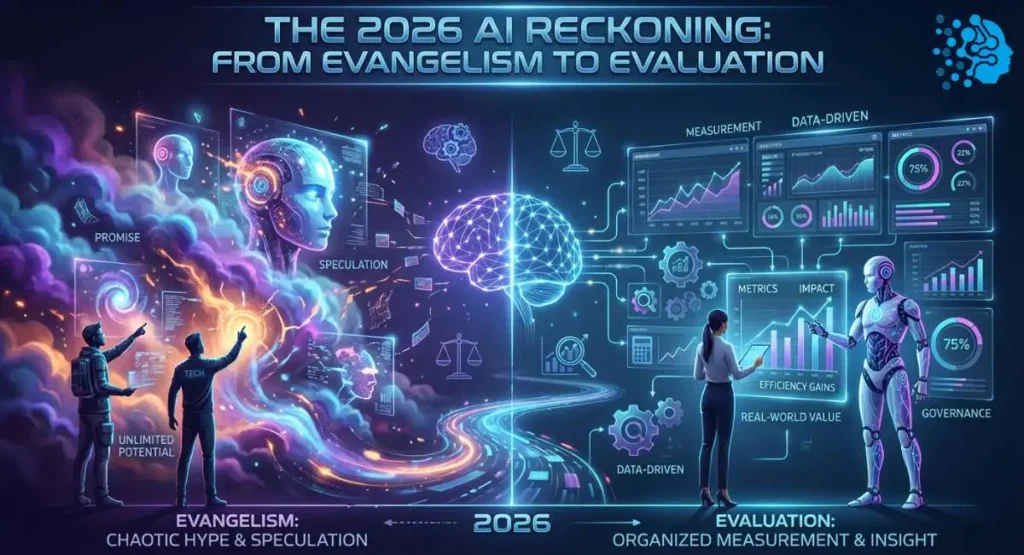
The global conversation surrounding artificial intelligence is undergoing a profound structural shift as we approach 2026. For the past several years, the technology sector and the broader labor market have operated in a phase best described as “AI Evangelism“, characterized by boundless speculation, aggressive venture capital investment, and a pervasive fear of immediate, total displacement. However, leading researchers and economic analysts now indicate that 2026 will mark the transition into an era of “AI Evaluation“. This pivot is not merely semantic; it represents a fundamental change in how corporations, governments, and workers value human labor versus algorithmic output. The question is no longer “Can AI do this?”—a query that dominated headlines in 2023 and 2024—but rather “How well does it do it, at what cost, and with what liability?”
This transition is driven by the emergence of rigorous economic measurement. Stanford University’s Digital Economy Lab predicts the deployment of “AI economic dashboards” by 2026, tools designed to track the impact of automation at a granular, task-specific level rather than broadly across occupations. These dashboards will function like national accounts, utilizing high-frequency payroll and platform data to identify exactly where AI is boosting productivity and where it is failing to deliver a return on investment. This data-driven realism is expected to puncture the “AI bubble” in sectors where the technology has been overhyped, leading to a “pragmatic reset” where wary buyers demand proof of utility over promises of revolution.
The Return on Investment (ROI) Reality Check
The friction between technological capability and economic reality is becoming the primary safeguard for many jobs. Forrester’s AI spending forecasts for 2026 suggest that enterprises may delay up to 25% of their projected AI spending into 2027 because the value proposition is failing to land in complex operational environments. This “year of reckoning” implies that jobs previously thought to be vulnerable may have a significantly longer shelf life than anticipated, provided they involve “hard hat work” tasks that require navigating physical reality, complex emotional landscapes, or unstructured data that defies clean digitization.
The delay in adoption is not due to a lack of computing power but due to the “last mile” problem of implementation. AI models in 2025 and 2026 are proving exceptional at generating content but mediocre at integrating that content into legacy workflows without creating massive downstream errors. This phenomenon, often referred to as “the tsunami of noise,” requires human intervention to filter, verify, and apply AI outputs, thereby creating a protective moat around roles that possess deep domain expertise and critical thinking skills.
AI Sovereignty and the Localization of Talent
A significant, underreported trend reshaping job security is the rise of “AI Sovereignty“. As nations and multinational corporations seek independence from centralized, US-centric AI providers, there is a growing demand for localized talent capable of building, maintaining, and securing independent Large Language Models (LLMs) and data infrastructures. This geopolitical shift moves Information Technology (IT) and engineering roles away from generic coding, which is highly susceptible to automation by global models, toward specialized infrastructure management and cybersecurity roles that require deep, localized context, physical presence in secure data centers, and adherence to specific national regulations.
The concept of sovereignty extends to data privacy and “digital provenance.” Gartner predicts that by 2027, 35% of countries will be locked into region-specific AI platforms, creating a fragmented landscape that protects local jobs from being outsourced to a single global algorithm. This fragmentation necessitates the need for human intermediaries who understand the specific cultural, legal, and technical nuances of their region—nuances that a generalized model trained on the open internet often overlooks or misinterprets.
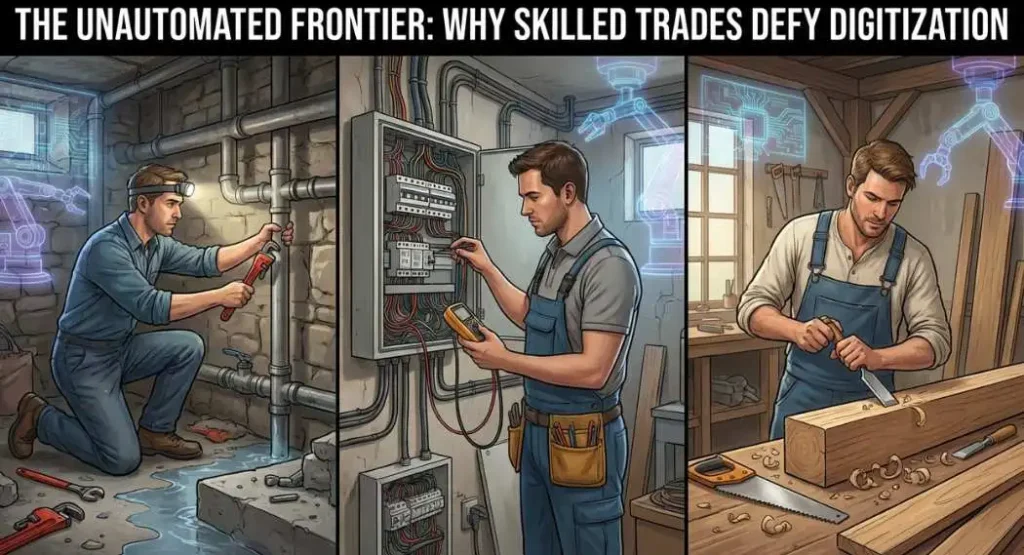
The Unautomated Frontier: Why Skilled Trades Defy Digitization
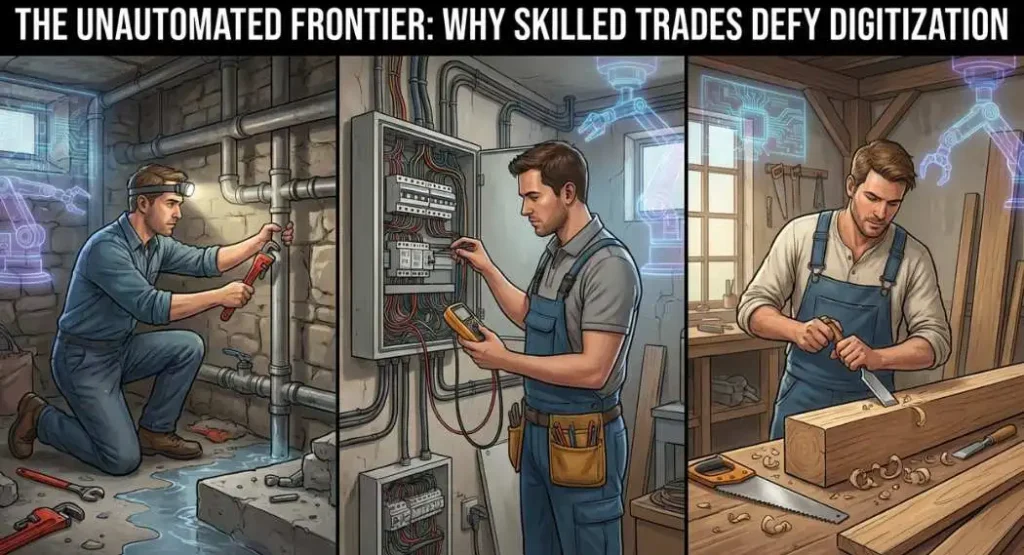
Contrary to the dystopian view of total automation, the skilled trades, specifically plumbing, electrical work, HVAC installation, and specialized construction, stand as the most resilient sector against AI encroachment in the 2026 landscape. The primary barrier to automating these jobs is not intelligence or computational power, but the chaotic, non-negotiable nature of the physical world.
The Physics of Unstructured Environments
To understand why a plumber is safer than a junior software developer, one must distinguish between “structured” and “unstructured” environments. Robotics and AI excel in structured environments, such as manufacturing assembly lines, where every variable is controlled, lighting is constant, and the location of parts is predictable to the millimeter. Construction sites, residential homes, and commercial retrofit projects are considered “unstructured environments”.
Learn more about mastering Microsoft Word and productivity tools.
A plumber responding to a call in a 1920s basement faces a matrix of unpredictable variables: corroded pipes made of obsolete materials (lead, cast iron), non-standard fittings, cramped access points that require contortion, and water damage that alters the structural integrity of the workspace. These conditions change minute by minute. A robot, which relies on sensors and pre-programmed (or even learned) paths, struggles to adapt to this chaos. Current robotics lacks the sensory feedback, the “touch” required to gauge thread tension on a rusted bolt or the fragility of a crumbling drywall.
Table 1: Automation Barriers in Skilled Trades
Trade | Automation Barrier | Technological Limitation | Economic Friction |
Unpredictable workspaces; variability of materials (copper, PVC, lead). | Robots lack the haptic feedback to gauge thread tension or pipe fragility; they cannot interpret sensory cues like dampness/smell | High cost of robotics vs. low cost of flexible human labor in small businesses | |
Complex decision-making regarding safety codes; retrofit challenges in old infrastructure. | AI cannot physically manipulate wires in varying gauges within confined wall spaces or navigate clutter in occupied homes. | Liability for fire hazards prevents autonomous sign-off; licensure requires human accountability. | |
Diagnostic ambiguity; multi-sensory requirements (smell, sound, temperature). | Robotics cannot effectively navigate attics/crawlspaces or interpret sensory cues like burning smells or vibration patterns.14 | Equipment is often custom-fitted or jury-rigged in older buildings, confusing standard robotic protocols. | |
Material inconsistency (wood grain, warping); custom fitting requirements. | Difficulty in real-time adjustment to material imperfections; artistic judgment in finish work. | The “artisan” premium: customers pay for human craftsmanship and custom design. |
The “Last Mile” of Manual Labor
The technological gap is most evident in the “last mile” of manual labor. While companies like Hilti have introduced semi-automated robots like the “Jaibot” for overhead drilling, these machines essentially function as power tools that still require human setup, oversight, and intervention. The robot can drill the hole, but it cannot decide where to drill if the digital plan conflicts with a physical obstruction, a common occurrence on dynamic job sites. The human electrician must still thread the wire, strip the insulation, and make the final connection. This dexterity, the ability to manipulate small, irregular objects in three-dimensional space, remains decades away from economic viability for automation.
Furthermore, the sensory limitations of AI in skilled trades are profound. A mechanic often diagnoses an engine problem by listening to the specific pitch of a rattle or smelling a particular type of burning fluid. A plumber finds a leak by feeling for dampness. These multi-modal sensory inputs are difficult to digitize and integrate into a robotic feedback loop. Until a robot can “feel” and “smell” with the sensitivity of a human veteran, the diagnostic aspect of the trades will remain strictly human.
The Economic Fragmentation Defense
Beyond technical limitations, the economic structure of the construction industry acts as a firewall against automation. The sector is highly fragmented, consisting largely of small and medium-sized businesses operating on tight margins. The capital expenditure (CapEx) required to purchase, insure, and maintain autonomous construction robots is prohibitive compared to the flexibility of human labor.
A human plumber is a “general purpose” worker: they can drive the van, talk to the client, fix the sink, invoice the job, and clean up the site. A robot is typically a “special-purpose” machine (e.g., a pipe cutter). To replace the human, a small business would need a fleet of expensive, specialized robots. The Return on Investment (ROI) for such technology simply does not exist for the vast majority of residential and commercial service work.
The "Agent Boss" and the Frontier Firm: Microsoft’s 2025 Vision
For knowledge workers who do not work with their hands, the path to safety lies in a complete reimagining of their role. The Microsoft 2025 Work Trend Index introduces a pivotal concept that redefines job safety for the white-collar sector: the “Agent Boss”. Rather than being replaced by AI, the safe professional transitions into managing a team of AI agents.
Stay updated on Microsoft AI news 2026.
The Rise of the Frontier Firm
Microsoft’s data reveals the emergence of the “Frontier Firm,” a new breed of organization built around “intelligence on tap”. In this model, the capacity of the workforce is no longer defined by headcount but by the effective utilization of AI agents. The human worker is no longer valued for their ability to generate outputwriting code, drafting emails, and creating spreadsheets, because AI can now generate these artifacts instantly and at near-zero marginal cost. Instead, the human value shifts to orchestration.
The “Agent Boss” is a professional who directs AI systems to execute work. This role requires a specific set of skills that are distinct from technical execution:
- Decomposition: The ability to break down a complex business problem (e.g., “Launch a new product in Japan”) into discrete, executable tasks that an AI agent can handle, a core capability identified in AI-enabled management research.
- Evaluation and Audit: The critical thinking required to assess the quality of AI output. Because AI hallucinations and logic errors persist, the human must act as the “quality assurance” layer. The Agent Boss must know enough about the subject to spot a subtle error in the AI’s reasoning.
- Integration: Synthesizing the fragmented work of multiple agents into a coherent strategy. While AI can generate isolated outputs, strategic alignment across business functions remains a human responsibility, requiring judgment, context, and accountability.
Closing the Capacity Gap
The driver for this shift is what Microsoft terms the “Capacity Gap.” 82% of leaders see 2025-2026 as a pivotal time to rethink operations because human employees are overwhelmed by the volume of digital debt (emails, meetings, data). The “safe” job in this context is the one that leverages AI to close this gap.
Professionals who refuse to adopt the “Agent Boss” persona risk obsolescence, not because the AI is better than they are, but because their AI-augmented peers become exponentially more productive. A graphic designer who manually creates every pixel will be outcompeted by a “Visual Strategy Director” who directs AI to generate 500 variations and then curates the best three. The safety is not in the tool but in the leverage of the tool.
The Human-Agent Ratio
A new metric for career viability is the “Human-Agent Ratio.” Microsoft suggests that future organizational charts will include AI agents as entities. The most valuable employees will be those with a high Human-Agent ratio, meaning one human successfully managing a large number of productive agents. This mirrors the evolution of the factory foreman: the worker who dug the ditch with a shovel was replaced by the operator who controlled the excavator. In 2026, the writer is replaced by the editor who controls the LLM.
The Empathy Economy: Healthcare’s Irreplaceable Human Element
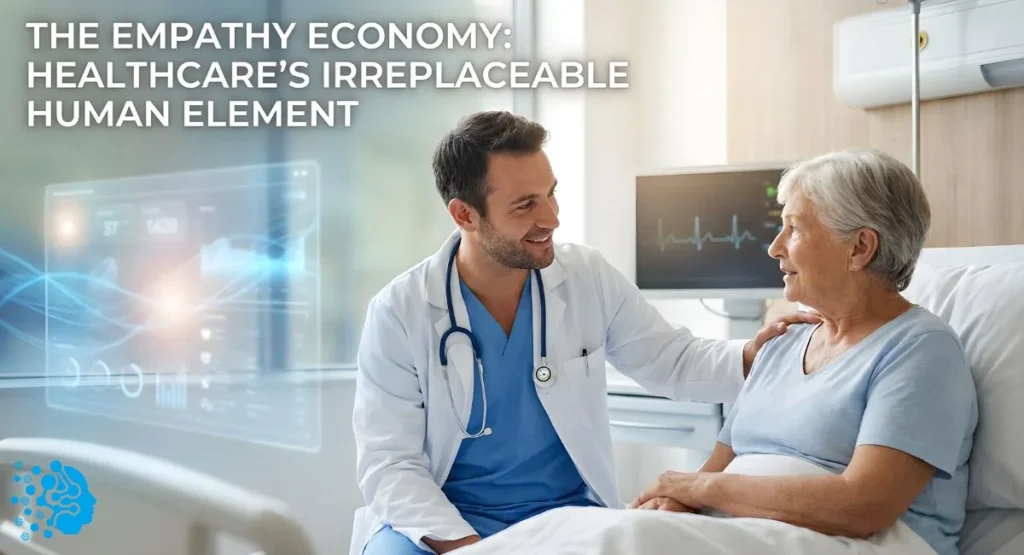
Healthcare remains a fortress of job security, but the reasons are evolving. It is not merely that medical knowledge is complex; AI in healthcare is rapidly catching up in diagnostics, with some systems outperforming radiologists in detecting anomalies, but that the delivery of care requires a “human-in-the-loop” for ethical, physical, and psychological reasons.
The “Tsunami of Noise” and the Clinical Filter
Stanford medical experts predict that by 2026, hospitals will face a “tsunami of noise” from medical AI startups, each promising revolutionary diagnostics. This influx of data creates a new burden: the need to filter signal from noise.
Job security in healthcare lies in roles capable of this filtration, Clinical Managers, Nurse Practitioners, and Senior Physicians, who can validate AI suggestions against patient reality. The ability to say “no” to an algorithm based on clinical intuition is a skill that will define the elite healthcare worker of the next decade. For example, an AI might flag a patient for sepsis based on vital signs, but a seasoned nurse might recognize that the patient is simply overheated from too many blankets. This contextual awareness, the “clinical gaze“, protects the role.
The “Placebo Effect” of Human Care
There is a tangible medical value to human interaction. Clinical research indicates that patients heal faster and comply better with treatment plans when they feel heard and cared for by a human being. This “placebo effect” of care is a medical outcome that AI cannot replicate. An AI chatbot can deliver Cognitive Behavioral Therapy (CBT) techniques, but it cannot provide the “therapeutic alliance”, the bond of trust between therapist and patient that is the strongest predictor of success in mental health treatment.
This limits the utility of AI in mental health to triage and support, preserving the role of the counselor for deep treatment. The “Uncanny Valley” effect, where a near-human interaction feels creepy or disingenuous, prevents AI from effectively managing trauma or grief, ensuring that Mental Health Counselors remain one of the fastest-growing and safest professions (projected 22.1% growth).
Physical Manipulation and Patient Safety
The physical aspect of nursing and therapy provides a robust defense against automation. Inserting an IV into a dehydrated patient with collapsing veins, physically rehabilitating a stroke victim who has lost balance, or safely restraining a combative patient in the ER are tasks requiring complex, real-time physical negotiation with another human body.
Table 2: Projected Growth of AI-Resistant Healthcare Roles (2022-2032)
Occupation | Projected Growth | Median Wage (2021) | AI Resistance Factor |
45.7% | $120,680 | High: Requires complex decision making, physical care, and diagnostic autonomy.1 | |
27.6% | $121,530 | High: Combines situational awareness with empathy; fills the gap between doctor and nurse. | |
22.1% | $48,520 | Very High: Emotional Intelligence (EQ) is the primary tool; human connection is the product. | |
16.9% | N/A | High: Relies on physical manipulation and tactile feedback; highly unstructured patient interactions. |
The Creative Pivot: From Generation to Curation and Strategy
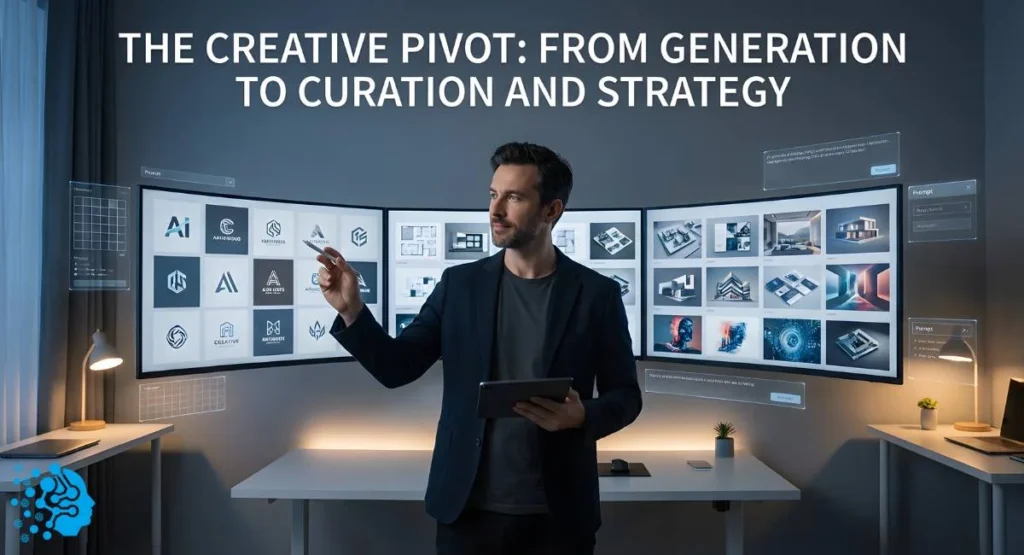
The creative industries are undergoing a violent restructuring that serves as a bellwether for all knowledge work. The era of the “junior graphic designer” or “copywriter” is ending, replaced by the “Visual Strategy Director” and the “AI Creative Director”.
The Death of the Junior Portfolio
Historically, creative careers began with an apprenticeship doing grunt work (e.g., resizing images, writing social media captions, sketching logo concepts) to learn the craft. Generative AI tools like Midjourney, DALL-E 3, and ChatGPT have automated this entry-level work entirely.
This creates a “Canary in the Coal Mine” effect where early-career professionals face a 13% decline in hiring, while senior roles remain stable. The “safe” creative job in 2026 focuses on curation and strategy rather than generation. The “AI Creative Director” does not draw; they define the core concept, establish brand guardrails, and curate the output of thousands of AI-generated iterations. They are the architect, not the bricklayer.
Authentic Human Premium
As the internet floods with AI-generated content, “human-made” is becoming a luxury label. Creative roles that involve live performance, physical art installation, and high-touch brand storytelling are seeing a resurgence in value. Roles like Choreographers (29.7% growth) remain untouched because they involve the physical movement of human bodies in space—a domain AI cannot digitize. Similarly, “high-stakes” writing—investigative journalism, crisis communications, legal arguments—remains safe because the cost of an AI hallucination is too high.
The Workflow of the Future Creative
The daily workflow of a safe creative professional in 2026 involves “Nano Banana” style integration: using AI to generate consistent product imagery or icons in minutes, then spending the bulk of their time on “Visual Strategy” ensuring those assets fit a cohesive psychological narrative for the consumer. The job has shifted from “making pretty pictures” to “managing visual systems.”
Learn more about Microsoft AI Copilot updates.
Strategic Leadership: The Liability Shield and Ethical Governance
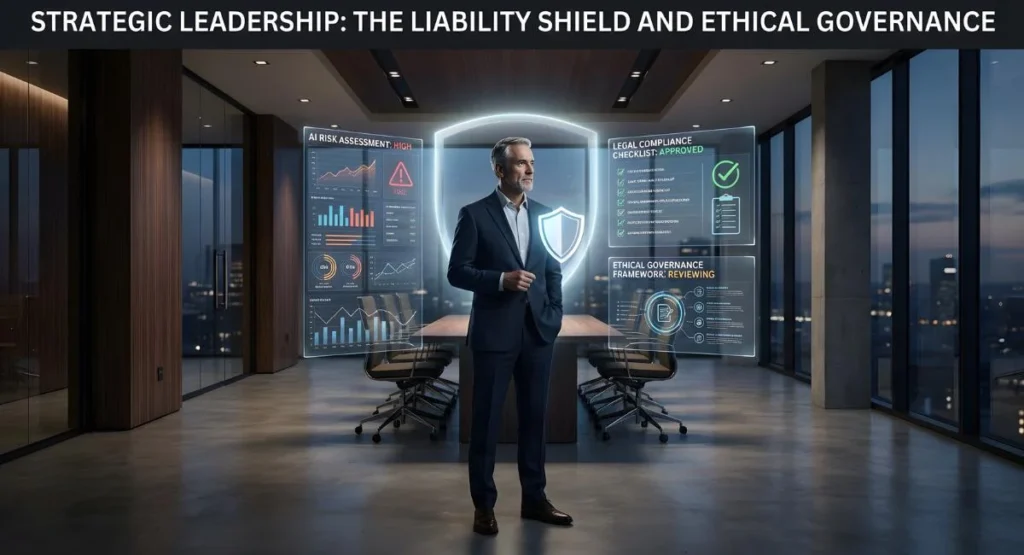
One of the most overlooked aspects of job safety is accountability. AI models, often described as “black boxes,” cannot be held legally liable for corporate malfeasance, strategic failures, or safety violations. This legal reality preserves the role of senior management and strategic oversight.
The “Death by AI” Liability Crisis
Gartner predicts that by 2026, there will be over 2,000 “Death by AI” legal claims due to insufficient guardrails in healthcare, finance, and safety systems. This looming litigation crisis ensures that human “signing officers”, engineers, doctors, and executives who sign off on AI decisions, remain essential.
The job is not just to do the work; it is to take the blame if it goes wrong. A CEO cannot blame an algorithm for a failed merger; a Civil Engineer cannot blame a simulator for a collapsed bridge. This “Liability Shield” function ensures that humans will always remain at the top of the decision-making chain in regulated industries.
Strategic Management vs. Spreadsheet Management
Management roles that rely on “spreadsheet control” tracking KPIs, assigning shifts, optimizing budgets—are dying. AI can optimize logistics and budgets better than any middle manager. However, roles requiring negotiation, conflict resolution, and cultural leadership are safe. A machine cannot navigate the internal politics of a merger, negotiate a hostage situation, or convince a board of directors to pivot the company strategy.
Strategic roles are evolving into “Thought Partners,” where the human provides the ambition and the AI provides the simulation. The human asks, “What if we acquired our competitor?” and the AI runs the financial models. The decision to act, however, remains human.
The Entry-Level Crisis: The "Canary in the Coal Mine" Phenomenon
A critical insight from the Stanford Digital Economy Lab is the disproportionate impact of AI on entry-level workers. Research indicates a 13% relative decline in employment for early-career workers in AI-exposed occupations, while senior roles in the same fields show stability or growth.
The Broken Apprenticeship Model
This presents a paradox: The senior jobs are safe, but the path to getting them is broken. If juniors are no longer hired to do the grunt work (which taught them the skills to become seniors), how does the next generation learn?
The “safe” career path in 2026 involves skipping the traditional “grunt work” phase by proving competence in AI Literacy and Complex Problem Solving immediately. The traditional advice of “start at the bottom” is dangerous in fields like coding or writing. The new advice is “start in the middle”, gain practical experience through apprenticeships in the trades, or build a portfolio of AI-managed projects that demonstrate “Agent Boss” capabilities before entering the corporate market.
Technical Deep Dive: Why Robotics Fail in "Unstructured" Reality
To truly understand job safety, one must look at the technical failures of robotics. Despite the hype, robots like the Hilti Jaibot have not revolutionized construction; they have merely augmented specific tasks.
The Sensor Fusion Challenge
Robots struggle with “Sensor Fusion”, the ability to combine visual data, auditory data, and haptic (touch) feedback to form a complete picture of the world. A human plumber uses sensor fusion effortlessly: they see a drip, feel the vibration of the water pressure, and smell the sewer gas to diagnose a blockage.
- Visual Limitations: Computer vision struggles with low light, dust, and occlusion (objects blocking the view), all common on construction sites.
- Haptic Dead Zones: Robots cannot “feel” the difference between a pipe that is stuck and a pipe that is about to break. This lack of force-feedback makes them dangerous for delicate repair work.
The “Good Enough” Problem
In many cases, AI and robotics are “good enough” for 90% of tasks but fail catastrophically at the last 10%. In software, a 90% correct code snippet is useful. In electrical work, a 90% correct wire connection causes a fire. This “zero tolerance for error” in the physical world creates a high barrier to entry for automation, protecting the trades for decades to come.
Competitor Analysis and The Macro-Economic Moat
Most reports on “AI-safe jobs” focus heavily on the capabilities of the technology. They often miss the macroeconomic and societal factors that slow adoption. These factors form a “moat” around certain jobs regardless of technological progress.
1. The Cost of Hardware vs. Software
While software (AI) is cheap and scalable (marginal cost near zero), hardware (robots) is expensive. A Generative AI subscription costs $20/month. A construction robot costs $100,000+. For a small plumbing business, the human is cheaper, more versatile, and requires no software updates. This economic reality protects blue-collar jobs even as white-collar jobs (which rely on cheap software) evaporate.
2. Cultural Inertia and Unions
The construction and healthcare industries are culturally resistant to change. Strong labor unions in the trades and nursing act as a powerful brake on automation, negotiating contracts that prohibit the replacement of humans with machines. This regulatory and cultural friction is a “hidden variable” that purely technological forecasts ignore.
3. Infrastructure Decay
As global infrastructure in the West ages, the demand for repair grows. Repair work is inherently unstructured and resistant to automation. New construction (which can be prefabricated by robots) is a smaller portion of the market compared to the maintenance of existing, decaying buildings. This shifts the labor demand toward the adaptable human repairman.
Future-Proofing Skills: The Human Advantage Matrix
To future-proof a career, one must audit their skills against the capabilities of Generative AI. The “safe” skills are those that AI fails to simulate convincingly.
Table 3: The Human Advantage Matrix
Skill Domain | Why AI Fails | Safe Job Examples |
Complex Physical Dexterity | Robotics is expensive, battery-limited, and struggles with non-repetitive motion in chaotic environments. | Electrician, Plumber, Surgeon, Athlete, Choreographer, HVAC Technician |
Emotional Intelligence (EQ) | AI can mimic empathy but cannot feel or build genuine trust bonds; it falls into the “Uncanny Valley” during deep stress. | Therapist, Social Worker, HR Director, Clergy, Hospice Nurse. |
Accountability & Ethics | AI cannot be sued, jailed, or shamed; legal frameworks require human liability for high-stakes decisions. | Judge, CEO, Civil Engineer, Licensed Architect, Ship Captain. |
Originality & Rebellion | AI predicts the next likely token based on past data; it cannot break rules to create novel paradigms or counter-intuitive art. | High-level Artist, Research Scientist, Entrepreneur, Investigative Journalist. |
Orchestration (Agent Boss) | AI excels at tasks but struggles to manage other AIs or align outputs with complex human goals. | Product Manager, Movie Director, “Frontier Firm” Manager. |
Frequently Asked Questions (FAQs)
1. Will AI replace electricians and plumbers by 2030?
No. Physical work in unstructured environments requires dexterity and problem-solving that AI cannot replicate cost-effectively.
2. Is coding still a safe career choice in 2026?
Coding alone is less secure; safe roles focus on system design, AI management, and architecture, not syntax writing.
3. What is the “Agent Boss” mentioned in Microsoft’s reports?
An “Agent Boss” manages AI agents, delegating tasks and auditing outputs, evolving the traditional managerial role.
4. Are creative jobs like graphic design dead?
Entry-level tasks are at risk, but strategic roles like Creative Director and Visual Strategy Director remain safe.
5. Why are healthcare jobs considered AI-proof?
They require physical skill, emotional intelligence, ethical judgment, and liability management—areas AI cannot fully replace.
6. Can AI replace project managers?
AI handles administrative tasks, but leaders skilled in negotiation, motivation, and problem-solving remain essential.
7. What is the safest white-collar profession?
High-stakes roles—CEOs, judges, senior legal counsel—require judgment, accountability, and liability, which AI cannot assume.
8. How will AI impact entry-level jobs?
Entry-level roles are most vulnerable; new hires must show strategic thinking, AI fluency, and leadership capability.
9. What skills should I learn to future-proof my career?
Develop human-centric skills: EQ, dexterity, critical thinking, adaptability, and AI management proficiency.
10. Will AI cause mass unemployment by 2026?
Not entirely; AI transforms jobs, creating millions of new roles while displacing routine tasks in certain sectors.
Download the AI Job Safety 2026 Career Survival Guide(PDF), with charts, tables, and a proven framework for identifying AI-safe careers.
Conclusion
The jobs safe from AI in 2026 are not merely those that computers cannot do, but those that society will not trust them to do. Safety lies in the physical complexity of the skilled trades, the emotional depth of healthcare, and the high-stakes accountability of strategic leadership. The era of the “Agent Boss” is here; survival requires transitioning from a generator of output to a director of intelligence. In this new economy, being authentically, flawed, and accountably human is the ultimate competitive advantage.


TechDecodedly – AI Content Architect. 4+ years specializing in US tech trends. I translate complex AI into actionable insights for global readers. Exploring tomorrow’s technology today.