Microsoft AI news today signals a significant shift toward autonomous agents and a massive global expansion. This report covers the $23B investment, Agent 365 governance, GPT-5.2 reasoning, and the Muse model reshaping work, security, and gaming.
In this article, we break down how Agent 365, GPT-5.2, and Microsoft’s $23B infrastructure investment are redefining autonomous work.
For a deeper understanding of how governments are responding to agentic AI and governance risks, see our related coverage on global AI regulation.
- 1. The Agentic Revolution: From Chatbots to Autonomous Digital Employees
- 2. Democratizing Enterprise AI: The Strategic Shift in SMB Pricing
- 3. The Brains of the Operation: GPT-5.2 and the Era of "Thinking" Models
- 4. Beyond Monoculture: Azure AI Foundry and the Multi-Model Strategy
- 5. The Physical Layer: A $23 Billion Bet on Global AI Infrastructure
- 6. Generative Gameplay: How "Muse" is Rewriting the Rules of Interactive Entertainment
- 7. The Security Paradox: AI as Both Guardian and Risk Vector
- 8. Human-AI Symbiosis: Insights from the 2025 Copilot Usage Report
- 9. The Friction of Progress: Windows 11 Integration, Privacy, and User Pushback
- 10. The Frontier Firm: 2026 Predictions and the New Definition of Work
-
FAQs
- 1. What is the difference between standard Microsoft Copilot and the new “Agent Mode”?
- 2. How much does the new Microsoft 365 Copilot Business plan cost?
- 3. What is Microsoft Agent 365, and why do IT admins need it?
- 4. Is GPT-5.2 available in Microsoft Copilot yet?
- 5. What is the “Muse” AI model mentioned in recent news?
- 6. Can I use Anthropic’s Claude models in Microsoft Azure?
- 7. How does the new “Security Copilot” in Microsoft Defender help stop attacks?
- 8. What specific investments is Microsoft making in India and Canada?
- 9. What did the “Copilot Usage Report 2025” reveal about AI usage?
- 10. Can I remove Copilot from Windows 11 if I don’t want it?
- Conclusion
1. The Agentic Revolution: From Chatbots to Autonomous Digital Employees
The prevailing narrative in Microsoft AI news today is no longer just about “generative” capabilities; it is about “agentic” action. For the past two years, the technology industry has been fixated on Large Language Models (LLMs) that can write poetry, summarize emails, or generate images. While impressive, these capabilities were largely passive; they required a human to prompt, review, and refine every output. As we move deeper into 2025 and look toward 2026, Microsoft is fundamentally re-architecting its AI stack to support autonomous agents, digital entities that don’t just talk, but do.
This shift represents a transition from the “Chat Era” to the “Agent Era.” In this new paradigm, AI is not merely a tool for answering questions but a partner capable of executing complex, multi-step workflows with minimal human supervision.1 The flagship announcement driving this transformation is Microsoft Agent 365, a platform that acknowledges a critical new reality: organizations will soon manage more AI agents than human employees, and they need a way to govern this new digital workforce.
The "Control Plane" for the AI Workforce
As enterprises have rushed to adopt AI, they have encountered a phenomenon known as “AI sprawl” or “agent sprawl“. Different departments—marketing, HR, engineering—have spun up their own bots using various frameworks, often without central oversight. This creates massive security risks, data silos, and governance nightmares. IT departments have struggled to visualize, let alone control, these thousands of disparate AI instances running inside their corporate networks.
Microsoft’s solution, Agent 365, acts as the centralized “control plane” for this chaos. It is designed to give IT leaders the same level of granular oversight for AI agents that they currently possess for human employees and physical devices.
The Five Pillars of Agent Governance
Agent 365 is not simply a monitoring dashboard; it is a foundational infrastructure overhaul that integrates deeply with Microsoft’s existing security stack. It operates on five core pillars that redefine how machines are managed in the enterprise:
- The Universal Registry: To prevent shadow AI, Agent 365 establishes a “single source of truth.” It maintains a comprehensive inventory of every agent operating within the tenant, regardless of its origin. Whether an agent was built using Microsoft Copilot Studio, coded in Python using open-source frameworks, or purchased from a third-party vendor, it must be registered here. This visibility allows IT administrators to instantly see which agents are active, who owns them, and what they are doing.
- Identity-Based Access Control: Perhaps the most critical innovation is the concept of Agent Identity. In the past, an AI bot often inherited the broad permissions of the user interacting with it. If a CEO used a bot, that bot might theoretically access sensitive board minutes. Agent 365 changes this by integrating with Microsoft Entra (formerly Azure Active Directory). Every AI agent now possesses a unique, verifiable digital identity. This allows for “Least Privilege” access policies. An agent designed to schedule meetings does not need, and will not be granted, access to the company’s financial database, regardless of who is prompting it.
- Visualizing the Neural Network of Work: Understanding how data flows between humans and agents is complex. Agent 365 provides advanced visualization tools that map the connections between agents, data sources, and users. An administrator can look at a graphical representation of the network and see, for example, that the “Marketing Analytics Agent” is pulling data from the “Salesforce Connector” and sharing summaries with the “CMO Direct Report Group.” This transparency is vital for compliance audits and understanding operational bottlenecks.
- Interoperability via “Work IQ”: An agent that doesn’t understand the business is useless. Agent 365 ensures agents have access to “Work IQ“, Microsoft’s intelligence layer that contextualizes data. This means the agent understands not just the content of a document, but its purpose within the organization, distinguishing between a “draft” contract and a “signed” one, for instance.
- Defense-in-Depth Security: Finally, Agent 365 integrates with Microsoft Defender and Microsoft Purview. This allows for “adaptive risk management“. If an agent begins behaving anomalously, such as accessing an unusually high volume of sensitive files at 3 AM or attempting to export data to an unknown external IP, the system can dynamically revoke its access in real-time, independent of the human user’s status. This capability effectively neutralizes the threat of a “rogue agent” or a compromised bot being used for data exfiltration.
Redefining the "Frontier Firm"
This infrastructure is the bedrock of what Microsoft CEO Satya Nadella calls the “Frontier Firm“, an organization that has fundamentally restructured its operations around human-AI collaboration. In a Frontier Firm, AI is not a novelty; it is a core operational component. Microsoft’s internal data suggests that “Frontier Firms” report returns on their AI investments that are roughly three times higher than slow adopters.
By 2026, the distinction between “tech companies” and “non-tech companies” will largely evaporate; the distinction will instead be between firms that have successfully integrated agentic workflows and those that have not. Agent 365 is the tool Microsoft is betting on to bridge that gap, ensuring that as companies scale their use of AI, they do not lose control of their digital destiny.
2. Democratizing Enterprise AI: The Strategic Shift in SMB Pricing
While the “Agentic Era” promises transformation for global enterprises, Microsoft AI news today also contains a critical update for the backbone of the economy: Small and Medium Businesses (SMBs). In a strategic move to capture the “long tail” of the market, Microsoft has aggressively restructured the pricing for Microsoft 365 Copilot, lowering the barrier to entry for millions of smaller organizations.
The $21 Price Point: Breaking the Adoption Barrier
When Microsoft 365 Copilot launched, the $30 per user/month price tag was a significant hurdle for many smaller firms. For a company with 50 employees, adding $1,500 in monthly recurring revenue (MRR) for a tool with unproven ROI was a difficult sell. Recognizing this, Microsoft has slashed the price of Microsoft 365 Copilot Business to $21 per user/month, effective December 1, 2025.
This price reduction is not merely a discount; it is a strategic maneuver to democratize access to enterprise-grade AI. By bringing the cost down by 30%, Microsoft is positioning Copilot not as a luxury for the Fortune 500 but as a utility for the Main Street business. This move is designed to accelerate adoption among the 99% of businesses that are not large enterprises but collectively employ the vast majority of the workforce.
Table 1: Microsoft 365 Copilot Pricing & Features Comparison
Feature | Copilot Business (New) | Copilot Enterprise (Standard) |
Price | $21.00 / user / month | $30.00 / user / month |
Target Audience | SMBs (<300 users) | Large Enterprises (>300 users) |
Microsoft 365 App Integration | Yes (Word, Excel, PPT, Teams, Outlook) | Yes (All Apps + Loop, OneNote) |
Agent Mode (Excel/Word) | Included | Included |
Copilot Studio (Custom Agents) | Included | Included |
Data Protection | Enterprise-Grade (No training on data) | Enterprise-Grade (No training on data) |
Management Console | Simplified Admin Center | Full Agent 365 Control Plane |
Availability | Global (Dec 1, 2025) | Global |
“Agent Mode” for Everyone
Crucially, this new lower-priced tier is not a “lite” version of the product. It includes full access to the revolutionary Agent Mode in apps like Excel and Word. For an SMB with limited staff, this capability is transformative.
Consider a small logistics company with a five-person team. They likely do not have a dedicated data analyst. With Agent Mode in Excel, a manager can upload a complex shipping manifest and simply ask, “Analyze our delivery times for Q3, identify which routes are causing the most delays, and create a dashboard comparing this to last year’s performance.”
The AI doesn’t just write a formula; it plans the analysis, cleans the data, executes the calculations, checks its own work for errors, and generates the requested visualizations—all autonomously. For $21 a month, that small business has effectively hired a junior data analyst. This “leveling of the playing field” allows smaller firms to compete with larger competitors on data sophistication, without the overhead of expanding their headcount.
Bundling for Growth
To further streamline adoption, Microsoft has introduced new bundles that pair Copilot Business with standard Microsoft 365 subscriptions (Basic, Standard, and Premium). This bundling strategy simplifies the purchasing decision for IT managed service providers (MSPs) who serve the SMB market. Instead of selling AI as a separate add-on, it becomes a standard part of the modern office stack.
However, existing customers on the $30 plan should note a caveat: there is no automatic migration to the lower price. Businesses must actively engage with Microsoft or their partner to switch plans at their renewal date, a detail that has caused some friction among early adopters who feel penalized for their loyalty.
3. The Brains of the Operation: GPT-5.2 and the Era of "Thinking" Models
Underpinning the governance tools and pricing strategies is the raw intelligence of the models themselves. Microsoft AI news today confirms the rollout of GPT-5.2, a generational leap in AI capability that fundamentally changes how the AI processes information.
The Bifurcation of Intelligence: Instant vs. Thinking
The most significant architectural change in GPT-5.2 is the recognition that not all tasks are created equal. Microsoft and OpenAI have bifurcated the model into two distinct modes, optimizing for efficiency and depth, respectively:
- GPT-5.2 Instant: This model is optimized for low latency and high speed. It is designed for “reactive” tasks—summarizing an email thread, suggesting a reply in Teams, or finding a file. It is lightweight, cost-effective, and feels instantaneous to the user.
- GPT-5.2 Thinking: This is the game-changer. It is a “reasoning” model designed for complex, multi-step problem solving. When presented with a difficult query, the model doesn’t just spit out the statistically most likely next word. It engages in a “chain of thought” process, simulating multiple potential paths, checking facts, and structuring a logical argument before generating a response.
Benchmarking the “GDPval”
The “Thinking” model is the first AI to perform at or above human expert levels on the GDPval benchmark, a metric designed to measure proficiency in high-value knowledge work across 44 distinct occupations.
In practical terms, this means GPT-5.2 Thinking can handle tasks that were previously the exclusive domain of highly skilled professionals. For example, in financial modeling, the model scored 68.4% on internal benchmarks simulating the work of a junior investment banking analyst (e.g., building three-statement models or leveraged buyout analyses). This is a nearly 10% improvement over GPT-5.1.
In software engineering, the gains are even more pronounced. On the SWE-bench Verified benchmark, which tests an AI’s ability to solve real-world GitHub issues, GPT-5.2 achieved an 80% success rate. This ability to understand entire codebases, diagnose bugs, and propose fixes with high accuracy is what powers the new “Agent Mode” capabilities in GitHub Copilot.
Minimizing Hallucinations through Reason
One of the persistent criticisms of LLMs has been their propensity to “hallucinate”—to confidently state falsehoods. The “Thinking” architecture directly addresses this by allowing the model to “fact-check” itself during the reasoning phase. Data indicates that GPT-5.2 Thinking reduces hallucinations by 30% compared to its predecessor on de-identified queries. This increase in reliability is crucial for enterprise adoption in risk-averse sectors like legal, healthcare, and finance, where a single error can have legal consequences.
4. Beyond Monoculture: Azure AI Foundry and the Multi-Model Strategy
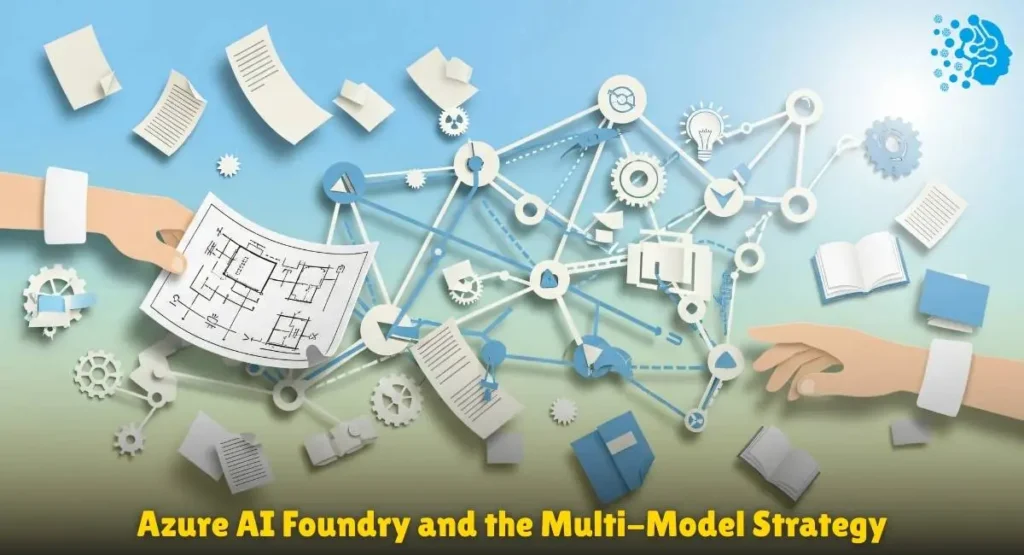
Perhaps the most surprising strategic pivot revealed in Microsoft AI news today is the company’s embrace of a “multi-model” future. For years, Microsoft was seen as the “OpenAI shop“, exclusively betting on the GPT family of models. However, the 2026 strategy is decidedly pragmatic and heterogeneous.
The Anthropic Alliance
In a move that acknowledges the diverse needs of its customers, Microsoft has integrated Anthropic’s Claude models (including Claude 3.5 Sonnet and Claude Opus 4.5) directly into Azure AI Foundry (formerly Azure AI Studio).
Why would Microsoft host a competitor’s models? The answer lies in utility. Different models excel at other things. While GPT-5.2 is a generalist powerhouse, many developers prefer Claude 3.5 Sonnet for coding tasks due to its nuanced understanding of complex instructions and a large context window. By offering Claude on Azure, Microsoft prevents “vendor flight.” Developers who might have left the Azure ecosystem to use Anthropic’s API directly can now stay within Microsoft’s walled garden.
Model-as-a-Service (MaaS)
This strategy positions Azure not just as a cloud provider, but as a “Model-as-a-Service” marketplace. Through Azure AI Foundry, an enterprise developer can build a single application that routes different queries to different models based on cost and capability.
- Scenario: A customer service bot might use GPT-5.2 Instant for simple greeting and routing (low cost, high speed).
- Scenario: If the user requests a complex refund calculation based on a 50-page contract, the app can seamlessly switch to Claude Opus 4.5 or GPT-5.2 to perform the complex reasoning.
This flexibility is governed by the same Agent 365 control plane, meaning that regardless of whether the bot uses OpenAI or Anthropic, the data remains secure, compliant, and within the corporate tenant. This “governance wrapper” is Microsoft’s true competitive moat.
Google Gemini in GitHub?
In an even more striking example of “coopetition,” reports indicate that GitHub Copilot is integrating Google’s Gemini 3 Flash model for specific low-latency tasks. Gemini 3 Flash is optimized for extreme speed, making it ideal for the “autocomplete” function in a code editor, where milliseconds matter. This hybrid approach—using a Google model inside a Microsoft product to improve the user experience—epitomizes the mature, pragmatic phase of AI adoption we are entering in 2026.
5. The Physical Layer: A $23 Billion Bet on Global AI Infrastructure

Software advances are meaningless without the physical hardware to run them. The “Thinking” models and autonomous agents require immense computational power. Microsoft AI news today highlights a staggering financial commitment to building the physical backbone of the AI age: over $23 billion in new infrastructure investments announced in December 2025 alone.
The India Hyperscale Strategy ($17.5 Billion)
Microsoft is making its largest-ever play for the Asian market with a $17.5 billion investment in India. This capital is not just for generic cloud servers; it is targeted at building the “AI factories” of the future.
- Hyderabad Hyperscale Region: A massive new data center region is being constructed in Hyderabad, scheduled to come online in 2026. This facility is designed specifically for high-density AI workloads, likely employing liquid cooling and next-generation energy infrastructure to support clusters of NVIDIA and custom Microsoft silicon
- Workforce Skilling: Hardware is useless without people to use it. Microsoft has doubled its commitment to the region, pledging to train 20 million people in AI skills by 2030. This “Advanta(i)ge India” initiative is a long-term strategic play to create a massive workforce of developers and engineers native to the Azure ecosystem.
- Sovereign Cloud: The investment also focuses on “sovereign” capabilities, ensuring that data generated in India stays in India. This is a response to the Indian government’s increasing focus on data localization and digital sovereignty.
The Canada Trust Strategy (C$7.5 Billion)
Simultaneously, Microsoft is investing C$7.5 billion (approx $5.3B USD) in Canada. While smaller in raw dollar terms than the India deal, this investment is critical for the North American market. It focuses heavily on Digital Sovereignty and Trust.
- Resilience and Security: The Canadian investment includes a “five-point plan” to protect national digital sovereignty. This is particularly important for public sector, healthcare, and financial services clients who are legally or ethically bound to keep sensitive citizen data within national borders.
- Latency Reduction: By building more capacity in Eastern and Western Canada, Microsoft is also reducing the latency for its “Thinking” models. For an autonomous agent to feel “real-time,” the physical distance between the user and the inference server matters.
Table 2: Global Infrastructure Investment Breakdown (Dec 2025)
Region | Investment Amount | Key Focus Areas | Strategic Goal |
India | $17.5 Billion (USD) | Hyperscale Data Centers (Hyderabad), Skilling (20M people) | Capture the world’s largest growing developer & user base. |
Canada | $7.5 Billion (CAD) | Sovereign Cloud, Digital Resilience, Cybersecurity | Secure public sector & regulated industry dominance. |
Global | (Ongoing) | Custom Silicon (Cobalt/Maia), Green Energy | Reduce dependency on NVIDIA, achieve carbon negativity. |
6. Generative Gameplay: How "Muse" is Rewriting the Rules of Interactive Entertainment

While enterprise tools dominate the headlines, Microsoft AI news today also showcases a breakthrough in the creative sector that could be just as transformative. Microsoft Research, in collaboration with its Xbox studio Ninja Theory, has unveiled Muse, a first-of-its-kind “World and Human Action Model” (WHAM).
From Rendering Pixels to Rendering Actions
Most generative AI models for video (like OpenAI’s Sora) operate on the level of pixels—they predict what the next frame should look like. Muse operates on a deeper level: it predicts action and physics. Trained on seven years of gameplay data from the combat game Bleeding Edge, Muse understands the mechanics of a 3D world.
It doesn’t just generate a video of a character jumping; it simulates the gameplay of a character jumping. It understands gravity, collision detection, and controller inputs. If a user inputs “move forward and attack,” Muse generates a sequence where the character performs those actions in a way that is consistent with the game’s rules, not just its visuals.
Revolutionizing Game Development
This technology has profound implications for the $200 billion gaming industry:
- Rapid Ideation & Prototyping: Designers can now “play” a game that doesn’t exist. By prompting Muse with a concept (e.g., “a sci-fi samurai fighting a robot in a neon city”), they can generate a playable snippet in seconds. This collapses the prototyping phase from weeks of coding to minutes of prompting.
- Preservation & Remastering: Microsoft is exploring the use of Muse to “optimize” back-catalog games. By teaching the model the logic of an old Xbox 360 title, it could theoretically regenerate the game’s visuals and mechanics for modern 4K hardware without requiring access to the original, often lost, source code. This could be the “Holy Grail” of game preservation.
- Open Innovation: In a break from the closed nature of many AI projects, Microsoft has open-sourced Muse’s model weights and datasets on Azure AI Foundry. This allows academic researchers and indie developers to experiment with generative gameplay, potentially sparking a wave of innovation similar to what Stable Diffusion did for 2D art.
7. The Security Paradox: AI as Both Guardian and Risk Vector
As AI agents become more powerful, they also become more dangerous potential vectors for attack. Microsoft’s response to this “Security Paradox” is to fight fire with fire, or rather, to fight AI with AI.
The Speed of Defense: Reducing MTTR
In cybersecurity, the most critical metric is Mean Time To Respond (MTTR). When a breach occurs, every second counts. Human analysts, no matter how skilled, have biological limits on how fast they can parse logs and analyze headers.
Security Copilot agents shatter these limits. New data reveals that SOC (Security Operations Center) analysts using these agents can detect and triage malicious emails 550% faster than those using manual tools.
- The Phishing Triage Agent: This agent automatically intercepts suspicious emails reported by users. It parses the headers, checks the sender’s reputation against global threat intelligence, “detonates” any attachments in a secure sandbox to check for malware, and then recommends a remediation strategy (e.g., “Quarantine email and block sender domain”).
- The Identity Agent: Working within Microsoft Entra, this agent scans for misconfigurations in Zero Trust policies. It has demonstrated 204% greater accuracy than human audits in identifying gaps where a user has more access than they need.
Democratizing the SOC
By bundling these advanced capabilities into Microsoft 365 E5 licenses, Microsoft is effectively democratizing high-end cyber defense. Small security teams at regional banks or hospitals, who cannot afford a 24/7 team of elite threat hunters, can now leverage these AI agents to perform the heavy lifting of threat detection. This levels the asymmetric playing field between attackers (who use AI to generate attacks) and defenders.
8. Human-AI Symbiosis: Insights from the 2025 Copilot Usage Report
Beyond the technology and the money, Microsoft AI news today offers a rare glimpse into the human side of this revolution. The Copilot Usage Report 2025, based on the analysis of 37.5 million de-identified conversations, reveals fascinating shifts in user behavior.
This shift is especially visible in healthcare, where AI is already transforming at-home care and remote monitoring.
The “Work Hard, Play Hard” Split
The data shows a distinct “crossover” event that occurs every week.
- Monday – Friday: Queries are dominated by Programming, Technical Writing, and Data Analysis. Usage peaks between 9 AM and 5 PM, mirroring the standard workday.
- The Weekend Shift: As soon as Friday evening hits, “Programming” drops off a cliff, replaced almost perfectly by Gaming queries.
This data point is significant because it suggests users view AI not just as a work tool (like Excel), but as a versatile utility that spans their entire life. They trust the same assistant to debug their Python code on Tuesday and help them beat a boss in Elden Ring on Saturday.
The 3 AM Philosophy Club
One of the most poignant findings is the temporal shift in emotional usage. While daytime queries are transactional and functional, queries made between 2 AM and 4 AM shift dramatically toward Philosophy, Religion, and Personal Growth 30
This suggests a rising phenomenon where AI is serving as a confidant or sounding board for existential thoughts when a human connection is unavailable. It raises profound ethical questions about the role of AI in mental health and the responsibility Microsoft has to ensure these “late-night” interactions are safe and supportive.
Mobile = Health
On mobile devices, the number one topic consistently—across every month and every time of day—is Health. Users are treating their mobile AI as a first-line triage nurse, a nutritionist, and a wellness coach. This reliance on AI for health advice highlights the critical need for the “fact-checking” capabilities of the GPT-5.2 “Thinking” model. In a health context, a hallucination is not just a bug; it is a safety hazard.
9. The Friction of Progress: Windows 11 Integration, Privacy, and User Pushback
No report on Microsoft AI news today would be honest without addressing the friction points. The aggressive integration of AI into Windows 11 continues to spark significant debate and resistance from a segment of the user base.
The “Bloatware” Debate and the Right to Remove
Microsoft views Copilot as a core system component, as fundamental to Windows as the Start Menu or File Explorer. Consequently, recent updates (specifically the 24H2 and 25H2 builds) have made it difficult to uninstall or disable AI features.
- The Backlash: This has led to a cat-and-mouse game between Microsoft and privacy-conscious users. Scripts and third-party tools (like “Recall Removers“) have surfaced in the tech community, allowing users to forcibly strip AI components from the OS.
- LG TV Controversy: This friction even extended to the living room, with LG TV owners discovering a “Copilot” app installed on their screens without permission via a firmware update. While LG clarified it was merely a web shortcut, the incident highlighted the public’s sensitivity to forced AI adoption.
The “Recall” Controversy
The feature known as Recall, which takes periodic snapshots of a user’s screen to create a searchable photographic memory, remains a lightning rod. While Microsoft has pivoted to making it an opt-in feature with enhanced security (following intense security research feedback), it serves as a proxy for the broader fear of “surveillance capitalism”. The Copilot Usage Report finding that AI agents access millions of records per company reinforces the validity of these concerns. For widespread adoption to continue, Microsoft must constantly prove that its “Agent 365” governance is robust enough to protect this massive trove of data.
10. The Frontier Firm: 2026 Predictions and the New Definition of Work
Looking ahead to 2026, the Microsoft AI news today paints a picture of a radically different corporate landscape. The WorkLab research identifies the emergence of the “Frontier Firm“, a new breed of organization that has successfully navigated the transition to the Agentic Era.
For a broader look at the technologies shaping 2026, explore our full breakdown of the latest AI updates.
Predictions for 2026
- The Death of the “Digital Divide,” The Birth of the “Agentic Divide”: The gap will no longer be about who has access to the internet, but who has access to high-quality autonomous agents. Firms that master the “delegation” of work to AI will operate at a velocity that traditional firms cannot match.
- The “Three-Person Global Firm”: Microsoft executives predict that by 2026, we will see the rise of “micro-multinationals“, teams of just 3-5 humans who use a fleet of AI agents to run a global operation (handling logistics, translation, legal, and customer support) that used to require hundreds of employees.
- Management as “Agent Orchestration”: Middle management will evolve. The job will shift from managing human schedules to orchestrating agent workflows. Managers will be judged on their ability to configure Agent 365 policies, optimize agent performance, and ensure human-AI alignment.
Conclusion: The Pivot Point
Microsoft AI news today confirms that we are at a pivot point. The novelty phase of AI is over. The “Chat Era” is ending. We are entering the “Infrastructure and Agency” phase.
The pieces are all connecting:
- The $23 Billion Infrastructure provides the raw power.
- The GPT-5.2 & Claude Models provide reasoning intelligence.
- The Agent 365 Control Plane provides the necessary governance.
- The $21 Pricing ensures ubiquitous access.
For the technology leader, the message is clear: The tools to build the “Frontier Firm” are now available. The challenge for 2026 is not technological, but organizational—having the courage to reimagine work for a world where the software doesn’t just listen, but acts.
For ongoing developments beyond today’s report, see our latest Microsoft AI news coverage.
FAQs
1. What is the difference between standard Microsoft Copilot and the new “Agent Mode”?
Standard Copilot answers questions and drafts content, while Agent Mode autonomously plans, executes, and verifies multi-step tasks, acting like a digital employee rather than a chat assistant.
2. How much does the new Microsoft 365 Copilot Business plan cost?
Microsoft 365 Copilot Business now costs $21 per user/month for SMBs (down from $30), available with eligible Microsoft 365 Business plans for up to 300 users.
3. What is Microsoft Agent 365, and why do IT admins need it?
Agent 365 is a centralized control system that lets IT teams manage, secure, and govern all AI agents, preventing AI sprawl and unauthorized access.
4. Is GPT-5.2 available in Microsoft Copilot yet?
Yes. GPT-5.2 is rolling out in Microsoft 365 Copilot, offering Instant mode for speed and Thinking mode for deep reasoning and complex tasks.
5. What is the “Muse” AI model mentioned in recent news?
Muse is Microsoft’s generative gaming AI that understands physics and player actions, allowing developers to generate playable gameplay—not just videos.
6. Can I use Anthropic’s Claude models in Microsoft Azure?
Yes. Claude models are available via Azure AI Foundry, enabling developers to use Anthropic AI with Microsoft’s security, billing, and governance.
7. How does the new “Security Copilot” in Microsoft Defender help stop attacks?
Security Copilot automates threat analysis using AI agents, allowing security teams to detect and respond to attacks up to 550% faster.
8. What specific investments is Microsoft making in India and Canada?
Microsoft announced $17.5B in India for AI data centers and skilling, and C$7.5B in Canada focused on digital sovereignty and infrastructure.
9. What did the “Copilot Usage Report 2025” reveal about AI usage?
The report found mobile users mostly ask about health, while late-night desktop queries shift toward philosophy and personal growth.
10. Can I remove Copilot from Windows 11 if I don’t want it?
Officially, Copilot is deeply integrated into Windows 11, though third-party tools can disable it; features like Recall are now opt-in due to privacy concerns.
Conclusion
Microsoft AI news today paints a picture of a company aggressively pivoting from “experimentation” to “deployment.” The novelty of chatting with a bot has faded; 2026 is about agents that do work. The pieces are all connecting: Infrastructure ($23B investment) powers the Models (GPT-5.2/Claude), which fuel the Agents (Copilot/Muse), which are governed by the Control Plane (Agent 365).


TechDecodedly – AI Content Architect. 4+ years specializing in US tech trends. I translate complex AI into actionable insights for global readers. Exploring tomorrow’s technology today.