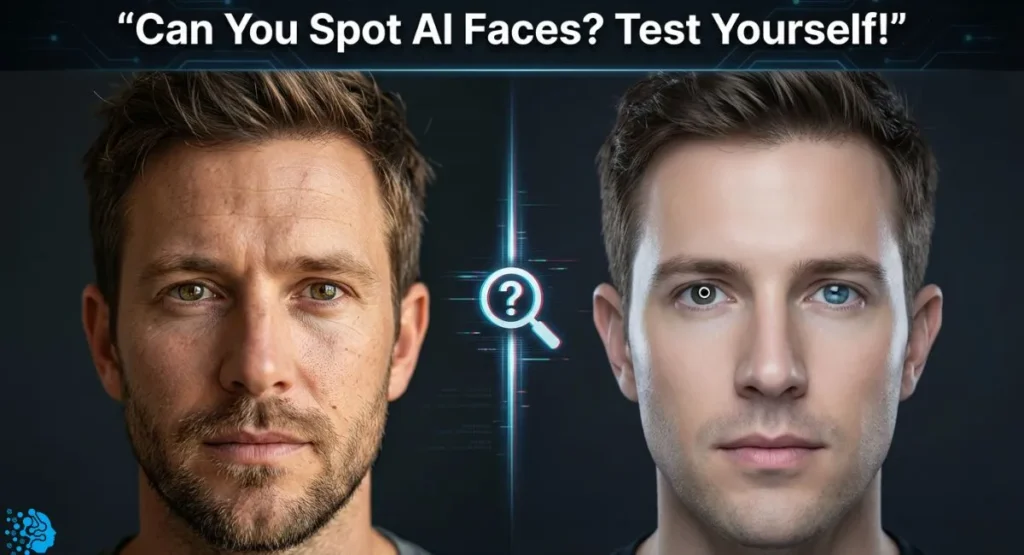
Yes, you can spot AI faces, but it takes attention. Check the eyes, hands, lighting, and facial symmetry. AI-generated images often appear overly perfect or slightly unnatural. With basic practice and simple checks, most people can learn to detect fake faces. In this article, you’ll learn how to spot AI-generated faces by identifying subtle visual clues that most people miss.
- Why Spotting AI-Generated Faces Matters in 2025
- How AI Creates Hyper-Realistic Faces Today
- Common Visual Clues in AI-Generated Faces
- The Role of Hands and Body in Detection
- Lighting and Reflections: Subtle Giveaways
- Training Your Brain to Spot Fakes
- Tools and Apps for AI Face Detection
- 2025 Advancements Making Detection Harder
- Ethical Implications of AI Faces
- Practical Tips to Avoid Falling for Fakes
- Real-World Case Studies from 2025
- Future Trends: AI vs. Detection in 2026+
-
FAQs
- How accurate are humans at spotting AI-generated faces?
- What are the best free tools for detecting fake faces?
- Why do AI-generated hands look weird?
- Can AI faces be used ethically?
- What's new in AI face generation for 2025?
- How do reflections help detect fakes?
- Are super-recognizers better at this?
- What risks does undetected AI pose?
- How can I train to spot AI faces?
- Will detection tools keep up in 2026?
- Conclusion
Why Spotting AI-Generated Faces Matters in 2025
Spotting AI-generated faces isn’t just a fun quiz; it’s crucial for media trust and security. Deepfakes fueled misinformation in the 2024 elections, and with models like Gemini 3 rolling out in 2025, fakes are harder to catch.
Fraudsters use AI faces for scams, costing billions yearly. A 2025 study from Swansea University shows that AI-generated images can fool 67% of viewers, eroding trust in photos.
Consider social media: a single fake profile photo can lead to identity theft. As AI evolves, knowing these signs protects your wallet and worldview.
Also read: Is there an AI with no restrictions, and why does it raise serious risks
How AI Creates Hyper-Realistic Faces Today
AI generates faces using generative adversarial networks (GANs), where one network generates images and another criticizes them until they’re convincing. In 2025, tools like StyleGAN3 produce faces indistinguishable at first glance.
Models are trained on large datasets of real photos, learning features such as skin texture and facial expressions. Google’s Veo 3.1 advances this with multimodal inputs, blending text, images, and video for lifelike results.
But flaws persist. AI struggles with physics, like consistent lighting. A funny anecdote: I once mistook an AI-generated celeb for real until spotting mismatched earrings, a classic GAN glitch.
Read more: How AI-powered research and development is driving realistic AI generation
Common Visual Clues in AI-Generated Faces
Look for asymmetries first. AI often misaligns the ears, eyes, or teeth. A 2025 Phys.org report notes unusual hairlines and misshapen features as top giveaways.
Eyes tell tales, too. Real ones show natural reflections; AI versions might have inconsistent glints. PCMag highlights this in their 2025 guide: check for odd iris shapes.
Backgrounds and skin? Blurry edges or unnatural smoothness scream fake. Humorously, AI faces sometimes look “too perfect,” like airbrushed magazine covers gone wrong.
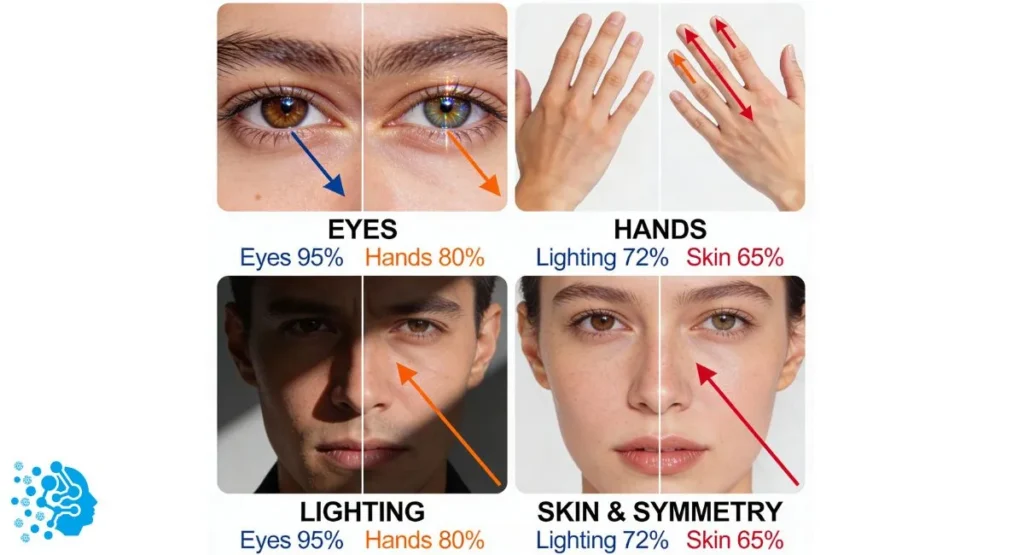
Visual Guide: How to Spot AI-Generated Faces - Real vs. AI Comparisons
Clue | Real Face Example | AI Face Tell |
Ears | Symmetrical, detailed lobes | Mismatched sizes or shapes |
Eyes | Consistent reflections | Uneven glints or odd pupils |
Teeth | Natural alignment | Gaps or floating edges |
Hair | Realistic strands | Clumpy or unnatural flow |
The Role of Hands and Body in Detection
Hands are AI’s Achilles heel. Fingers often merge, bend oddly, or multiply. CanIPhish’s 2025 analysis shows 80% of AI videos fail here due to complex anatomy.
Bodies follow suit. Proportions may skew, such as elongated necks. In a TED Talk, Hany Farid demonstrates how AI struggles to capture natural poses.
Next time you see a photo, zoom on the hands. It’s logical: AI trains less on extremities. Anecdote: A friend shared a “viral” meme; the six-fingered hand gave it away instantly.
Lighting and Reflections: Subtle Giveaways
Lighting inconsistencies expose fakes. Real photos have uniform shadows; AI might mix sources oddly. A 2025 University of Leeds study found that eye reflections often do not match the environment.
Check eyeballs for coherent light patterns. Tools like DetectGPT analyze this, but your eye can spot basics. It’s like detective work, yet practical.
In 2025, with Sora 2 advancing video, static images still lag. Logic: Physics simulation isn’t perfect yet.
Training Your Brain to Spot Fakes
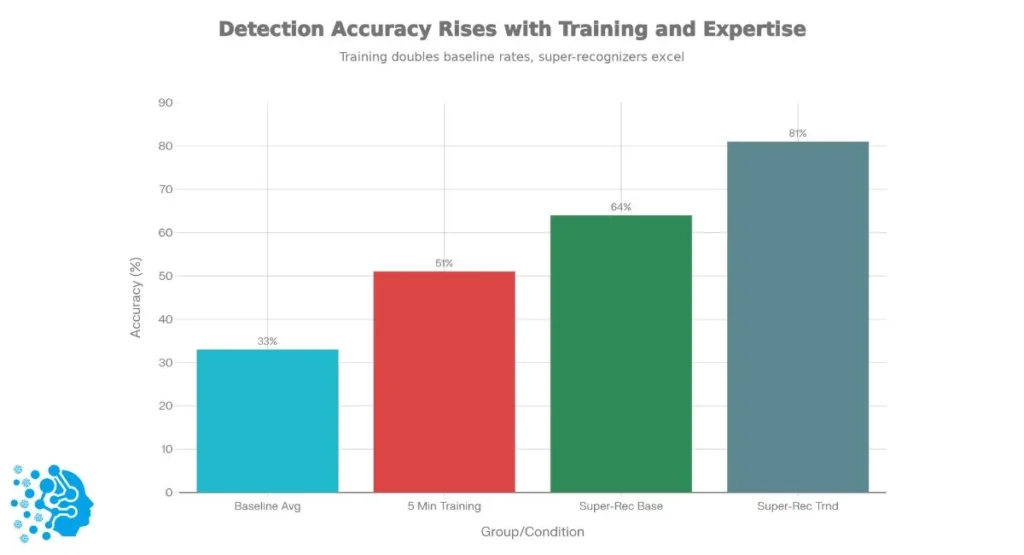
Human Detection Accuracy: From Baseline to Trained Super-Recognizers
You can train to detect AI faces in minutes. A Royal Society study shows that five minutes boosts accuracy from 33% to 51% for the average person and from 64% to 81% for super-recognizers.
Practice with quizzes: Metro’s 2025 interactive test uses real vs. AI pairs.
Step-by-step:
- Study real faces daily.
2. Compare with AI generators like Midjourney.
3. Note patterns. It’s engaging, like a game, and sharpens real-world skills.
Tools and Apps for AI Face Detection
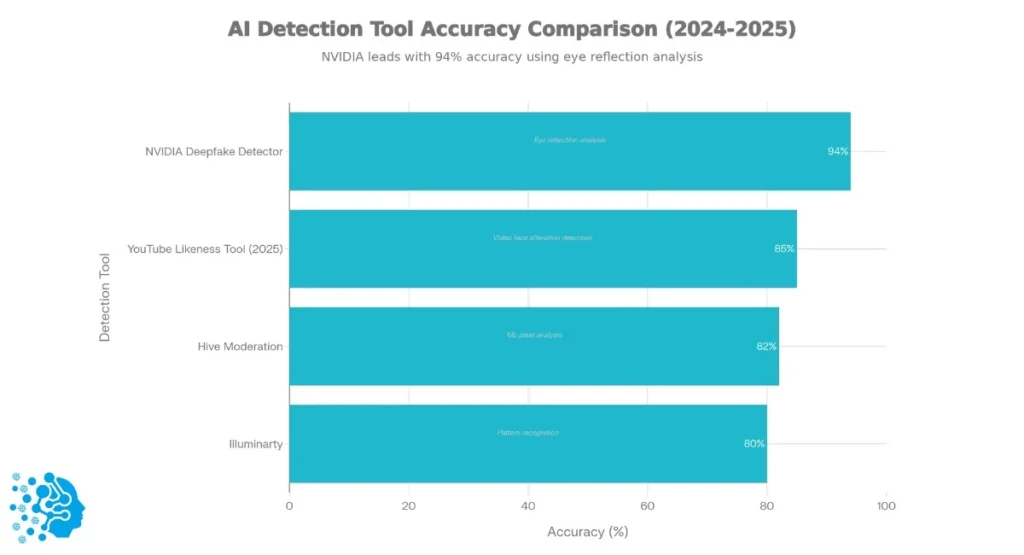
AI Detection Tools: Accuracy Comparison & Key Capabilities
Tech helps where eyes fail. NVIDIA’s Deepfake Detector identifies fakes with 94% accuracy via eye reflections.
YouTube’s 2025 likeness tool scans videos for altered faces. Free apps like Hive Moderation use ML for quick checks.
For pros, Sardine’s system detects partial morphing. Anecdote: I tested a family photo app, confirmed real, easing my paranoia.
- Top Tools: Hive, Illuminarty, FakeCatcher.
- Pros: Fast, accurate.
- Cons: Evolving AI beats some.
2025 Advancements Making Detection Harder
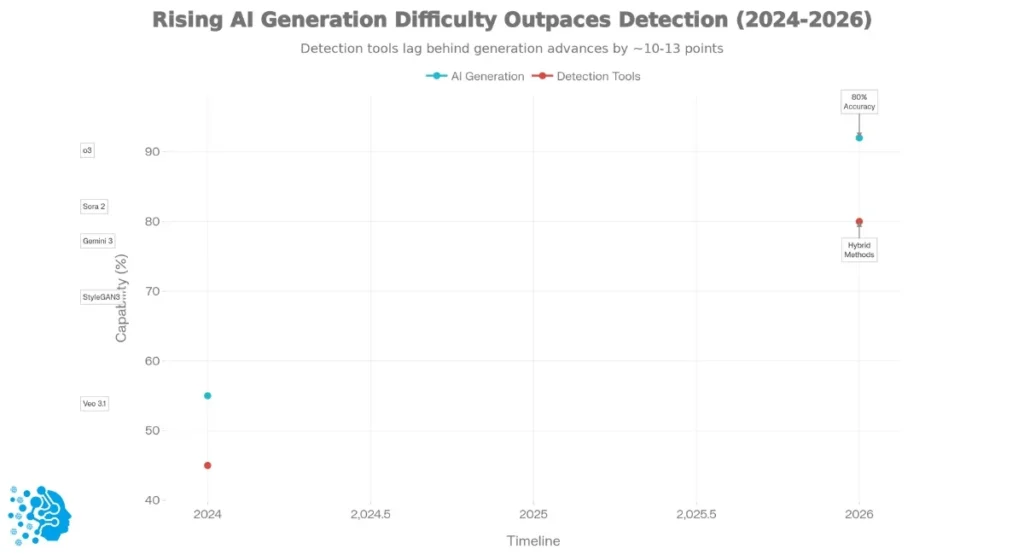
AI Generation vs. Detection Capability: The 2024-2026 Arms Race
AI face generation leaps in 2025. OpenAI’s o3 model enhances reasoning for realistic expressions. Meta’s datasets speed material discovery, indirectly improving textures.
But detection evolves, too. Hugging Face’s models help identify inconsistencies.
Future: By 2026, multimodal detectors that combine audio and video will dominate. Logic: As generation improves, hybrid checks win.
Ethical Implications of AI Faces
AI faces raise privacy woes. HeyGen’s tools cut video costs by 80% but pose a risk of misuse through deepfakes.
Laws lag: 2025 sees OpenAI allow military use, sparking debates. Trust erodes when fakes spread.
Humor: Imagine catfishing with perfect AI romance scams gets weirder. But seriously, ethical AI demands watermarks and transparency.
Also read: AI regulation news covering the most critical updates shaping AI use
Practical Tips to Avoid Falling for Fakes
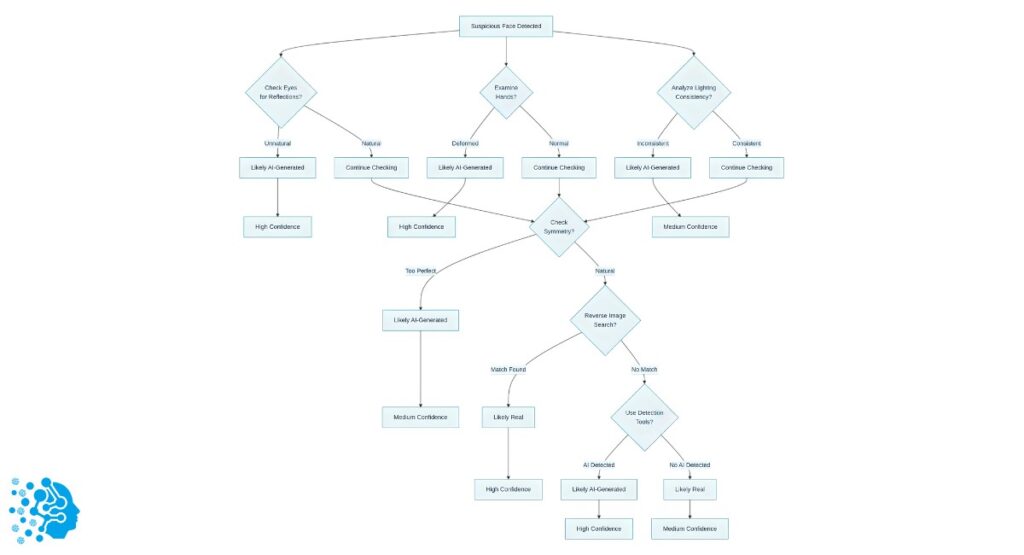
AI Face Detection Decision Tree: Step-by-Step Verification Process
Start simple: run a reverse image search on Google. If it points to AI sites, flag it as a red flag.
Cross-check sources. AML Intelligence lists signs such as unusual backgrounds.
For daily use: Train with Reddit quizzes.
Step-by-step:
1. Zoom in.
2. Check symmetries.
3. Use tools. Stay vigilant, it’s your best defense.
Real-World Case Studies from 2025
In 2025, a viral political deepfake fooled millions until its hands gave it away. Farid’s TED analysis exposed it.
Another: Beauty apps like API4AI’s virtual try-ons use clean face detection, reducing returns by improving realism.
Anecdote: A marketer I know used AI faces for ads, boosted engagement 30%, but transparency built trust.
Future Trends: AI vs. Detection in 2026+
By 2026, diffusion models for text-to-face will refine outputs. Open-source like Mistral democratizes tools.
Detection counters with hybrid human‑AI detection. Livescience predicts 80% accuracy with combined approaches.
Exciting? Yes, but prepare: AI agents in daily life mean constant vigilance.
Read more: US AI regulation updates to watch as 2026 approaches
FAQs
How accurate are humans at spotting AI-generated faces?
Most detect only 33%, but training increases it to 51-64% by 2025, according to studies.
What are the best free tools for detecting fake faces?
Try Hive Moderation or Illuminarty—they analyze pixels and patterns quickly.
Why do AI-generated hands look weird?
AI struggles with complex anatomy; datasets lack enough hand variations.
Can AI faces be used ethically?
Yes, in marketing, such as HeyGen’s videos, but always disclose to build trust.
What’s new in AI face generation for 2025?
Models such as Gemini 3 and Veo 3.1 enhance multimodality and realism.
How do reflections help detect fakes?
Real eyes show consistent lighting; AI often mismatches, according to NVIDIA tools.
Are super-recognizers better at this?
Yes, they achieved 64% accuracy post-training, outperforming the average.
What risks does undetected AI pose?
Misinformation, scams, and eroded trust in media—seen in recent elections.
How can I train to spot AI faces?
Use quizzes from Metro or Reddit; practice 5 minutes daily.
Will detection tools keep up in 2026?
Hybrid human-AI methods should, as open-source advances rapidly.
Conclusion
Spotting AI faces is becoming a critical digital skill. As AI grows more realistic in 2026, combining human awareness with detection tools will matter more than ever. Stay alert, practice often, and question what you see to protect yourself from misinformation and scams.



I’m Fahad Hussain, an AI-Powered SEO and Content Writer with 4 years of experience. I help technology and AI websites rank higher, grow traffic, and deliver exceptional content.
My goal is to make complex AI concepts and SEO strategies simple and effective for everyone. Let’s decode the future of technology together!