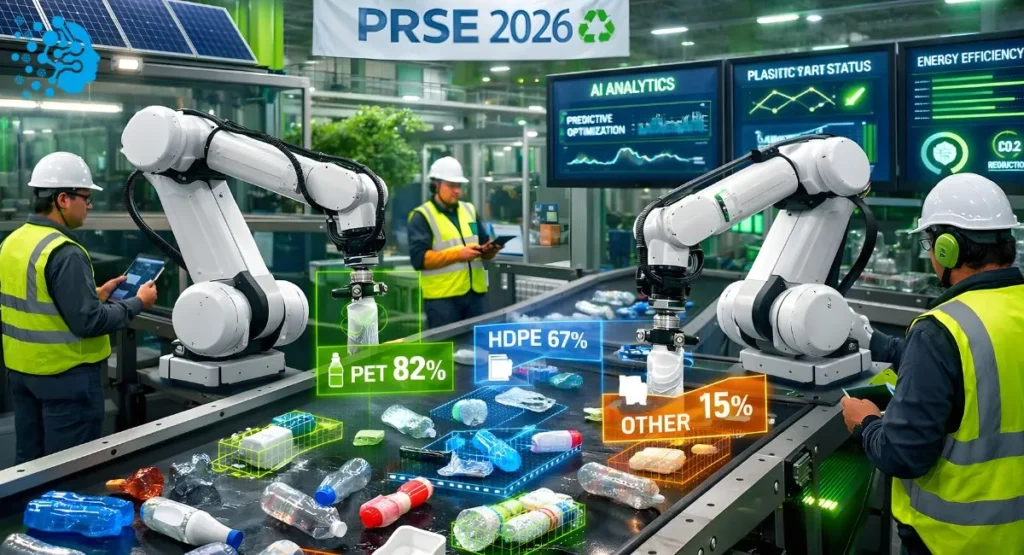
The AI Innovation Hub at PRSE 2026 showcases how artificial intelligence is transforming plastic recycling, delivering faster sorting, higher recovery rates and lower emissions. Discover why this showcase matters and how it will reshape the industry for manufacturers, recyclers and investors alike, similar to how AI models drive efficiency in business planning.
- What Is the AI Innovation Hub and Why It Matters
- How AI‑Powered Vision Systems Improve Sorting Accuracy
- Predictive Maintenance Reduces Unplanned Downtime
- Closed‑Loop Data Platforms Enable Real‑Time Process Control
- AI Detects Contamination That Human Eyes Miss
- Energy Optimisation Lowers Carbon Footprint and Costs
- Workforce Upskilling Turns AI Into an Enabler
- Regulatory Landscape Drives AI Adoption
- Investment Trends Signal Strong Market Confidence
- Emerging Technologies Set the Stage for Future Shows
-
Frequently Asked Questions
- What is the AI Innovation Hub?
- How does AI improve sorting accuracy?
- Can AI reduce operational costs?
- Is AI safe for the environment?
- Do I need a data‑science team to adopt AI?
- What regulatory requirements affect AI adoption?
- How quickly can AI be integrated?
- Will AI replace workers?
- What ROI can I expect?
- Where can I learn more?
- Conclusion
- Trusted Sources and References
What Is the AI Innovation Hub and Why It Matters
The AI Innovation Hub is a dedicated exhibition space inside Plastics Recycling Show Europe 2026, held May 5‑6 at RAI Amsterdam. It brings together startups, research labs and industry leaders to demonstrate AI tools that automate, optimise and upscale plastic‑waste processing, echoing strategies seen in AI-driven recruitment solutions. The hub matters because global plastic waste is projected to reach 380 million tons by 2026, and traditional recycling struggles with contamination, sorting speed and feed‑stock variability. AI promises to cut processing time by up to 30 percent and improve material recovery rates by 15‑20 percent, according to a 2025 McKinsey report.
Companies such as AMP Robotics, Tomra and Siemens are presenting vision systems, predictive maintenance models and closed‑loop data platforms, highlighting how startups are being empowered by venture funds like Vanagon’s €20M talent boost. The hub functions as a live laboratory where theory meets the factory floor, allowing visitors to see real‑time performance data and understand how AI can become a profit centre for recycling operations.
How AI‑Powered Vision Systems Improve Sorting Accuracy
AI‑powered vision systems use high‑resolution cameras and deep‑learning algorithms to classify plastics by resin type, colour and additive composition. Within milliseconds the system directs robotic arms to divert each item to the correct stream, achieving sorting accuracies above 95 percent.
AMP Robotics reported a 28 percent increase in PET recovery at a Dutch pilot plant after deploying its AI sorter in 2025. Tomra’s AI‑enhanced system reduced mis‑sort rates from 8 percent to 2 percent, generating €1.2 million in annual savings for a mid‑size recycler. These results demonstrate that AI is not a peripheral add‑on but a core technology that directly boosts revenue and material quality.
Predictive Maintenance Reduces Unplanned Downtime
Unplanned downtime can cost a recycler between €150,000 and €300,000 per hour. Predictive maintenance uses sensor data vibration, temperature and power draw to feed cloud‑based analytics platforms that forecast component wear before failure occurs.
A German facility that adopted Siemens’ MindSphere platform cut unplanned downtime by 45 percent, freeing 3,200 hours of production per year. By scheduling maintenance only when models predict degradation, plants avoid costly emergency repairs and keep production lines operating at peak efficiency.
Closed‑Loop Data Platforms Enable Real‑Time Process Control
Closed‑loop data platforms integrate collection, sorting, processing and product‑design information into a single dashboard. Real‑time feedback allows operators to adjust sorting thresholds, improving material purity from 85 percent to 93 percent in Tomra’s pilot.
These platforms also provide supply‑chain transparency, enabling brands to trace recycled content back to its source and meet ESG reporting standards. Dynamic pricing algorithms use AI to predict market demand for specific recycled grades, allowing recyclers to optimise sale timing and maximise profit.
AI Detects Contamination That Human Eyes Miss
Contamination from food residue, oil or non‑plastic items reduces the quality of recycled streams. Computer‑vision models trained on millions of labeled images can spot contaminants as small as 2 mm, while spectroscopy‑AI hybrids identify polymer blends invisible to visual systems.
A pilot in Spain integrated an AI‑driven near‑infrared scanner and achieved a 12 percent reduction in contamination, resulting in €500,000 higher revenue per annum. By removing invisible impurities, AI improves the market value of recycled material and supports higher‑grade applications.
Energy Optimisation Lowers Carbon Footprint and Costs
Recyclers face the dual challenge of reducing emissions while increasing throughput. AI‑driven dynamic load balancing adjusts motor speeds based on real‑time feed characteristics, cutting electricity use by 18 percent in a Siemens case study from 2024.
Predictive heat‑recovery optimisation matches furnace temperatures with feedstock calorific value, saving 2–3 percent of total energy consumption. The combined effect is a more sustainable operation that also improves the bottom line, aligning environmental goals with profitability.
Workforce Upskilling Turns AI Into an Enabler
A common myth is that AI will eliminate jobs. In practice, AI augments staff by turning operators into supervisors who monitor dashboards rather than manually sorting. Data scientists collaborate with engineers to fine‑tune models, creating new specialised roles.
Training programs highlighted at PRSE include the Ellen MacArthur Foundation’s “AI for Circularity” bootcamp, which equipped 150 recyclers with basic machine‑learning skills in 2025. TU Delft’s “Smart Recycling” curriculum now includes a mandatory AI ethics module, ensuring responsible deployment across the sector.
Regulatory Landscape Drives AI Adoption
The EU Circular Economy Action Plan (2023‑2026) mandates recycled‑content quotas for packaging, 30 percent by 2026, and imposes data‑sharing obligations for recyclers handling more than 10,000 tons per year. AI platforms that provide transparent, auditable data give companies a compliance advantage.
In the United States, the American Plastics Council introduced a voluntary AI‑assisted reporting framework in 2025, encouraging early adopters to showcase reduced landfill diversion rates. Aligning AI solutions with regulatory requirements accelerates market acceptance and reduces legal risk.
Investment Trends Signal Strong Market Confidence
Venture capital poured $1.2 billion into AI‑focused recycling startups between 2023 and 2025, according to PitchBook. Corporate R&D budgets in the plastics sector grew 22 percent year‑on‑year, with a sizable share earmarked for AI pilots.
The AI Innovation Hub at PRSE 2026 attracted €18 million in on‑site partnership commitments, underscoring investor confidence in the technology’s ability to generate scalable returns.
Emerging Technologies Set the Stage for Future Shows
Edge AI brings inference directly onto sorting devices, eliminating latency and reducing cloud costs, similar to how new device features like those in the iPhone 18 Pro enhance performance at the edge. Generative AI can simulate new recycling line layouts in minutes, accelerating plant design. Digital twins of recycling plants enable real‑time optimisation and predictive scenario testing, while quantum‑enhanced materials discovery promises polymer blends that are easier to recycle.
These emerging technologies are expected to dominate the agenda at PRSE 2027 and beyond, building on the foundations laid by the AI Innovation Hub in 2026.
Frequently Asked Questions
What is the AI Innovation Hub?
It is a dedicated exhibition space at PRSE 2026 where AI‑driven recycling solutions are demonstrated live, allowing visitors to see real‑time performance data and interact with vendors.
How does AI improve sorting accuracy?
AI uses high‑resolution cameras and deep‑learning models to classify plastics by type, colour and additive composition, achieving sorting accuracies above 95 percent and reducing mis‑sort rates dramatically.
Can AI reduce operational costs?
Yes, predictive maintenance, energy optimisation and higher recovery rates can lower costs by 15‑30 percent per plant, delivering a payback period of one to two years for most early adopters.
Is AI safe for the environment?
AI reduces waste and emissions by improving material recovery and energy efficiency, making recycling operations more sustainable and supporting climate goals.
Do I need a data‑science team to adopt AI?
Not necessarily; many vendors offer plug‑and‑play solutions with built‑in analytics, allowing plants to start with minimal internal expertise.
What regulatory requirements affect AI adoption?
The EU mandates recycled‑content quotas and data‑transparency for large recyclers, while the US is introducing voluntary AI‑assisted reporting frameworks.
How quickly can AI be integrated?
Pilot projects can launch in three to six months, with full rollout typically taking twelve to eighteen months depending on plant size and complexity.
Will AI replace workers?
AI augments staff, shifting roles from manual sorting to system supervision and data analysis, creating higher‑skill jobs rather than eliminating them.
What ROI can I expect?
Most early adopters see a return on investment within one to two years, driven by higher recovery rates, lower downtime and reduced energy consumption.
Where can I learn more?
Attend PRSE 2026, explore webinars from the Ellen MacArthur Foundation, and read industry reports from McKinsey and Siemens for deeper insights.
Conclusion
The AI Innovation Hub demonstrates how AI-driven recycling boosts efficiency, reduces emissions, and maximizes profits, making intelligent technology crucial for a sustainable, high-performing future in plastic recycling and circular economy solutions.
Trusted Sources and References
Ellen MacArthur Foundation, “Plastics and the Circular Economy – Deep Dive.”
Siemens, “MindSphere” (industrial IoT and predictive analytics platform).
Tomra Recycling, “AI in Recycling: Unlocking New Possibilities.”
AMP Robotics, “Artificial Intelligence for Recycling” (circular economy case).
PitchBook Data, “AI Startups Dominate Global VC Funding (2025).”



I’m Fahad Hussain, an AI-Powered SEO and Content Writer with 4 years of experience. I help technology and AI websites rank higher, grow traffic, and deliver exceptional content.
My goal is to make complex AI concepts and SEO strategies simple and effective for everyone. Let’s decode the future of technology together!