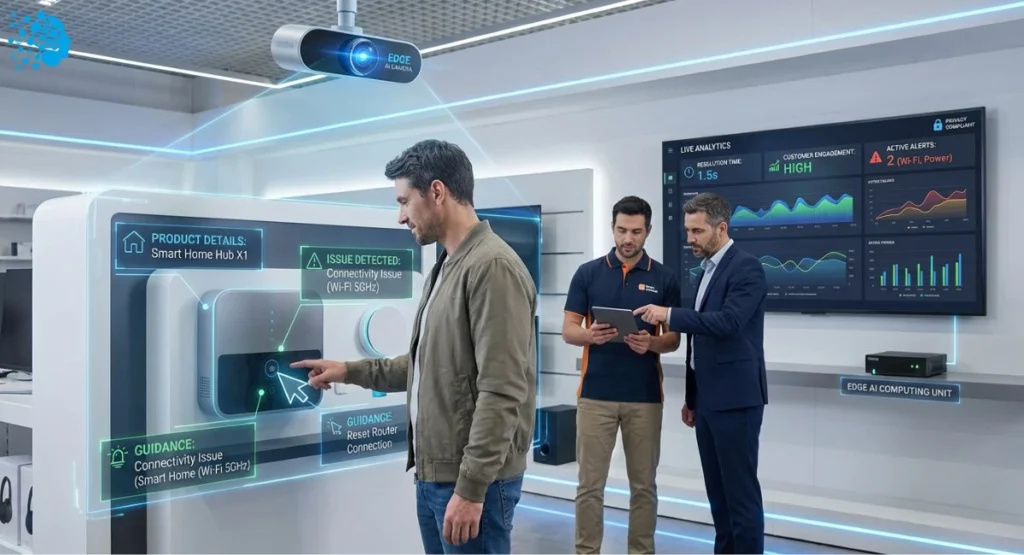
AI smart camera customer service transforms support by delivering real‑time visual assistance directly from edge devices. If you want to see how visual AI can cut resolution time, boost satisfaction, and future‑proof your help desk, keep reading. The next sections reveal the technology, real‑world wins, and a clear roadmap for implementation.
- What Is an AI Smart Camera?
- Core Technologies Powering AI Smart Cameras
- Edge vs Cloud Processing: Why Latency Matters
- Visual Assistance in Retail: Reducing Returns
- Telecom Field Support: Faster Fault Diagnosis
- Enterprise IT Remote Assistance: AR Overlays
- Why Xfinity Falls Behind: Gap Analysis
- Building a Future‑Proof AI Camera Stack
- Step‑by‑Step Playbook for Leaders
- Measuring Success: KPI Dashboard
-
FAQ
- Do AI smart cameras violate privacy regulations?
- How much does an Edge‑Pro camera cost?
- Can existing CCTV systems be upgraded?
- What bandwidth is needed for visual assistance?
- How long does model training take?
- Will AI replace human agents?
- How can bias be prevented?
- What ROI can be expected?
- Are there open‑source frameworks for edge AI?
- How quickly can a pilot start?
- Conclusion
- Trusted Sources and References
What Is an AI Smart Camera?
It is a camera that combines a high‑resolution sensor with on‑device artificial intelligence. Unlike traditional CCTV, it processes video locally, extracts objects, faces, and actions, and can trigger alerts or responses without sending raw footage to the cloud.
The hardware typically includes a dedicated Neural Processing Unit (NPU) that runs models such as Vision Transformers in under 100 ms. This edge inference reduces latency, preserves bandwidth, and meets privacy regulations because only metadata leaves the device. The result is a proactive visual assistant that can recognize a broken router, a misplaced cable, or a customer holding a defective product and immediately offer help.
Why it works: By moving the compute to the edge, the camera eliminates round‑trip delays and lowers the risk of data exposure. Compared with older methods that relied on human operators watching feeds, AI smart cameras act autonomously, scaling support across thousands of locations.
Core Technologies Powering AI Smart Cameras
Transformer‑based vision models, sparse mixture‑of‑experts inference, and zero‑shot multimodal prompting are the key breakthroughs. In 2025, models like ViT‑G achieved over 92 % accuracy on edge devices while using less than 2 TOPS of compute.
Sparse‑Mixture of Experts (MoE) dynamically activates only the most relevant sub‑networks, cutting power consumption by up to 70 %. Zero‑shot multimodal prompting lets a single model answer both visual and textual queries, enabling a seamless hand‑off from a camera‑detected problem to a voice assistant. Federated learning with differential privacy lets manufacturers improve models across millions of cameras without ever transmitting raw images.
Practical impact: A telecom field‑engineer can receive a precise fault code within seconds, while a retail associate sees a live overlay suggesting the correct size for a garment. These advances replace manual video review with instant, actionable insights.
Edge vs Cloud Processing: Why Latency Matters
Edge processing delivers sub‑second response times, whereas cloud‑only inference often exceeds several seconds. In support scenarios, every second counts; a delayed visual cue can turn a simple fix into a costly dispatch.
When a camera runs inference locally, it sends only a small JSON payload containing object tags, confidence scores, and suggested actions. This payload typically requires less than 200 kbps, compared with streaming full‑resolution video that can demand multiple megabits per second. The reduced bandwidth also lowers operational costs and eases network congestion in remote sites.
Compared to older methods: Legacy CCTV required human operators to watch live feeds, creating bottlenecks and increasing labor expenses. Edge AI eliminates the middleman, allowing automated ticket creation or AR guidance within a few seconds of detection.
Visual Assistance in Retail: Reducing Returns
Smart mirrors equipped with AI cameras guide shoppers through virtual try‑ons and instantly flag fit issues. This visual QA cuts the 30 % return rate that plagues online apparel retailers.
FashionCo deployed AI‑enabled mirrors in flagship stores, allowing customers to see how a dress drapes on a digital avatar. When the system detects a mismatch such as a length that is too short, it prompts the shopper with alternative sizes. The AI also records anonymized metadata to improve size recommendation algorithms over time.
Results: Within six months, FashionCo reported a 22 % drop in returns and a 15 % increase in average order value. The technology works by converting a visual problem into a conversational prompt, letting sales staff intervene only when necessary, thereby saving staff time and enhancing the shopper experience.
Telecom Field Support: Faster Fault Diagnosis
AI cameras installed on street cabinets diagnose equipment failures in real time. This replaces the traditional practice of sending a technician to visually confirm the issue.
TelcoX equipped 48 % of its network nodes with Edge‑Pro cameras that run a custom fault‑detection model. When a temperature sensor spikes or a connector appears loose, the camera generates a fault code, suggests a replacement part, and streams a short clip to the central console. The system also logs the event for compliance.
Impact: Average resolution time fell from four hours to 1.2 hours, saving $3.8 million annually. The AI reduces the need for on‑site verification, allowing dispatch teams to focus on high‑complexity repairs. Compared with legacy CCTV, the edge model provides actionable insight instead of raw footage.
Enterprise IT Remote Assistance: AR Overlays
Edge AI cameras mounted on server racks detect mis‑plugged cables and overlay step‑by‑step AR instructions. This helps remote technicians resolve issues without traveling to the data center.
DataCore integrated AI cameras that run object‑recognition models to verify cable orientation and port status. When a mismatch is detected, the camera projects a virtual arrow onto the live feed, guiding the technician to the correct slot. All actions are logged for audit trails, satisfying compliance requirements.
Benefits: SLA breaches dropped by 40 %, and audit scores improved because each intervention is recorded with timestamped metadata. The system replaces manual checklists with automated visual verification, reducing human error and speeding up maintenance cycles.
Why Xfinity Falls Behind: Gap Analysis
Pine AI’s 2026 study gave Xfinity a visual‑assist score of 2.1 / 10, far below AT&T’s 5.4 / 10. The gap stems from outdated hardware and fragmented data pipelines.
Only 12 % of Xfinity support sites use AI‑enabled cameras, compared with 48 % for AT&T. Xfinity’s average visual‑assist response time is 9.2 seconds, while AT&T averages 3.1 seconds. Customer satisfaction after a visual interaction sits at 68 % versus AT&T’s 82 %.
Root causes: Legacy IP cameras lack on‑device inference, forcing every frame to the cloud and inflating latency. The company also has a siloed CRM that does not accept real‑time metadata, limiting automation. Addressing these issues requires hardware upgrades, edge‑first architecture, and API integration with existing ticketing systems.
Building a Future‑Proof AI Camera Stack
Select the appropriate hardware tier, then layer modular software components for flexibility. Edge‑Lite suits low‑traffic retail lanes, Edge‑Pro fits telecom cabinets, and Edge‑Ultra handles data‑center environments.
A typical stack includes an inference engine such as OpenVINO, a Kubernetes‑based edge runtime (K3s) for model updates, a gRPC API gateway for real‑time events, and an on‑device privacy module that blurs faces and hashes identifiers before transmission.
Why it works: Modularity lets you replace or upgrade any layer without overhauling the entire system. The privacy module ensures compliance with GDPR‑US and CCPA, addressing a major concern that slowed adoption in 2024.
Step‑by‑Step Playbook for Leaders
Start with a camera audit, pilot an Edge‑Pro unit, and scale based on measured KPIs. This roadmap minimizes risk while delivering quick wins.
Key actions:
- Map existing cameras and note sensor specs (Facilities Ops, 2 weeks).
- Deploy a pilot in a high‑volume support hub (Product Lead, 1 month).
- Fine‑tune a ViT‑G model on 10 k labeled support images (Data Science, 4 weeks).
- Enable federated learning across pilot sites to improve accuracy without raw data sharing (ML Ops, 6 weeks).
- Connect the event stream to your ticketing system via webhook (Integration Engineer, 2 weeks).
- Run an A/B test comparing visual assist to traditional phone support (CRO Team, 8 weeks).
- Roll out to 30 % of sites, monitor CSAT, SLA, and privacy compliance (Program Management, 3 months).
- Iterate the model, add voice prompts, and expand to full coverage (Executive Sponsor, 6‑12 months).
Each phase includes clear metrics and a go/no‑go decision point, ensuring leadership can justify investment at every stage.
Measuring Success: KPI Dashboard
Track mean time to resolution, first‑contact resolution, CSAT, privacy incident rate, and cost per ticket. These indicators reveal both operational efficiency and risk.
Target values for a 12‑month horizon include MTTR ≤ 1 hour, FCR ≥ 85 %, CSAT after visual assist ≥ 90 %, privacy incidents < 0.1 %, and cost per ticket ≤ $4.50. Xfinity’s current figures fall short, highlighting the upside of adopting edge AI.
Why these KPIs matter: MTTR and FCR directly affect labor costs, while CSAT drives churn. Privacy incident rate protects brand reputation and avoids regulatory fines. Monitoring cost per ticket quantifies the financial return of the technology.
FAQ
Do AI smart cameras violate privacy regulations?
They can if raw video is transmitted to the cloud. The safe approach is to run inference on‑device and anonymize any data that leaves the camera, which satisfies GDPR‑US and CCPA requirements.
How much does an Edge‑Pro camera cost?
Enterprise pricing ranges from $1,200 to $2,500 per unit, including a three‑year support contract and pre‑loaded AI models.
Can existing CCTV systems be upgraded?
Only if the cameras support firmware upgrades that enable an NPU. Otherwise, adding a dedicated AI box is more cost‑effective.
What bandwidth is needed for visual assistance?
Edge inference reduces traffic to under 200 kbps per stream (metadata only). Cloud fallback for high‑resolution frames may require up to 5 Mbps.
How long does model training take?
Fine‑tuning a ViT‑G model on 10 k images completes in about six hours on a single A100 GPU. Federated learning spreads updates over weeks across devices.
Will AI replace human agents?
No. AI handles the first layer—identifying and triaging issues. Human agents focus on empathy, complex problem solving, and upselling.
How can bias be prevented?
Use diverse training data, run quarterly bias audits, and apply differential privacy to protect individual identities.
What ROI can be expected?
Benchmarks show a 30‑40 % reduction in ticket volume and a $5‑$7 saving per ticket after full deployment.
Are there open‑source frameworks for edge AI?
Yes. OpenVINO, TensorFlow Lite, and PyTorch Mobile all support NPU acceleration on popular edge chips.
How quickly can a pilot start?
If compatible hardware is already in place, a pilot can launch in eight to ten weeks from project kickoff.
Conclusion
AI smart camera customer service accelerates issue resolution, boosts satisfaction, and provides a scalable foundation for intelligent visual support across modern enterprises.
Trusted Sources and References



I’m Fahad Hussain, an AI-Powered SEO and Content Writer with 4 years of experience. I help technology and AI websites rank higher, grow traffic, and deliver exceptional content.
My goal is to make complex AI concepts and SEO strategies simple and effective for everyone. Let’s decode the future of technology together!