AI-Powered Research and Development uses artificial intelligence to accelerate innovation, design products, and discover solutions faster and cheaper than traditional methods, reshaping industries from pharmaceuticals to automotive and electronics. In this article, I explain how AI-Powered Research and Development is transforming innovation, making discoveries faster, smarter, and reshaping industries from healthcare to technology.
- Executive Summary: The Dawn of the Cognitive Industrial Revolution
- AI Transforming Global R&D: Breakthroughs Across Industries
- Agentic AI and the Future of High-Velocity R&D
- 1. The Macro-Economic Landscape of AI-Driven Innovation
- 2. The Technological Pillars of the R&D Revolution
- 3. Industry Deep Dive: Pharmaceuticals & Biotechnology
- 4. Industry Deep Dive: Materials Science & Chemistry
- 5. Industry Deep Dive: Automotive & Aerospace
- 6. Industry Deep Dive: Electronics & Semiconductors
- 7. The New R&D Workflow: Agentic AI and Synthetic Users
- 8. Regulatory, Legal, and Ethical Frameworks
- 9. Future Outlook: 2026 and Beyond
- 10. Detailed Appendix: Technologies & Companies Watchlist
-
FAQs
- 1. What is AI-Powered Research and Development?
- 2. How does AI accelerate innovation in R&D?
- 3. Which industries benefit most from AI-driven R&D?
- 4. What is agentic AI in research and development?
- 5. How is AI changing drug discovery?
- 6. What role do digital twins play in AI-powered R&D?
- 7. Can AI replace human researchers in R&D?
- 8. What are autonomous laboratories in AI research?
- 9. What challenges does AI introduce in R&D?
- 10. Why is AI-Powered R&D critical for future innovation?
- Conclusion: The New Art of the Possible
Executive Summary: The Dawn of the Cognitive Industrial Revolution
The global economy stands at the precipice of a transformation so profound that it rivals the mechanization of the 19th century and the digitization of the late 20th century. We are witnessing the dawn of the Cognitive Industrial Revolution, a paradigm shift where the primary engine of value creation, Research and Development (R&D) is being fundamentally re-engineered by Artificial Intelligence (AI). For over a century, the scientific method has remained largely unchanged: a hypothesis-driven, human-centric cycle of trial and error. While tools have improved, the cognitive bottleneck has always been the human mind’s capacity to process complexity. Today, however, AI is shattering that bottleneck, decoupling innovation from the constraints of human bandwidth and ushering in an era of “generative discovery”.
AI Transforming Global R&D: Breakthroughs Across Industries
This report offers an exhaustive analysis of how AI is reshaping product innovation across the United States and the globe. The stakes are existential for industries ranging from pharmaceuticals to semiconductors. Analysis from major consultancies suggests that AI could unlock between $360 billion and $560 billion in annual economic value solely through the acceleration of R&D innovation. This is not merely about doing the same things faster; it is about doing things that were previously impossible. In materials science, deep learning models have discovered more stable crystal structures in a single year than humanity had identified in the previous eight centuries. In the automotive sector, generative algorithms are designing chassis structures that mimic the efficiency of bone, manufacturing them with zero-tooling flexibility.
Agentic AI and the Future of High-Velocity R&D
As we move through 2025 and look toward 2030, the integration of agentic AI systems that can autonomously plan, execute, and iterate on experiments is transforming R&D from a cost center into a high-velocity value driver. However, this transition is fraught with challenges, from the legal quagmire of AI inventorship to the ethical perils of algorithmic bias and data hallucinations. This document serves as a strategic roadmap for technology leaders, detailing the mechanisms of this disruption, the sector-specific applications, and the operational imperatives required to thrive in the age of AI-powered innovation.
1. The Macro-Economic Landscape of AI-Driven Innovation

The Global Innovation Stagnation and the AI Catalyst
To understand the necessity of AI in R&D, one must first recognize the crisis facing traditional innovation. Economists have long observed a phenomenon known as “Eroom’s Law” in pharmaceuticals, where the cost of developing a new drug doubles roughly every nine years, despite improvements in technology. This trend of diminishing returns is not unique to biotech; it permeates the chemicals industry, where production grows, but innovation has become incremental, and the semiconductor industry, where the physical limits of Moore’s Law are threatening to stall progress.
AI offers the first viable counter-force to this stagnation. By shifting the burden of trial-and-error from the physical world (atoms) to the virtual world (bits), AI dramatically lowers the cost of failure. This “in-silico” experimentation allows companies to test millions of hypotheses for the cost of electricity, reserving expensive physical testing only for the highest-probability candidates. The result is a potential doubling of innovation rates in science-heavy sectors and a 20-80% acceleration in complex engineering.
Table 1: Economic and Operational Impact of AI on R&D Across Key Sectors
Sector | Primary Challenge | AI Impact Mechanism | Estimated Economic Value/Acceleration |
Pharmaceuticals | Eroom’s Law (High attrition, high cost) | Generative Biology, Synthetic Control Arms | High (>50% acceleration); Multi-billion dollar savings per drug |
Semiconductors | Moore’s Law limits, Physics constraints | AI Floorplanning, Computational Lithography | Very High; Essential for sub-2nm nodes |
Chemicals/Materials | Finite discovery space, Sustainability | Inverse Design, GNoME Database | 30-60% R&D acceleration; Discovery of 2.2M new crystals |
Automotive | Weight reduction vs. Safety, Mfg complexity | Generative Design, Digital Twins | Medium-High; 20-50% cycle time reduction |
Consumer Electronics | Miniaturization, User Experience | Simulation (Acoustics/Thermal), GenAI | Rapid iteration; Personalized UX at scale |
The Shift from OpEx to CapEx: The Investment Boom
The financial markets are signaling a massive structural shift. Investment strategies are pivoting from operating expenditure (hiring more researchers) to capital expenditure (building AI infrastructure). Major financial institutions like Bank of America and Goldman Sachs forecast that AI investment will continue to grow at a solid pace through 2026, driven by the tangible ROI seen in early adopters. This is not a speculative bubble; it is a retooling of the industrial base.
By 2032, generative AI is projected to contribute an additional 0.2 percentage points annually to productivity growth, leading to a permanent increase in the level of economic activity. This capital deepening is visible in the construction of massive “AI Supercomputers” by private enterprises. For instance, pharmaceutical companies are no longer just buying microscopes; they are buying Nvidia H100 clusters to run molecular simulations. This infrastructure is the new “lab bench” of the 21st century.
The “Time-to-Market” Imperative
Speed is the new currency. In a globalized market, the first-mover advantage is amplified by digital distribution. The compression of development cycles is becoming the primary metric of R&D success. For example, in the pharmaceutical sector, select AI-driven programs have compressed the timeline from target identification to preclinical candidate to just 12–18 months, a fraction of the historical 4-5 year average.
This velocity allows companies to be more responsive to market shifts. In the chemicals sector, where product lifecycles are shortening, AI enables “agile chemistry”, the ability to rapidly reformulate products in response to supply chain disruptions or new regulations. The ability to innovate faster is not just about profit; it is about resilience.
2. The Technological Pillars of the R&D Revolution
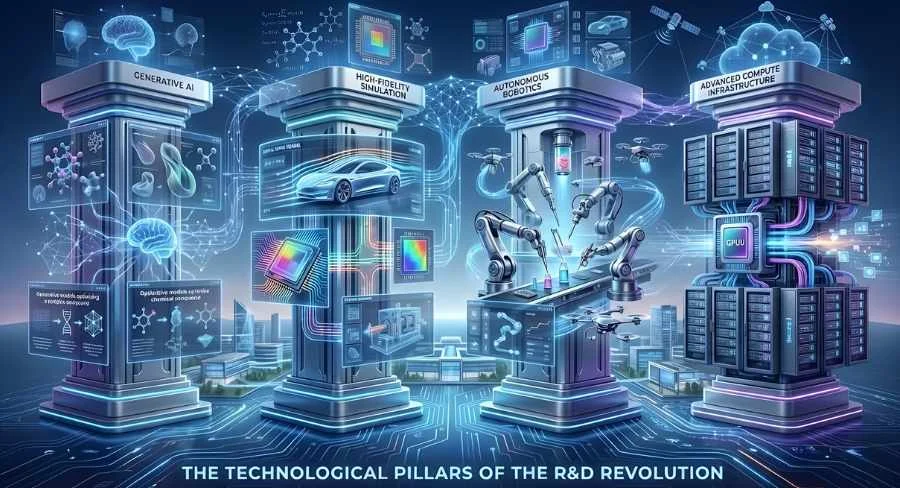
The transformation of R&D is not the result of a single breakthrough but the convergence of several high-performance technologies. These pillars, Generative AI, Simulation, Autonomous Robotics, and Compute, reinforce one another, creating a flywheel effect that accelerates discovery.
Generative AI and Large Language Models (LLMs)
While ChatGPT popularized Generative AI for text, its application in R&D is far more technical. “Generative” in this context refers to the ability of the model to create novel designs, molecules, or code that did not exist in its training data.
The Rise of the “Scientific LLM”
Specialized LLMs are being trained not just on internet text, but on the corpus of scientific literature, patent databases, and chemical structures. These models serve as “co-pilots” for researchers. For instance, the “Coscientist“ system, developed by Carnegie Mellon University, utilizes GPT-4 to plan complex organic chemistry experiments. It can read instruction manuals for robotic equipment, browse the web for solubility data, and write the Python code necessary to execute the reaction. This moves the scientist up the stack, from the manual execution of tasks to the strategic orchestration of research.
Code Generation as an R&D Accelerator
In software-heavy R&D (such as autonomous driving or fintech), GenAI is automating the writing of boilerplate code and the generation of unit tests. This allows software engineers to focus on complex architectural problems. The “superagency” of these coding bots means that a single engineer can now manage workflows that previously required a team.
Deep Learning in Geometry and Physics (Graph Neural Networks)
Standard LLMs struggle with 3D spatial reasoning. To solve problems in biology and materials science, researchers rely on Graph Neural Networks (GNNs) and geometric deep learning.
GNoME: Graph Networks for Materials Exploration
DeepMind’s GNoME system represents a watershed moment for deep learning in the physical sciences. Traditional material discovery relies on guessing which combinations of elements might form stable crystals. GNoME treats atoms and their bonds as a graph and uses deep learning to predict the stability of new arrangements. The result: 2.2 million new crystal structures, 380,000 of which are thermodynamically stable. This expands the palette of materials available to engineers by an order of magnitude, touching everything from solar cells to superconductors.
AlphaFold and Beyond
Similarly, in biology, predicting how a 1D string of amino acids folds into a 3D functional protein was a 50-year-old grand challenge. DeepMind’s AlphaFold solved this, predicting the structures of nearly all known proteins. This allows drug designers to visualize the “lock” (the disease target) so they can design the “key” (the drug) with atomic precision.
Digital Twins and High-Fidelity Simulation
A Digital Twin is a dynamic virtual model of a physical asset or system. In R&D, digital twins allow for “preventative innovation.”
Product Simulation
In the automotive and consumer electronics sectors, digital twins are used to simulate millions of operational hours before a physical prototype is built. Dyson, for example, uses advanced airflow simulation to develop its digital motors. By modeling the thermodynamics and acoustics of air moving at supersonic speeds, they can optimize their vacuum motors for power and sound quality without building thousands of physical iterations.
The Digital Twin of the Customer (DToC)
Simulation is extending to the market itself. Companies are creating Digital Twins of Customers synthetic personas based on real-world behavioral data. These twins allow R&D teams to test how different user segments might react to a new feature or product design. By 2025, Gartner predicts this will be a standard tool for minimizing the risk of product flops. This allows for “infinite A/B testing” in a virtual environment.
Autonomous Laboratories and Robotics
The final pillar is the automation of the physical loop. The “Self-Driving Lab” combines AI decision-making with robotic hardware.
The A-Lab
At Berkeley Lab, the A-Lab uses AI to guide robots in mixing powders, heating them in furnaces, and analyzing the results using X-ray diffraction. In a recent test, it synthesized 41 novel materials in 17 days, operating 24/7 without human intervention. This closes the loop: the AI predicts a material (GNoME), and the Robot synthesizes it (A-Lab), feeding the results back to the AI to improve future predictions.
3. Industry Deep Dive: Pharmaceuticals & Biotechnology

The pharmaceutical industry is perhaps the most aggressive adopter of AI in R&D, driven by the existential threat of patent cliffs and the astronomical cost of failure.
The “Generative Biology” Revolution
We are moving from “drug discovery” (finding something in nature) to “drug design” (engineering a molecule for a specific purpose). Generative biology uses AI to design novel proteins and small molecules that have never existed in nature.
Case Study: Insilico Medicine
Insilico Medicine has become a poster child for this approach. They utilized a generative AI platform to identify a novel target for Idiopathic Pulmonary Fibrosis (IPF), a chronic lung disease. The AI then designed a novel molecule (a TNIK inhibitor) to target it.
- Speed: The program moved from target identification to a preclinical candidate in roughly 18 months. The industry average for this phase is 4-5 years.
- Validation: The drug successfully entered human clinical trials and reported positive Phase 2a results in 2025. This proves that AI-designed drugs are not just theoretical curiosities; they are viable clinical candidates.
Case Study: Iambic Therapeutics
Similarly, Iambic Therapeutics used its AI platform to design an HER2 inhibitor (for cancer treatment). They advanced from discovery to first-in-human trials in under two years. Their platform integrates physics-based simulation with deep learning, allowing them to predict how a drug will bind to a protein with high accuracy.
Synthetic Control Arms and Clinical Trials
The bottleneck in pharma is often the clinical trial itself—recruiting patients is slow and expensive. AI is addressing this through Synthetic Control Arms (SCAs).
- Mechanism: Instead of recruiting a placebo group (patients who get no treatment), companies use historical data from past trials and electronic health records to model how the control group would have performed.
- Benefits: This reduces the number of patients needed for a trial, accelerating the timeline and reducing costs. It is also more ethical in trials for fatal diseases, where giving a patient a placebo is morally fraught.
- Adoption: Regulatory bodies like the FDA are increasingly open to SCAs for rare diseases and oncology, provided the historical data is robust.
The Integration of “Wet” and “Dry” Labs
The future pharma lab is a hybrid. The “Dry Lab” (computational) generates hypotheses, and the “Wet Lab” (biological) validates them. Companies like Recursion Pharmaceuticals and Isomorphic Labs (a DeepMind spinoff) are building massive datasets of cellular images and biological data to train their models. The goal is to turn biology into a search problem, similar to how Google indexes the web.
4. Industry Deep Dive: Materials Science & Chemistry
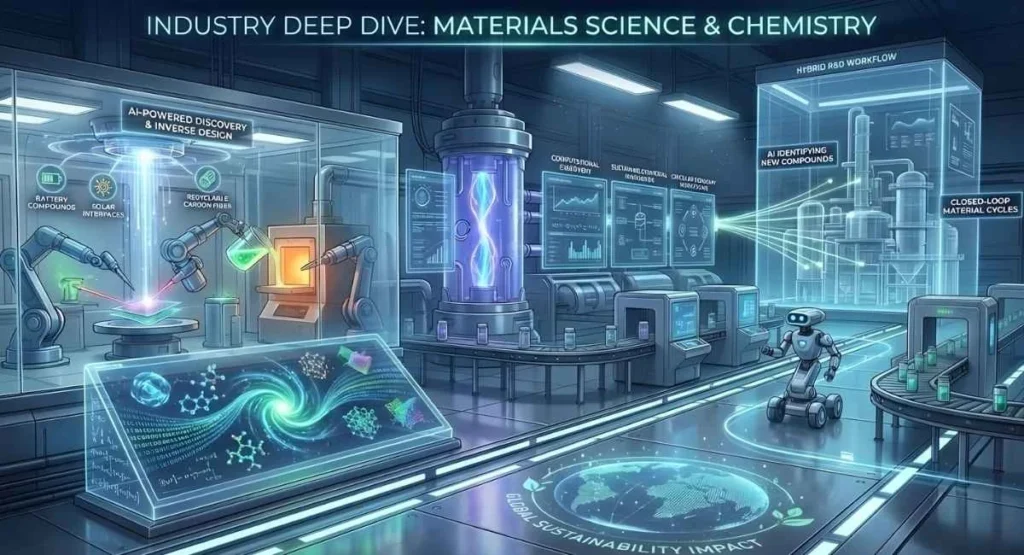
If data is the new oil, materials are the new steel. The transition to a green economy depends entirely on finding new materials for batteries, solar panels, and carbon capture.
The End of Serendipity: Computational Discovery
Historically, material discovery was serendipitous (e.g., Teflon, Penicillin). AI industrializes this luck. DeepMind’s GNoME project has fundamentally altered the landscape of inorganic chemistry.
- The Convex Hull: In thermodynamics, the “convex hull” represents the set of stable materials. GNoME uses deep learning to predict which theoretical combinations of atoms will fall onto this hull.
- Impact: It identified 52,000 new layered compounds (similar to graphene) that could be revolutionizing electronics, and 528 potential lithium-ion conductors that could lead to solid-state batteries
- Open Science: DeepMind released the structures of these 380,000 stable materials to the Materials Project, an open-access database, effectively democratizing this knowledge for researchers worldwide.
Autonomous Synthesis and the “Self-Driving Lab”
Discovering a material on a computer is step one. Making it is step two. The A-Lab at Berkeley demonstrates the future of chemical engineering.
Workflow:
- Recipe Generation: The AI scans literature to propose a “recipe” (heating times, precursors) for a new material.
- Robotic Execution: Automated arms weigh, mix, and heat the samples.
- Active Learning: If a synthesis fails, the AI analyzes the “gunk” produced, learns from the failure, adjusts the recipe, and tries again.
- Efficiency: This iterative loop allows the system to troubleshoot synthesis routes hundreds of times faster than a human. In its debut run, it achieved a 71% success rate in synthesizing novel compounds.
Circular Economy and Inverse Design
AI is also driving sustainability through Inverse Design. Instead of asking “what does this chemical do?”, engineers ask “I need a biodegradable plastic with the strength of nylon—what is the structure?”
- Case Study: Fairmat: This French startup uses AI and robotics to recycle carbon fiber composites. The AI analyzes the waste material (often from aircraft) and determines the optimal way to cut and repurpose it into new high-performance materials. This creates a “second life” for carbon fiber, which is notoriously difficult to recycle.
AI platforms not only accelerate drug discovery but also enable home-based patient monitoring and trials, reflecting broader trends in AI in healthcare innovation.
5. Industry Deep Dive: Automotive & Aerospace
The automotive industry is undergoing a dual transformation: electrification and software-defined vehicles. AI in R&D is the enabler for both.
Generative Design and the “Bone-Like” Chassis
Generative design is replacing traditional CAD (Computer-Aided Design). In traditional CAD, the engineer draws the part. In Generative Design, the engineer defines the constraints (load, weight, material), and the AI “grows” the part.
Case Study: Czinger 21C & Divergent 3D
The Czinger 21C hypercar is the ultimate proof of concept for this technology. Its chassis looks organic, with bone-like structures that are impossible to manufacture with traditional casting or stamping.
- Divergent Adaptive Production System (DAPS): This system combines generative design with 3D metal printing. The AI optimizes the part for the specific load paths of the vehicle.
- Agility: When the team wanted to widen the car by 200mm, they didn’t have to retool a factory. They simply changed the parameters in the software, and the AI regenerated the frame. They went from design to a track-ready chassis in 3 months.
- Implication: This decouples unit cost from volume. It makes low-volume manufacturing (100-1000 units) profitable, allowing for more niche, innovative vehicles.
Case Study: Toyota & Autodesk
Toyota applied this technology to a mass-market problem: the seat frame.
- Objective: Increase rear legroom and reduce weight.
- Process: The AI generated hundreds of options. The engineers chose a design that was lighter and thinner than the incumbent, yet met all safety crash test standards.
- Result: A seat frame that human designers would likely never have conceived, which saves fuel (due to lower weight) and improves passenger comfort.
Autonomous Vehicle (AV) R&D
R&D for self-driving cars is almost entirely data-driven. It is impossible to drive enough physical miles to validate an AV (it would take billions of miles).
- Simulation: Companies use generative AI to create “synthetic worlds” and virtual cities where the AV software is tested. They can generate “edge cases” (e.g., a child chasing a ball into the street in a blizzard) that rarely happen in real life but are critical for safety.
- Generative AI for Training Data: GenAI is used to create training images for the car’s vision system, effectively “dreaming” up scenarios to teach the car how to react.
6. Industry Deep Dive: Electronics & Semiconductors
The semiconductor industry is the bedrock of the AI revolution, and fittingly, it is using AI to save itself from the slowdown of Moore’s Law.
AI-Driven Electronic Design Automation (EDA)
Modern chips have billions of transistors. Placing them optimally to minimize heat and maximize speed is a problem that exceeds human cognitive capacity.
- AI Floorplanning: Reinforcement learning agents (similar to those that play Go) are used to play the “game” of chip layout. They iterate through millions of layouts to find the optimal configuration.
- Key Players: Synopsys and Cadence have integrated AI into their EDA tools. Synopsys, partnering with Nvidia culitho, utilizes the Grace Blackwell platform to accelerate these workflows by 30x.
- Impact: This allows chip designers to achieve higher performance per watt, which is critical for data centers and mobile devices.
Computational Lithography and Manufacturing
Once a chip is designed, it must be printed using light (lithography). As features shrink to 2nm, the physics of light diffraction cause errors. Correcting these errors (Optical Proximity Correction) requires a massive amount of computation.
- Nvidia cuLitho: This library uses GPUs and AI to speed up these calculations by 40-60x. This acceleration is a necessary condition for the manufacturing of next-generation chips. Without AI, the computational cost of manufacturing 2nm chips would be prohibitive.
Consumer Electronics: The Smart Device Era
In consumer electronics, AI is moving from the cloud to the edge (the device itself).
- Samsung & GenAI: The 2025 lineup of devices features on-device AI that optimizes battery life based on user habits and provides real-time translation. This requires R&D teams to optimize AI models to run on low-power mobile chips.
- Dyson’s Integration: Dyson’s use of AI extends to the software inside their purifiers and vacuums, which sense the environment (dust levels, pollutants) and adjust motor speed in real-time. Their R&D process involves massive data collection from prototype fleets to train these control algorithms.
7. The New R&D Workflow: Agentic AI and Synthetic Users
The most significant operational shift in 2025 is the move from “using tools” to “managing agents.”
From Chatbots to Superagents
A “Chatbot” answers a query. An “Agent” pursues a goal. In R&D, agents are being given high-level objectives.
- Example: “Optimize the yield of this reaction.” The agent then plans the experiment, runs the simulation, analyzes the data, and iterates.
- Multi-Agent Systems: Complex tasks are handled by teams of agents. One agent might be the “Literature Reviewer,” another the “Code Writer,” and a third the “Critic.” Research shows that these multi-agent debates lead to higher quality outcomes than single-model outputs.
Leading technology companies, including Microsoft, are pushing the envelope in agentic AI, highlighting the latest AI advancements that are redefining autonomous R&D.
Synthetic Users: The End of the Focus Group?
Testing a product with real humans is slow, expensive, and logistically difficult. Synthetic Users offer a scalable alternative.
- Mechanism: Using RAG (Retrieval-Augmented Generation), companies create AI personas grounded in real demographic data.
- Application: A startup can test a new app interface with 10,000 synthetic users from diverse backgrounds in a few hours. The AI users “interact” with the product and provide feedback on usability and appeal.
- Validation: While not a complete replacement for human testing, synthetic users allow for rapid “pre-flighting” of concepts, filtering out bad ideas before they reach the expensive human testing phase.
Redesigning the Workforce
This shift demands a new type of R&D worker. The value of manual technical skills (pipetting, drafting) is declining. The value of system architecture, problem framing, and AI orchestration is skyrocketing.
- Human-on-the-Loop: The scientist sets the goal and reviews the output, but the AI handles the loop of execution. This “superagency” empowers individuals to do the work of entire departments, but it also raises concerns about skill atrophy and the “black box” problem.
As AI takes on more R&D execution tasks, human roles are shifting toward strategic oversight and system architecture, redefining the AI-driven job changes of tomorrow.
8. Regulatory, Legal, and Ethical Frameworks
As AI becomes an inventor, the legal system—built for human ingenuity—is straining to adapt.
The Patentability Crisis: Thaler v. Vidal
Can an AI own a patent? The global consensus, for now, is “No.”
- The Case: Stephen Thaler attempted to name his AI system, DABUS, as the inventor on patent applications in the US, UK, and EU.
- The Ruling: The US Federal Circuit and the USPTO ruled that the Patent Act defines an inventor as a “natural person.” Therefore, AI-generated inventions are not patentable if they lack a significant human contribution.
- The Implication: This creates a gray area. If an AI designs a drug molecule with minimal human input, is it unpatentable? R&D teams are now incentivized to emphasize (or overstate) the human role in the process to ensure IP protection. The USPTO’s 2025 guidance attempts to clarify this by requiring “significant human contribution” to the conception of the invention.
Data Integrity and the “Hallucination” Risk
In science, a lie is fatal. Generative AI models are prone to “hallucinations”—fabricating facts or citations.
- Retractions: There have already been instances of scientific papers being retracted because they contained AI-generated data that looked plausible but was entirely fictitious.
- Mitigation: R&D organizations are implementing “Traceability” protocols. Every data point used in a decision must be traceable to a primary source or a validated experiment. The motto is “AI Generates, Human Verifies.”
Bias and Ethical AI
AI models inherit the biases of their training data.
- WEIRD Bias: If a synthetic user model is trained primarily on Western internet data, it will reflect Western biases. Using such a model to test a product for the Indian or African market could lead to disastrous miscalculations.
- Clinical Bias: If AI drug discovery models are trained on genomic data that lacks diversity, the resulting drugs may be less effective for underrepresented populations. Ethical AI guidelines now mandate diversity in training datasets to prevent this “algorithmic inequality”.
9. Future Outlook: 2026 and Beyond
The Convergence of Quantum and AI
The next frontier is the marriage of AI and Quantum Computing.
- The Synergy: AI is great at pattern recognition but struggles with the exact physics of complex molecules. Quantum computers excel at simulating quantum mechanical systems (like molecules).
- The Vision: By 2030, we expect to see hybrid workflows where AI acts as the “orchestrator,” identifying candidate molecules, and a Quantum Computer runs the high-fidelity simulation to validate them. This could finally solve the hardest problems in nitrogen fixation (fertilizer) and carbon capture.
Economic Resilience and Growth
Despite fears of an “AI Bubble,” major economic indicators suggest a long-term productivity boom.
- Forecasts: Analysts from BofA and Goldman Sachs predict that AI investment will continue to drive growth through 2026. The shift is from “hype” to “implementation.” The companies that will win are those that successfully integrate AI into their workflows, not just those that buy the most GPUs.
- GDP Boost: The “Cognitive Industrial Revolution” is expected to add trillions to the global GDP over the next decade, primarily by unlocking value in R&D-heavy industries that have been stagnant for years.
10. Detailed Appendix: Technologies & Companies Watchlist
Table 2: Key Companies Driving AI in R&D (2025)
Company | Sector | Key Innovation/Contribution | Source |
DeepMind (Google) | AI/Bio | AlphaFold (Protein Structure), GNoME (Materials) | 3 |
Insilico Medicine | Pharma | Generative Biology, End-to-End AI Drug Discovery | 9 |
Divergent 3D | Auto/Mfg | DAPS (Generative Design + 3D Printing) | 4 |
Synopsys | Semi | AI-driven EDA, Chip Floorplanning | 35 |
Nvidia | Hardware | H100/Blackwell Chips, cuLitho, BioNeMo | 10 |
Carnegie Mellon | Academia | Coscientist (Autonomous Chemical Synthesis) | 19 |
Fairmat | Materials | AI-driven Carbon Fiber Recycling | 31 |
Iambic | Pharma | AI-driven drug design (HER2 inhibitor) | 9 |
Dyson | Consumer | Simulation-led Motor R&D | 13 |
(This table summarizes the key players discussed in the report and their specific contributions to the AI R&D landscape.)
Several emerging companies continue to innovate at the intersection of AI and R&D, as highlighted by recent reports on emerging tech startups.
FAQs
1. What is AI-Powered Research and Development?
AI-Powered R&D uses artificial intelligence to design, test, and optimize products faster by shifting experimentation from physical labs to digital simulations.
2. How does AI accelerate innovation in R&D?
AI tests millions of hypotheses virtually, reducing trial-and-error costs and cutting development timelines from years to months.
3. Which industries benefit most from AI-driven R&D?
Pharmaceuticals, materials science, automotive, semiconductors, and consumer electronics see the fastest gains from AI-powered R&D.
4. What is agentic AI in research and development?
Agentic AI systems autonomously plan, execute, and refine experiments, transforming R&D into a high-velocity value engine.
5. How is AI changing drug discovery?
AI designs novel molecules, predicts protein structures, and shortens preclinical drug development from 4–5 years to under 2 years.
6. What role do digital twins play in AI-powered R&D?
Digital twins simulate products and customers virtually, allowing companies to test designs and market responses before physical production.
7. Can AI replace human researchers in R&D?
No. AI handles execution and analysis, while humans provide strategy, oversight, and ethical judgment.
8. What are autonomous laboratories in AI research?
Autonomous labs combine AI and robotics to run experiments 24/7, rapidly discovering and validating new materials and chemicals.
9. What challenges does AI introduce in R&D?
Key challenges include data hallucinations, algorithmic bias, patent ownership issues, and the need for human verification.
10. Why is AI-Powered R&D critical for future innovation?
AI removes cognitive and cost bottlenecks, enabling faster discovery, sustainable materials, and resilient global innovation systems.
Download the complete AI-Powered R&D report with detailed insights, images, and charts: AI-Powered R&D Final Report – COMPLETE WITH IMAGES
Conclusion: The New Art of the Possible
We are entering an era of “Hyper-Innovation.” The constraints on product development are shifting from feasibility (can we build it?) to desirability (should we build it?).
AI gives us the power to explore the entire chemical space, to design any geometry, and to simulate any market. The winners of the next decade will be the organizations that can master this new toolkit—balancing the raw speed of AI with the strategic wisdom and ethical oversight of the human mind. The future of product innovation is not artificial; it is augmented.
Methodological Note:
This report is based on a synthesis of industry reports, academic publications (Nature, Frontiers in AI), and market analysis from 2024-2025. All claims are supported by the research snippets provided in the referenced source IDs.



I’m Fahad Hussain, an AI-Powered SEO and Content Writer with 4 years of experience. I help technology and AI websites rank higher, grow traffic, and deliver exceptional content.
My goal is to make complex AI concepts and SEO strategies simple and effective for everyone. Let’s decode the future of technology together!