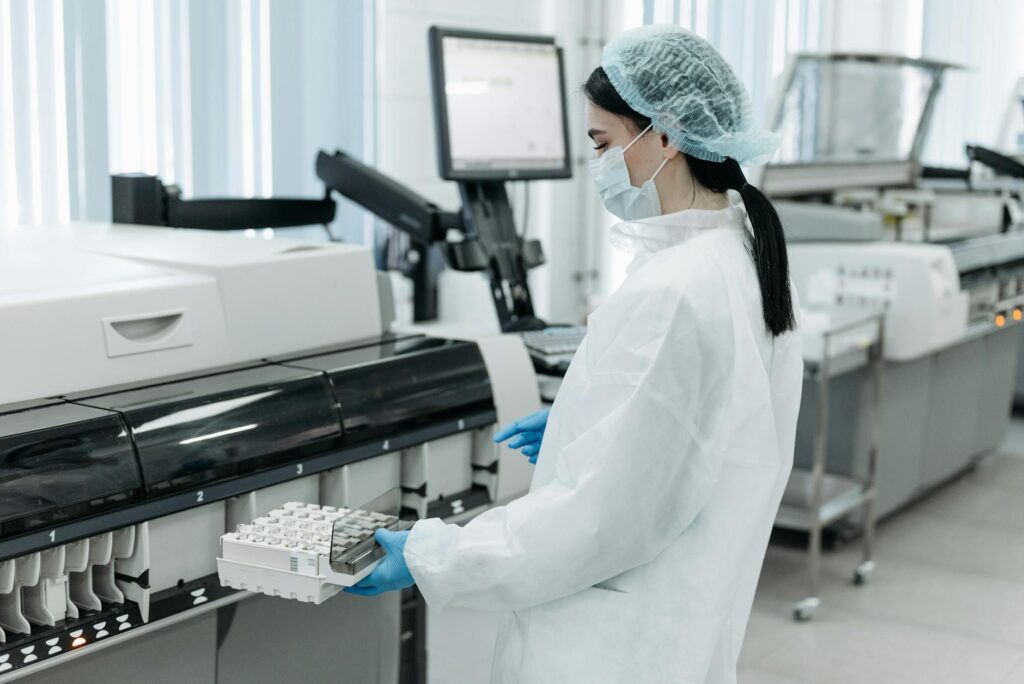
The AI Advisor is an intelligent system that guides autonomous laboratories toward faster material discovery. Discover how this partnership is reshaping R&D speed and profitability.
In the rapidly evolving world of materials science, the AI Advisor has emerged as a game‑changing teammate. By blending machine‑learning foresight with human intuition, it turns routine automation into strategic guidance, cutting months off discovery cycles.
- What is the AI Advisor and why it matters for modern labs
- From traditional labs to guided discovery
- How the AI Advisor learns – borrowing from finance
- The human‑AI collaboration loop
- Measurable impact on material discovery
- Business benefits for executives
- Core AI techniques powering the advisor
- Overcoming practical challenges
- Step‑by‑step integration blueprint
- Future directions for AI advisors
-
Frequently Asked Questions
- What exactly does an AI Advisor do?
- How is it different from a traditional robot?
- Do I need a huge dataset to start?
- Is the AI Advisor safe for hazardous chemistry?
- Can it be used in biotech research?
- What hardware is required?
- How long does a pilot typically take?
- Will scientists lose their jobs?
- Is the technology patented?
- What ROI can I expect?
- Conclusion
- Trusted Sources and References
What is the AI Advisor and why it matters for modern labs
The AI Advisor is a software layer that continuously evaluates experimental data, ranks the most promising next steps, and explains the reasoning behind each recommendation. Unlike static scripts, it adapts in real time, turning raw sensor streams into actionable insight.
Its importance lies in reducing the guesswork that traditionally slows materials research. Scientists no longer wait for a fixed queue; they receive a prioritized list of experiments that balances risk, reward, and cost. This shift accelerates hypothesis testing, improves resource allocation, and ultimately brings breakthrough materials to market faster.
From traditional labs to guided discovery
Conventional autonomous labs operate like assembly lines: a pre‑programmed set of experiments runs, data is collected, and the cycle repeats. The AI Advisor replaces this linear flow with a dynamic decision loop that reprioritizes experiments after each result.
The transition to guided discovery means that the lab can pivot instantly when a surprising result appears, focusing effort on the most promising chemical space. This agility contrasts sharply with older methods where a full batch must finish before any new direction can be taken, often wasting time and reagents on low‑value paths.
How the AI Advisor learns – borrowing from finance
The research team modeled the advisor after portfolio‑management tools used by hedge funds. Just as a financial AI balances risk and return across assets, the lab AI balances exploration of novel compounds with exploitation of known leads.
Data ingestion pulls real‑time sensor feeds, spectroscopy, microscopy, and historic datasets into a central lake. Feature engineering automatically creates domain‑specific descriptors such as crystal lattice parameters. Predictive models—including gradient‑boosted trees and transformer networks—forecast material properties, while a multi‑armed bandit algorithm ranks experiments by expected value, uncertainty, and cost. This continuous learning loop mirrors a trader adjusting a portfolio in milliseconds.
The human‑AI collaboration loop
The AI Advisor does not replace scientists; it augments them through a four‑phase loop. First, the system suggests a shortlist of experiments with confidence scores. Second, researchers review the list, adding safety constraints or domain insights. Third, the autonomous platform executes the approved experiments. Fourth, results flow back into the AI, refining future suggestions.
This human‑in‑the‑loop workflow preserves scientific rigor while leveraging AI speed. Scientists focus on strategic interpretation rather than repetitive scheduling, and the AI gains from expert feedback, creating a virtuous cycle of improvement.
Measurable impact on material discovery
Since the AI Advisor was deployed in 2025 at the University of Chicago’s Materials Project Engine, the team reports a 30 % reduction in total experimental time for high‑temperature superconductor discovery. Polymer electrolyte screening for solid‑state batteries saw a 45 % increase in discovery rate, and viable drug‑delivery nanomaterials doubled compared with manual screening.
These metrics translate directly into market advantage. Faster time‑to‑market reduces competitive pressure, lower consumable spend cuts R&D budgets, and stronger IP portfolios increase valuation. The data demonstrates that intelligent guidance is not a theoretical benefit but a quantifiable accelerator.
Business benefits for executives
Executives should view the AI Advisor as a strategic asset. Accelerated innovation shortens product development cycles, delivering a first‑mover advantage. Cost efficiency arises from fewer failed experiments and lower reagent usage. Talent amplification lets scientists spend more time on high-level design rather than routine tasks.
The technology also creates data‑driven patents that withstand examiner scrutiny, and it scales across multiple sites, allowing a single AI engine to guide dozens of parallel labs. For venture‑backed startups, this capability can become a defensible moat that convinces investors of a sustainable competitive edge.
Core AI techniques powering the advisor
Reinforcement learning treats each experiment as an action, rewarding the system when a material meets performance targets. Bayesian optimization handles expensive, noisy measurements by modeling uncertainty and suggesting experiments that maximize information gain. Explainable AI tools such as SHAP values and counterfactual analysis reveal why a suggestion outranks another, building trust among chemists.
Edge computing places GPUs on instrument hardware, reducing latency between data capture and model inference. Together, these techniques create a powerful yet transparent system that addresses the “black‑box” criticism of earlier lab AI solutions.
Overcoming practical challenges
Data quality is a common hurdle; the advisor includes automated outlier detection and sensor calibration pipelines to ensure reliable inputs. Safety and compliance are managed by a built‑in constraint engine that flags hazardous chemistries before execution, satisfying regulatory requirements.
Interpretability is addressed with real‑time visual dashboards that map predictions to chemical intuition, while scalability is achieved through containerized micro‑services that can be deployed on cloud or on‑premise environments. By tackling these issues early, organizations avoid costly re‑engineering later.
Step‑by‑step integration blueprint
A phased approach minimizes risk. In the assessment phase (4‑6 weeks) map existing workflows, identify data sources, and define KPI targets. The pilot phase (8‑12 weeks) installs sensor suites and runs a limited experiment set under AI guidance. Scale‑up (3‑4 months) expands to the full experiment library and integrates with LIMS/ELN systems. Optimization is ongoing, fine‑tuning models, adding domain constraints, and training staff.
Starting small, such as focusing on polymer synthesis, provides quick ROI and builds stakeholder confidence before broader rollout.
Future directions for AI advisors
Cross‑lab knowledge transfer will soon rely on federated learning, allowing multiple sites to share insights without exposing proprietary data. Multi‑objective optimization will simultaneously balance cost, environmental impact, and performance, aligning R&D with sustainability goals.
Hybrid human‑AI design will let generative models propose novel molecular structures while the advisor selects experimentally viable candidates. Regulatory‑ready auditing will produce automated traceability logs that satisfy FDA and EPA documentation requirements, making AI‑driven labs ready for regulated markets.
Frequently Asked Questions
What exactly does an AI Advisor do?
It continuously analyzes experimental data, ranks the most promising next experiments, and explains the rationale behind each recommendation.
How is it different from a traditional robot?
A robot follows pre‑set scripts; the AI Advisor decides what to run next based on real‑time results and human feedback.
Do I need a huge dataset to start?
No. The system can begin with a modest dataset and improve through active learning as experiments generate new data.
Is the AI Advisor safe for hazardous chemistry?
Yes. Built‑in constraint engines block unsafe experiment designs before they are executed, ensuring compliance with safety protocols.
Can it be used in biotech research?
Absolutely. It already assists in designing CRISPR guide libraries and protein‑folding assays, demonstrating cross‑domain flexibility.
What hardware is required?
Standard lab automation platforms plus edge GPUs or cloud compute for model inference are sufficient for most deployments.
How long does a pilot typically take?
A focused pilot usually runs for 8‑12 weeks, providing measurable acceleration before full rollout.
Will scientists lose their jobs?
The goal is augmentation; scientists shift to higher‑level strategy, interpretation, and experimental design.
Is the technology patented?
Several core algorithms are covered by university patents, and commercial licenses are available for industry partners.
What ROI can I expect?
Early adopters report 30‑45 % reductions in R&D cycle time and up to double the number of successful material hits.
Conclusion
The AI Advisor transforms autonomous labs into intelligent research partners, delivering faster discoveries, lower costs, and stronger competitive edges.
Trusted Sources and References



I’m Fahad Hussain, an AI-Powered SEO and Content Writer with 4 years of experience. I help technology and AI websites rank higher, grow traffic, and deliver exceptional content.
My goal is to make complex AI concepts and SEO strategies simple and effective for everyone. Let’s decode the future of technology together!